
ERP implementation is one of the most transformative journeys an organization can undertake. While many people mistakenly categorise it as a technology upgrade, COOs and transformation leaders know better — ERP is an organization-wide operating model redesign. It changes how teams work, how information flows, how decisions are made, and how the business functions day-to-day.
This makes collaboration the defining factor of ERP success. Technology alone cannot transform an organization; people and processes do.
Studies across ERP projects show that nearly 70% of failures occur not because the software was inadequate, but because organizational collaboration broke down. Departments hold back information, priorities clash, and data inconsistencies emerge.
In other words, the ERP is only as strong as the level of cooperation between teams.
The COO sits at the centre of this transformation. As the leader who oversees processes, operations, and cross-functional execution, the COO is uniquely equipped to champion collaboration. Without consistent involvement and alignment from the COO’s office, NetSuite ERP projects often drift, stall, or fail.
This expanded article provides COOs with:
- Deep insights into why collaboration is critical
- Frameworks to break silos
- Practical roadmaps for aligning teams
- Real examples to illustrate common pitfalls
- Tools, templates, and governance models
- Strategies to engage people throughout the ERP lifecycle
By the end, you’ll have a blueprint for building a collaborative environment that accelerates ERP success and prepares your organization for scalable growth.
The COO’s Role in Driving Cross-Departmental Alignment
COOs are the heartbeat of execution. When ERP transforms processes across the supply chain, sales, manufacturing, finance, HR, procurement, and customer service, the COO becomes the integrator who ensures unity across the enterprise.
Below is a deeper look at the COO’s multi-layered role.
Acting as the Bridge Between Business Teams and Project Stakeholders
ERP introduces change at every functional touchpoint. Many ERP failures stem from misalignment between functional leaders who know the business and technical teams who configure the system.
The COO acts as:
- Interpreter: Converts business needs into system goals
- Mediator: Resolves conflicts between departmental demands
- Integrator: Ensures workflows are interconnected
- Visionary: Helps teams understand the end-state operating model
Without this bridge, IT teams may build technically sound workflows that still fail because they do not reflect real operational conditions.
Translating Organizational Goals Into Functional Expectations
Every ERP project starts with strategic objectives:
- Improve efficiency
- Increase visibility
- Standardize processes
- Accelerate growth
- Strengthen governance
But unless each department understands how they contribute to these goals, alignment is impossible.
The COO ensures that:
- Finance understands standardisation of the chart of accounts
- Sales understands accurate forecasting and pipeline revenue tracking
- Supply chain understands inventory accuracy and fulfilment processes
- HR understands workforce data automation
- Operations understand process visibility and cycle-time reduction
This translation helps shift ERP from a system project to a business transformation journey.
Ensuring Every Department Understands Their Role
Many ERP challenges arise not because people resist change, but because they simply do not know what their role is. The COO must ensure that each function knows:
- What processes do they own
- What data they are responsible for
- What changes affect their workflows
- What decisions they must make during implementation
Clear ownership eliminates confusion and accelerates collaboration.
Setting the Tone for Transparency and Shared Ownership
Culture flows from leadership. When the COO reinforces open communication, departments feel comfortable sharing issues early instead of hiding them until it’s too late.
This includes:
- Creating a “no-blame” culture during discovery
- Encouraging honest conversations about inefficiencies
- Rewarding collaboration rather than silo protection
- Reinforcing the importance of end-to-end ownership
When teams feel like they are building something together, they commit to the transformation.
Why ERP Implementations Often Fail Without Collaboration
ERP integrates every part of the business. A change in one module impacts multiple departments. Without collaboration, these interdependencies break.
Here is a deeper look at the ripple effects.
Functional Silos with Conflicting Priorities
Each department naturally prioritises its own targets:
- Sales wants speed
- Finance wants control
- Operations want efficiency
- IT wants stability
- HR wants compliance
If these priorities are not aligned early, ERP design becomes a battleground of competing interests. Instead of optimising the entire value chain, organizations end up customising to satisfy silos — creating technical debt and slowing the system.
Lack of Shared Understanding of Business Processes
ERP requires process clarity. But most organizations:
- Do not have updated process documentation
- Have informal workflows known only to a few employees
- Have different process versions in different regions
- Depend on manual or work-around steps
When processes are unclear, ERP configuration becomes guesswork — leading to rework and repeated UAT failures.
Poor Data Ownership and Inconsistent Standards
Data issues create:
- Duplicate vendors
- Multiple definitions of customers
- Misaligned product codes
- Incorrect financial mappings
- Mismatches between legacy systems
These issues often go unnoticed until migration, causing delays and cost overruns.
Misalignment Between IT and Business Functions
Business teams expect the system to adapt to their preferences.
IT teams expect business teams to adapt their processes.
This tension becomes destructive when:
- Requirements are unclear
- Change requests pile up
- Customizations increase
- Testing cycles never end
Collaboration ensures both teams meet halfway to build scalable workflows.
Change Resistance Due to Poor Communication
Employees resist ERP when:
- They think it threatens their job
- They fear new responsibilities
- They are not informed early
- They feel forced into changes
Resistance creates hidden barriers that surface only at go-live.
Result of Poor Collaboration
The consequences are severe:
- Months of delays
- Overrun budgets
- Misconfigured processes
- High technical debt
- Low adoption and poor ROI
ERP is not a software problem — it’s a people and process alignment problem.
Core Areas Where Cross-Department Collaboration Is Critical
ERP success depends on collaboration in four foundational areas.
Process Mapping & Requirement Gathering
This is where most projects go wrong.
Without collaboration:
- Processes are incomplete
- Assumptions replace facts
- Edge cases are ignored
- System fails during real-world usage
Cross-functional process mapping helps teams visualise:
- End-to-end workflows
- Hand-offs and dependencies
- Exceptions and approvals
- Manual tasks that need automation
A collaborative approach ensures ERP reflects reality — not assumptions.
Data Migration & Data Ownership
Data migration affects every module.Departments must work together to:
- Identify source systems
- Define master data ownership
- Clean duplicates
- Standardize naming conventions
- Validate before loading
When only IT leads migration, business context is lost. When only business teams handle data, technical structure is ignored.
Collaboration is the only way to ensure clean, accurate, and reliable data in ERP.
Workflow Design & Automation
ERP workflows automate:
- Approvals
- Notifications
- Role-based access
- Hand-offs
- Document flows
- Exception handling
Each workflow spans multiple teams. Example: Order-to-Cash connects:
Sales → Operations → Finance → Customer Service → Accounting
If these teams don’t agree on workflow rules, automation breaks.
Change Management & Training
Collaboration ensures:
- Common understanding of system changes
- Unified messaging during communication
- Consistent training across functions
- Cross-team scenarios during UAT
- Joint ownership of new processes
When each department designs its own change practices, the organization ends up with contradictory messages and inconsistent adoption.
A COO’s Framework for Fostering Collaboration During ERP Implementation
This section expands into a deeper, actionable framework COOs can use.
Establish a Cross-Functional Steering Committee
This committee:
- Makes key decisions
- Removes blockers
- Reviews risks
- Ensures dependencies are managed
- Aligns technical and business teams
A good steering committee includes:
- COO (Chair)
- CFO
- CIO / CTO
- Head of Supply Chain
- Head of HR
- Head of Sales
- ERP Program Manager
- Implementation Partner Lead
This group ensures alignment at the highest level.
Define a Clear Communication Plan
ERP thrives on transparency.
Your plan should include:
- Weekly PMO updates
- Bi-weekly functional meetings
- Monthly executive reviews
- Daily stand-ups during testing
- Issue logs accessible to all
- Progress dashboards
- Documentation repositories
Clear communication eliminates ambiguity.
Encourage Early Engagement from All Departments
Don’t wait until testing to involve teams.
Teams must participate from:
- Discovery
- Requirements
- Design
- Data cleansing
- Prototype demos
- Testing
- Go-live preparation
Early engagement reduces last-minute surprises and redesign loops.
Promote Shared KPIs and Success Metrics
Examples of collaborative KPIs:
- 98% data accuracy
- 30% reduction in process cycle time
- 20% decrease in manual tasks
- 100% UAT coverage
- On-time milestone completion
When teams share KPIs, they avoid finger-pointing and work jointly toward outcomes.
Build a Culture of Transparency & Feedback
COOs can promote:
- Open issue reporting
- Anonymous feedback channels
- Retrospective meetings
- Cross-functional improvement committees
- Early warnings for risks
Encouraging early concerns avoids crisis situations later.
Facilitate Collaborative Testing & UAT
Testing must include:
- End-to-end scenarios
- Cross-team workflows
- Real data
- Exception handling cases
- Negative testing
The COO’s oversight ensures testing remains business-driven, not IT-driven.
Collaboration Tools & Techniques COOs Can Leverage
The right tools amplify collaborative behaviours. Invest in platforms that make joint work easier.
- Shared Documentation Platforms (Confluence, Notion, SharePoint): Create a single source of truth for process documentation, requirements, decisions, and training materials. When everyone references the same documentation, inconsistencies decrease and alignment increases.
- Workflow Mapping Tools (Miro, Lucid-chart, Visio): Visual process maps create shared understanding faster than text. Use these tools in collaborative workshops where teams jointly diagram current and future state processes. The act of creating these maps together builds alignment.
- Project Management Tools (Jira, Asana, Monday.com): Track tasks, dependencies, and ownership transparently. When teams can see how their work connects to others’, coordination improves. Use these tools to make cross-functional dependencies visible and hold teams accountable to commitments.
- ERP-Specific Sandboxes for Hands-On Collaboration: Provide access to configuration and test environments where business users can experiment. When teams can see and touch the system collaboratively, abstract concepts become concrete. Schedule regular “system show and tell” sessions where teams demo configured functionality to each other.
- Daily Stand-Ups and Cross-Team Review Sessions: Short, frequent touchpoints maintain alignment better than infrequent lengthy meetings. Use daily stand-ups for tactical coordination. Use weekly cross-team reviews for integration points and dependencies.
The key is not the tools themselves, but the collaborative practices they enable. Choose tools that reduce friction for joint work, make information transparent, and create shared visibility into progress and issues.
Common Collaboration Challenges COOs Must Watch
Even with the best intentions, collaboration faces predictable obstacles. Anticipate these challenges and address them proactively.
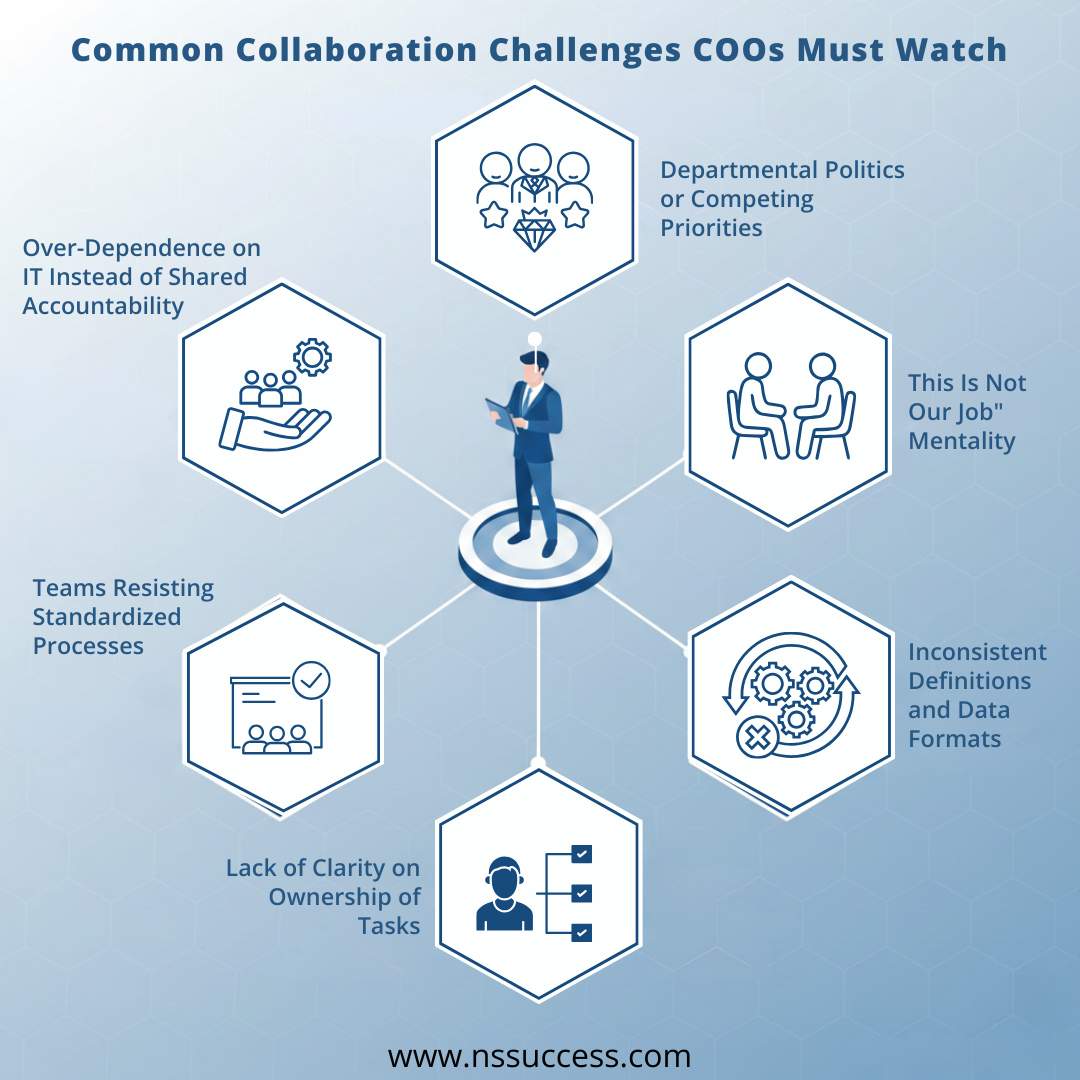
- Departmental Politics or Competing Priorities: Every department has objectives that sometimes conflict. Sales wants flexibility; finance wants control. Operations wants standardisation; business units want customization. As COO, you must arbitrate these conflicts based on enterprise benefit, not political power.
- “This Is Not Our Job” Mentality: Some teams view ERP implementation as IT’s responsibility, not theirs. They resist dedicating time to requirements, testing, or training. Combat this by making participation non-negotiable and tying it to performance evaluations and incentives.
- Inconsistent Definitions and Data Formats: Different departments may use the same terms differently. “Customer” might mean end-user to sales but bill-to party to finance. These semantic differences cause major integration problems. Establish a common business glossary early and enforce consistent usage.
- Lack of Clarity on Ownership of Tasks: When responsibilities overlap or fall between departments, tasks don’t get done. Use RACI matrices to clarify who is Responsible, Accountable, Consulted, and Informed for every major decision and deliverable. Eliminate gaps and overlaps explicitly.
- Teams Resisting Standardized Processes: Departments may have legitimate reasons for unique processes, or they may simply resist change. Distinguish between necessary customization and unnecessary complexity. Default to standardisation unless business-critical differentiation requires customization.
- Over-Dependence on IT Instead of Shared Accountability: When business teams view ERP as “IT’s system,” they disengage from ownership. Constantly reinforce that IT enables the system, but business owns the processes and outcomes. Business must lead, with IT as a partner, not the other way around.
Best Practices to Build a Unified Implementation Culture
Culture change doesn’t happen through memos—it happens through consistent reinforcement of desired behaviours.
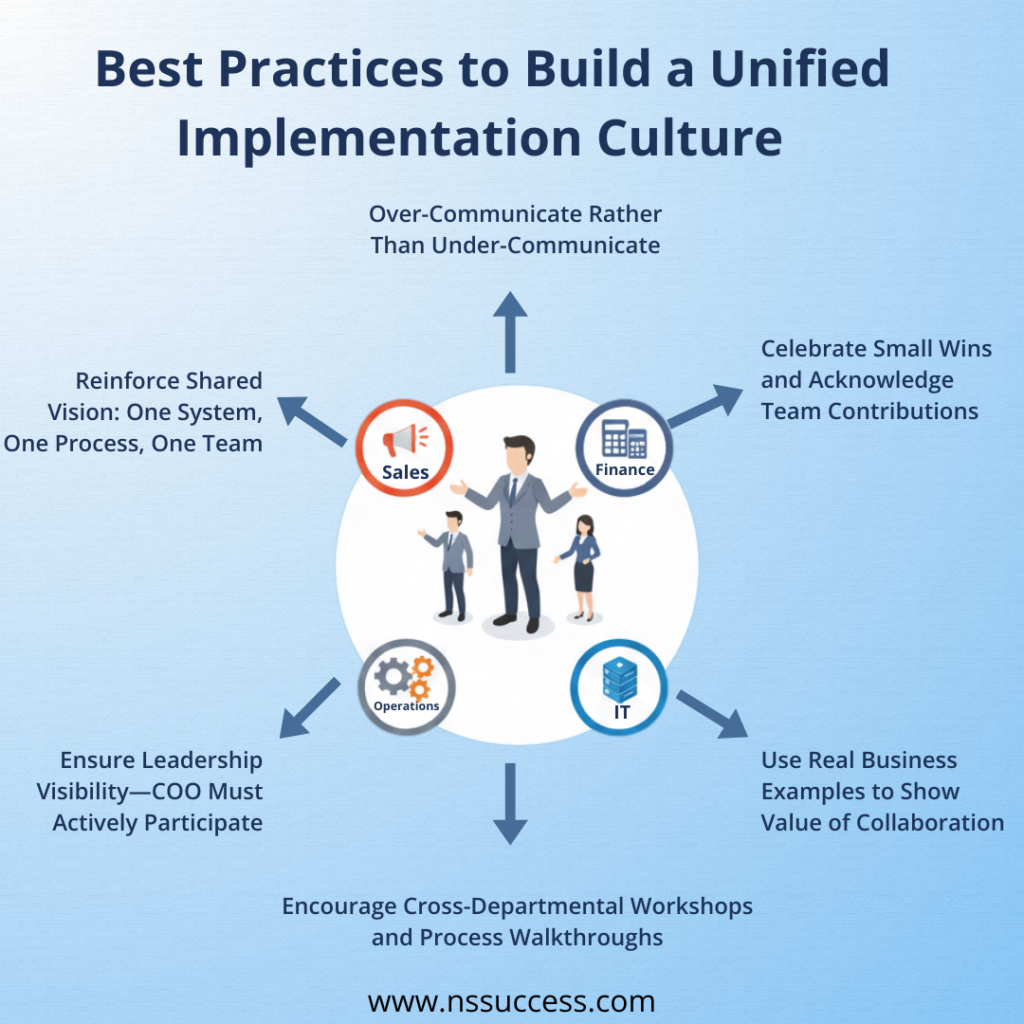
- Over-Communicate Rather Than Under-Communicate: You cannot communicate too much during transformation. Repeat key messages through multiple channels. Assume people need to hear something seven times before it sinks in. Use stories, examples, and metaphors to make abstract concepts concrete.
- Celebrate Small Wins and Acknowledge Team Contributions: Recognize collaborative behaviour publicly. When a department helps another solve a problem, acknowledge it. When cross-functional testing uncovers and resolves an issue, celebrate it. These positive reinforcements encourage more of the same behaviour.
- Use Real Business Examples to Show Value of Collaboration: Connect the dots between collaborative work and business outcomes. Show how joint process design reduced approval cycle time. Demonstrate how collaborative data cleansing improved reporting accuracy. Make the benefits of collaboration tangible and specific.
- Encourage Cross-Departmental Workshops and Process Walkthroughs: Create opportunities for teams to see each other’s work. Have sales observe how orders flow through operations. Have finance watch how procurement approves invoices. This exposure builds empathy and reveals integration opportunities.
- Ensure Leadership Visibility—COO Must Actively Participate: Your presence signals importance. Attend key workshops, steering committee meetings, and go-live events. Ask questions that emphasise collaboration: “How did finance and sales work together on this?” Your attention shapes organizational attention.
- Reinforce Shared Vision: One System, One Process, One Team: Every communication should reinforce unity. We’re not implementing separate systems for separate departments—we’re creating one integrated platform that serves the entire enterprise. This shared vision counteracts siloed thinking.
Real-World Example: How Cross-Department Collaboration Impacted ERP Success
Consider a mid-sized manufacturing company implementing an ERP system to replace fragmented legacy applications. Initially, departments worked independently, defining requirements from their own perspectives.
Background and Initial Challenges:
Sales defined customer relationship requirements without involving finance or operations. Finance specified financial controls without understanding sales cycle realities. Operations designed warehouse workflows without considering how inventory is connected to financial costing. The result was conflicting requirements, duplicate data structures, and workflows that didn’t connect.
Six months into implementation, the project faced significant delays. Testing revealed that customer data couldn’t flow properly from sales to billing. Purchase orders couldn’t connect to inventory receipts. The project steering committee escalated concerns to the COO.
The COO’s Intervention:
The COO established cross-functional alignment workshops, mandatory for all department leaders and key SMEs. These workshops focused on end-to-end processes rather than departmental functions.
First, they mapped the complete order-to-cash process with representatives from sales, credit, operations, shipping, billing, and collections. This exercise revealed 47 hand-off points where information passed between departments—most of which had never been explicitly documented or agreed upon.
Second, they created collaborative data governance. A joint team from sales, finance, and operations defined what constituted a “customer,” what attributes were required, who owned which fields, and how data quality would be measured and maintained.
Third, they implemented a “design authority” model where representatives from each department met twice weekly to resolve integration questions. These design authorities had decision-making power, eliminating the delays caused by constant escalation.
Results:
Within three months, the project regained momentum. Requirements were consolidated and conflicts resolved. Data migration achieved 96% accuracy on the first pass because departments had agreed on standards. UAT revealed fewer critical issues because cross-functional testing had validated workflows earlier.
Go-live occurred only one month later than the original target—remarkable given the six-month delay the project had faced. More importantly, user adoption reached 89% within the first quarter, compared to the 60-65% industry average. Employees understood the system because they had participated in designing it.
Twelve months post-implementation, the company achieved significant benefits: order-to-cash cycle time reduced by 34%, inventory accuracy improved to 98%, the financial close cycle shortened from 12 days to 7 days, and customer satisfaction scores increased by 16 points.
Key Takeaway: Collaboration isn’t a one-time activity at project kick-off—it’s a continuous discipline throughout implementation and beyond. The COO’s persistent focus on breaking down silos and creating shared accountability transformed what was becoming a failed project into a significant business success.
How Working with an Expert Partner Improves Collaboration
Even with an internal commitment to collaboration, external expertise can accelerate success and avoid costly mistakes.
Experts Help Define Governance Structures and PMO Processes: Implementation partners bring proven frameworks for decision-making, escalation, and coordination. They’ve seen what works across dozens or hundreds of implementations and can help you avoid reinventing the wheel.
Neutral Perspective Minimizes Cross-Department Conflicts: Internal politics can derail collaboration. An external partner provides objective facilitation, helping departments see beyond their own interests to enterprise benefit. They can say difficult things without the baggage of organizational history.
Structured Workshops for Requirement Gathering and Process Mapping: Expert partners bring facilitation skills and methodologies that ensure productive workshops. They know which questions to ask, how to draw out tacit knowledge, and how to document outcomes in formats that drive clear implementation decisions.
At NSSuccess, We Provide:
- Proven Implementation Methodologies: Our structured approach ensures collaboration happens at the right times for the right purposes. We don’t leave collaboration to chance—we build it into the project plan.
- Standardized Templates to Align Teams: Our process documentation, requirement gathering, and testing templates have been refined across numerous implementations. They provide structure that helps diverse teams communicate clearly.
- Ongoing Support to Maintain Collaboration After Go-Live: Collaboration doesn’t end at implementation. We help you establish operational governance models that sustain cross-functional coordination as your system evolves and your organization grows.
Conclusion
The equation for ERP success is straightforward: Unified Teams + Clear Communication + Shared Ownership = Successful Implementation.
Technology has never been the limiting factor in ERP success. Modern systems have remarkable capabilities. What determines whether those capabilities translate into business value is whether your organization can align around new ways of working.
As COO, you are uniquely positioned to drive this alignment. You span business functions. You understand both strategic objectives and operational realities. You have the authority to break down silos and create accountability. You set the cultural tone for how departments work together.
With structured collaboration—supported by the right frameworks, tools, and partner expertise—ERP implementation becomes more than a system upgrade. It becomes a catalyst for operational excellence, process maturity, and organizational capability that extends far beyond the software itself.
The question isn’t whether you can afford to invest in collaboration. The question is whether you can afford not to.
Want to Build a Collaborative ERP Implementation? Connect with NSSuccess to guide your teams across every phase of your transformation. Our proven methodologies, experienced facilitators, and ongoing support ensure your implementation achieves both technical success and organizational adoption.
Let’s turn your ERP implementation into an opportunity for lasting operational excellence.

 “NS Success” is the NetSuite Consulting Practice of Dhruvsoft Services Private Limited – a leading NetSuite Solution Provider Partner from India – providing services worldwide …