
ERP Implementation Is a Leadership Decision, Not an IT Task. As a CEO, have you thought about balancing the risks and opportunities of an ERP implementation? This guide is written for CEOs and senior executives who want to approach ERP implementation with clarity and confidence.
Enterprise Resource Planning (ERP) implementations are among the most consequential decisions a CEO can make. Few initiatives touch as many aspects of the organization as finance, operations, compliance, reporting, people, and long-term scalability. Yet, despite this broad impact, ERP projects are still too often delegated to IT teams and treated as system upgrades rather than enterprise transformations.
This belief is where many organizations go wrong. ERP is not a technology exercise. It is a leadership decision that defines how a business will operate, govern itself, and scale for the next decade.
Every ERP initiative introduces risk—financial risk, operational risk, people risk, and execution risk. But it also introduces significant opportunity: better visibility, faster decisions, scalable growth, and stronger governance. The CEO’s responsibility is not to eliminate risk—that is neither realistic nor desirable. The responsibility is to balance risk against long-term business value.
Modern cloud ERP platforms such as Oracle NetSuite are built precisely to support this balance. They reduce traditional ERP execution risks while enabling CEOs to unlock new opportunities in growth, agility, and resilience.
This guide explores:
- How ERP risk should be understood from a leadership perspective
- Why ERP transformation is as much about opportunity as it is about risk
- The most common ERP risks CEOs must anticipate
- How NetSuite helps balance risk and opportunity
- A practical CEO framework for leading ERP transformation successfully
Understanding ERP Risk Through a CEO Lens
Why ERP Risk Is Often Misunderstood
ERP risk is frequently discussed in technical terms: data migration failures, system downtime, integration challenges, or customization complexity. While these risks exist, they are not the primary concerns for CEOs.
From a leadership perspective, ERP risk is about:
- Business continuity
- Financial exposure
- Strategic alignment
- Organizational readiness
- Governance and accountability
Technology problems rarely derail ERP programs on their own. What causes ERP initiatives to fail—or under deliver—is misalignment between leadership intent and execution reality.
The Real ERP Risks CEOs Must Manage
1. Business Disruption Risk
ERP implementations can disrupt core processes such as order management, billing, procurement, or financial close. When these disruptions are not anticipated or managed, the impact is immediate and visible—delayed revenue, frustrated customers, and stressed employees.
For CEOs, this risk is not theoretical. It directly affects brand trust and market confidence.
2. Cost Overrun Risk
ERP budgets often expand beyond original expectations due to:
- Scope creep
- Over-customization
- Poor requirements definition
- Weak governance
What begins as a well-intentioned transformation can quickly become a cost centre if executive oversight is limited.
3. Change Resistance Risk
ERP systems change how people work. If employees do not understand the purpose of the transformation—or if they feel the system is imposed rather than enabling—resistance emerges. This resistance may not be vocal, but it shows up as workarounds, delayed adoption, and underutilization.
4. Poor Adoption Risk
An ERP that is technically live but operationally underused delivers only a fraction of its promised value. CEOs may believe the system has failed, when in reality, the organization has failed to adopt it fully.
5. Strategic Misalignment Risk
Perhaps the most dangerous risk is implementing ERP without tying it to long-term business strategy. When ERP decisions are driven by current pain points rather than future direction, organizations lock themselves into systems that limit growth instead of enabling it.
The Hidden Risk: Not Modernizing at All
Many CEOs underestimate the risk of inaction. Legacy systems often appear stable because they are familiar, but they introduce silent and compounding risks:
- Limited real-time visibility
- Dependence on spreadsheets and manual processes
- Difficulty scaling or integrating acquisitions
- Increased compliance and cybersecurity exposure
In volatile markets, outdated systems reduce leadership’s ability to respond quickly. Over time, the risk of staying still often exceeds the risk of transformation.
The Opportunity Side of ERP Transformation
ERP should not be viewed solely as a risk management initiative. At its best, ERP is a platform for opportunity creation.
ERP as a Foundation for Scalable Growth
Growth introduces complexity. New markets, entities, products, and revenue models strain fragmented systems. A modern ERP provides the structural backbone required to scale without chaos.
With the right ERP, organizations can:
- Add new subsidiaries without rebuilding systems
- Support global operations with multi-currency and multi-tax capabilities
- Enable new business models without extensive rework
For CEOs, this means growth becomes repeatable and controlled, not fragile.
Better Decision-Making Through Real-Time Visibility
ERP consolidates operational and financial data into a single source of truth. This enables:
- Faster executive decision-making
- Reduced reliance on delayed or manually prepared reports
- More confident forecasting and scenario planning
When leaders trust the data, they move faster—and with greater conviction.
Operational Resilience
Integrated ERP processes reduce dependency on individuals and informal knowledge. This strengthens resilience during leadership transitions, market disruptions, or sudden growth spurts.
Financial Transparency and Governance
ERP improves visibility into:
- Cash flow and working capital
- Profitability by product, region, or customer
- Compliance and audit readiness
For CEOs and boards, this transparency strengthens governance and reduces uncertainty.
Common ERP Implementation Risks CEOs Must Anticipate
Strategic Risk
When ERP is implemented without clear alignment to business vision, it becomes a tactical fix rather than a strategic asset. Technology ends up driving decisions instead of enabling them.
CEO implication: ERP must be anchored to where the business is going—not where it has been.
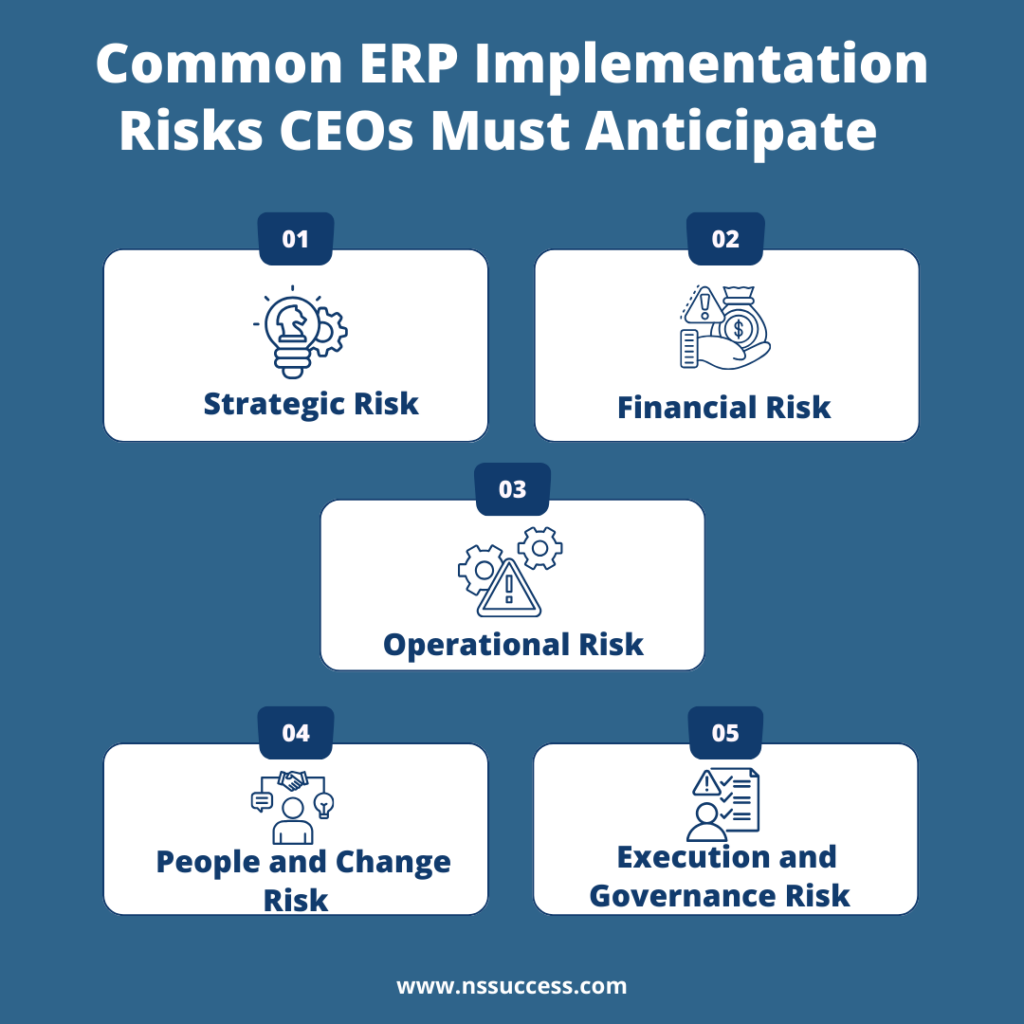
Financial Risk
Many organizations underestimate the true cost of ERP ownership. Over-customization, extended timelines, and reactive decision-making inflate budgets.
CEO implication: Simplicity and discipline reduce risk more effectively than feature accumulation.
Operational Risk
ERP transitions can disrupt core processes if execution is rushed or poorly sequenced. Data migration errors can undermine trust in reporting and decision-making.
CEO implication: Phased execution and strong validation reduce operational shock.
People and Change Risk
Employees are often the most underestimated risk factor. Without proper communication, training, and leadership sponsorship, adoption stalls.
CEO implication: Change management is a leadership responsibility, not an HR afterthought.
Execution and Governance Risk
Lack of ownership, unclear decision rights, and weak escalation mechanisms increase execution risk.
CEO implication: ERP governance must be explicit, visible, and enforced.
How Oracle NetSuite Helps CEOs Balance Risk and Opportunity
Cloud-Native Architecture Reduces Technology Risk
NetSuite’s cloud-native design eliminates the need for on-premise infrastructure and disruptive upgrades. CEOs benefit from:
- Predictable deployment timelines
- Lower infrastructure risk
- Always-current software
Technology becomes an enabler, not a distraction.
Unified Platform Minimizes Complexity
By consolidating finance, operations, inventory, and reporting into a single platform, NetSuite reduces:
- Integration dependencies
- Data silos
- Reconciliation effort
This simplicity directly lowers operational and execution risk.
Scalability Without Reimplementation
NetSuite supports growth across:
- Multiple entities
- Geographies
- Business models
As the organization evolves, the ERP evolves with it—without requiring reimplementation.
Built-In Controls and Executive Visibility
Integrated controls ensure strong governance across finance and operations. Real-time dashboards give leadership continuous visibility into performance, risks, and KPIs. Role-based access and audit trails strengthen accountability and compliance within the system.
Continuous Innovation Without Disruption
With Oracle NetSuite, regular platform updates enhance features and capabilities without disrupting daily operations. Businesses benefit from innovation without costly upgrades or downtime. ERP becomes a dynamic growth platform rather than a static back-office system.
A CEO’s Framework for Balancing Risk and Opportunity in ERP
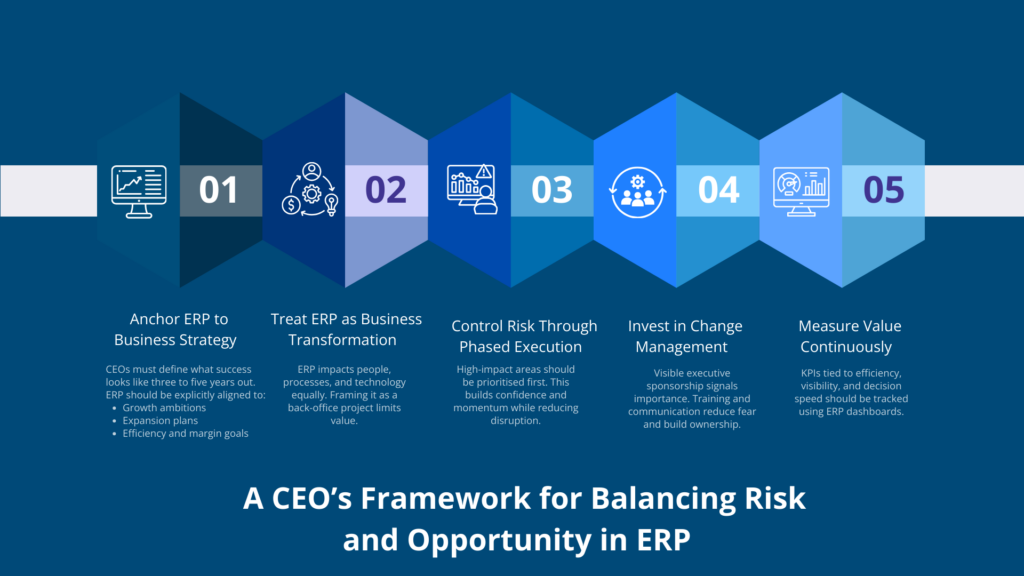
Step 1 — Anchor ERP to Business Strategy
CEOs must define what success looks like three to five years out. ERP should be explicitly aligned to:
- Growth ambitions
- Expansion plans
- Efficiency and margin goals
Step 2 — Treat ERP as Business Transformation
ERP impacts people, processes, and technology equally. Framing it as a back-office project limits value.
Step 3 — Control Risk Through Phased Execution
High-impact areas should be prioritised first. This builds confidence and momentum while reducing disruption.
Step 4 — Invest in Change Management
Visible executive sponsorship signals importance. Training and communication reduce fear and build ownership.
Step 5 — Measure Value Continuously KPIs tied to efficiency, visibility, and decision speed should be tracked using ERP dashboards.
Where CEOs Unlock the Biggest Opportunities with NetSuite
- Faster, data-driven decisions
- Reduced manual work and spreadsheet dependency
- Improved cash flow and margin visibility
- Scalable operations without system rework
- Stronger governance and compliance posture
The Risk of Inaction: Staying on Legacy Systems
Legacy systems create hidden liabilities:
- Rising maintenance costs
- Limited real-time insight
- Inflexibility during acquisitions
- Higher compliance and cybersecurity risk
ERP modernization should be viewed as risk mitigation, not discretionary spending.
The Importance of the Right NetSuite Partner
Partner choice has a direct impact on risk exposure. Experienced partners reduce:
- Scope creep
- Timeline delays
- Adoption failures
NSSuccess supports CEOs through:
- ERP readiness assessments
- Strategy-aligned NetSuite implementations
- Strong governance and optimization
- Long-term value realisation
Conclusion: ERP Success Is About Leadership Balance
ERP implementation is not about avoiding risk—it is about managing risk in pursuit of opportunity.
When approached as a leadership initiative, ERP becomes a strategic asset. With the right platform, governance, and partner, Oracle NetSuite enables CEOs to modernise with confidence, clarity, and control—transforming ERP from a liability into a growth engine.
Considering a NetSuite ERP implementation?
NSSuccess helps CEOs balance risk and opportunity to deliver long-term value. Connect with our experts to start your ERP journey with confidence.

 “NS Success” is the NetSuite Consulting Practice of Dhruvsoft Services Private Limited – a leading NetSuite Solution Provider Partner from India – providing services worldwide …