
Modern businesses operate in an environment where change happens faster than ever before. Market demand shifts quickly, supply chains face disruptions, and customer expectations continue to evolve. For CEOs and COOs, the ability to respond quickly to these changes is no longer optional — it is essential for long-term success.
Organizations that rely on fragmented systems or delayed reporting often struggle to make timely decisions. Leadership teams need accurate and real-time information to respond confidently to market changes.
This is where Oracle NetSuite becomes an important strategic platform. Adapting to Market Changes with Oracle NetSuite is easy, as NetSuite provides unified data, real-time insights, and scalable operations, and helps businesses stay agile and adapt to changing market conditions.
Why Agility Is a Leadership Priority
Business leaders today face constant uncertainty. Economic conditions fluctuate, global competition intensifies, and customer expectations change rapidly.
For CEOs and COOs, agility means the ability to identify changes quickly and adjust strategies without delay.
Rapid Changes in Global Markets
Markets are more connected than ever. A shift in global supply chains, regulatory changes, or technological innovation can impact businesses almost immediately.
Organizations must be able to react quickly to:
- Changes in demand
- Supply chain disruptions
- New competitors entering the market
- Economic uncertainty
Companies that respond faster gain a competitive advantage.
Limitations of Fragmented Systems
Many organizations still operate with disconnected systems for finance, operations, sales, and inventory.
This creates several problems:
- Data is stored in different systems
- Reports take longer to prepare
- Leadership lacks real-time visibility
Without a unified system, decision-making becomes slow and reactive.
Enabling Agile Decision-Making
Modern ERP platforms like Oracle NetSuite help leadership teams access real-time business information. Instead of waiting days or weeks for reports, executives can monitor performance instantly and make strategic decisions faster.
Understanding Market Volatility in Modern Business
Market volatility is now a constant reality. Organizations must prepare to handle sudden changes in demand, pricing, or operational conditions.
Increasing Market Uncertainty
Businesses are influenced by many external factors, including:
- Economic shifts
- Changing consumer behaviour
- Global supply chain challenges
- Competitive pressure
These factors make forecasting and planning more complex.
Operational Challenges for Leadership
Without proper systems, leaders often face operational challenges such as:
- Delayed financial visibility: Financial reports may take weeks to consolidate, preventing timely insights.
- Disconnected departmental data: Sales, finance, and operations teams often work with separate systems, creating information gaps.
- Slow response to supply or demand changes: If leadership cannot quickly see inventory levels, production capacity, or revenue performance, decision-making becomes difficult.
The Need for Real-Time Intelligence
Leadership teams need accurate and timely insights to guide business strategies.
Real-time intelligence allows executives to:
- Identify risks early
- Monitor operational performance
- Respond to market changes quickly
This is why many organizations are moving toward integrated ERP systems.
Why Traditional Systems Limit Organizational Agility
Legacy systems often slow down organizations instead of supporting growth.
Data Silos Across Departments
When departments operate with separate systems, collaboration becomes difficult.
For example:
- Finance uses accounting software
- Sales relies on CRM platforms
- Operations uses inventory tools
Without integration, leadership cannot see the complete business picture.
Slow Reporting and Decision Cycles
Many organizations rely on manual reporting processes. Data must be gathered from multiple systems and consolidated into spreadsheets.
This leads to:
- Delayed reporting
- Increased risk of errors
- Slow strategic decision-making
Lack of Scalability
Traditional systems often struggle when businesses expand.
Challenges may include:
- Supporting multiple subsidiaries
- Managing international operations
- Handling increased transaction volumes
Businesses need scalable systems that grow with them.
How Oracle NetSuite Helps Adapting to Market Changes & Agile Decision-Making
Oracle NetSuite is a cloud-based ERP platform designed to provide unified visibility across the entire organization.
By connecting finance, operations, sales, and supply chain processes, NetSuite creates a single platform for business management.
Real-Time Business Visibility
NetSuite provides real-time dashboards that allow leadership teams to monitor performance instantly.
Executives can view:
- Financial performance
- Sales metrics
- Operational data
- Inventory levels
This visibility enables faster decision-making.
Centralized Data for Faster Decisions
NetSuite creates a single source of truth across the organization.
Instead of relying on separate systems, teams work with shared data that remains consistent and accurate.
Benefits include:
- Reduced reporting delays
- Improved collaboration
- More reliable insights
Scenario Planning and Forecasting
Market conditions can change quickly. NetSuite allows leadership teams to evaluate multiple scenarios and adjust strategies accordingly.
Executives can model:
- Revenue forecasts
- Cost changes
- Supply chain disruptions
- Market expansion strategies
This helps organizations prepare for uncertainty.
Operational Agility Across Departments with NetSuite
Agility is not only about leadership decisions. It also depends on how quickly operational teams can respond to changes.
Finance Teams Respond Faster
Finance teams benefit from real-time financial reporting and automated processes.
Key advantages include:
- Faster financial close cycles
- Improved financial visibility
- Accurate budgeting and forecasting
With better financial insights, executives can make informed decisions faster.
Supply Chain and Inventory Flexibility
Supply chain disruptions have become common in many industries.
NetSuite provides real-time visibility into inventory levels and supply chain performance, allowing businesses to:
- Adjust procurement strategies
- Optimize inventory levels
- Respond quickly to demand changes
Sales and Customer Operations Adapt Quickly
Sales teams gain better visibility into customer behaviour and revenue trends.
This helps organizations:
- Align sales strategies with market demand
- Improve customer engagement
- Increase revenue opportunities
Better coordination between sales, finance, and operations improves overall business agility.
Enable Leadership with NetSuite-Provided Data-Driven Insights
Successful organizations rely on data to guide strategic decisions.
Executive Dashboards
NetSuite provides dashboards that display key performance indicators in one place.
Executives can monitor:
- Revenue performance
- Operational efficiency
- Financial health
- Customer metrics
These insights allow leaders to act quickly when performance changes.
Predictive Analytics and Planning
Advanced analytics help organizations identify trends and potential risks.
Predictive insights allow leadership teams to:
- Forecast market demand
- Identify operational inefficiencies
- Plan for future growth
Faster Strategic Decision-Making
When leaders have access to reliable data, they can make decisions with confidence.
Data-driven leadership improves:
- Strategic planning
- Resource allocation
- Risk management
How you can Manage Change During Market Disruptions with Oracle NetSuite
Organizations must be prepared to adjust strategies during unexpected market changes.
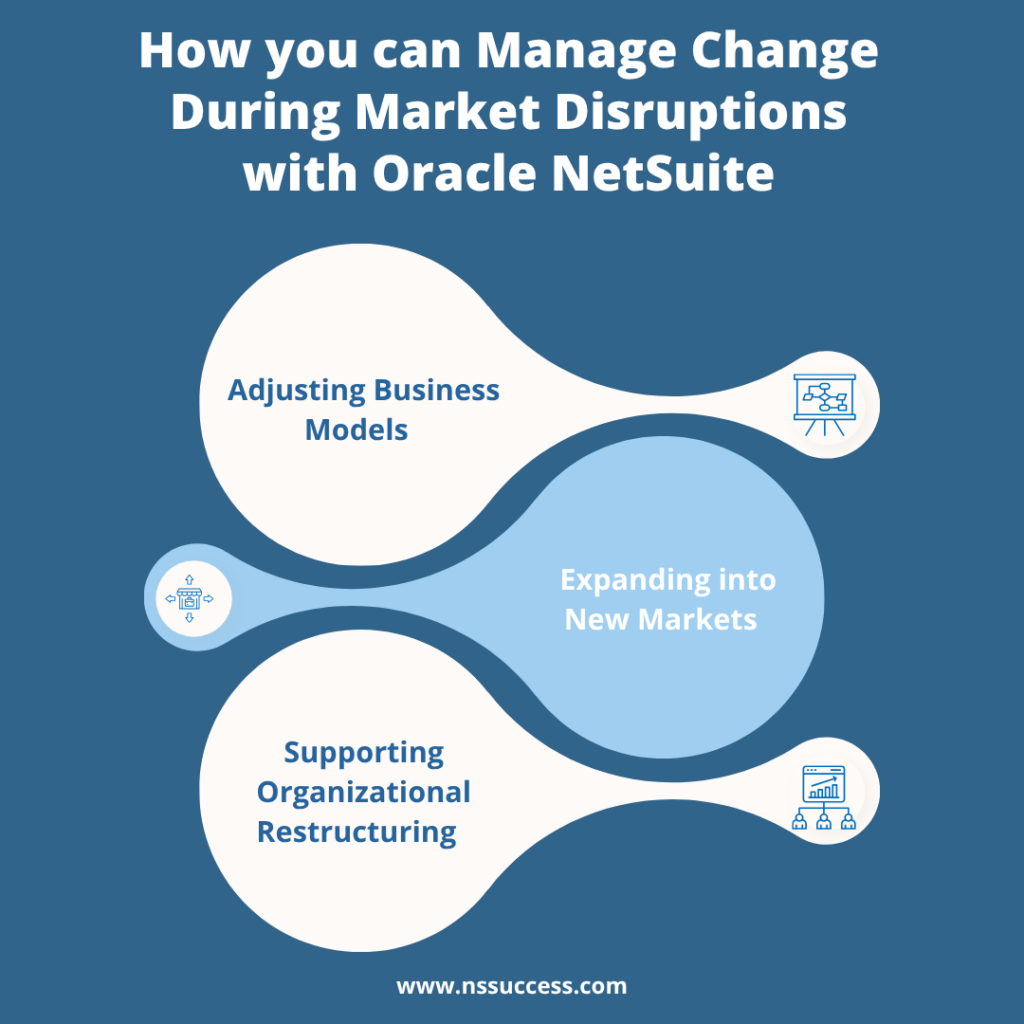
Adjusting Business Models
- Many companies are shifting toward subscription or service-based business models.
- NetSuite supports flexible billing and revenue management processes that help organizations adapt to these changes.
Expanding into New Markets
- Businesses looking to expand globally must manage multiple subsidiaries, currencies, and tax regulations.
- NetSuite supports international operations through:
- Multi-currency management
- Multi-subsidiary reporting
- Global financial consolidation
Supporting Organizational Restructuring
- Business growth often involves acquisitions, restructuring, or new business units.
- NetSuite provides the flexibility needed to support these organizational changes.
Case Study: Responding to Market Changes with NetSuite
A fast-growing international trade company was facing sudden changes in market demand.
Business Challenge
The company experienced rapid demand fluctuations but lacked visibility across its operations.
Leadership struggled with:
- Limited financial insights
- Inconsistent inventory data
- Slow reporting cycles
NetSuite Implementation Approach
By implementing NetSuite, the organization unified its financial and operational systems.
Key improvements included:
- Real-time dashboards for executives
- Integrated inventory management
- Automated financial reporting
Business Outcomes
After implementation, the company experienced significant improvements.
Results included:
- Faster strategic decision-making
- Improved operational efficiency
- Better risk management
This allowed leadership teams to respond quickly to market changes.
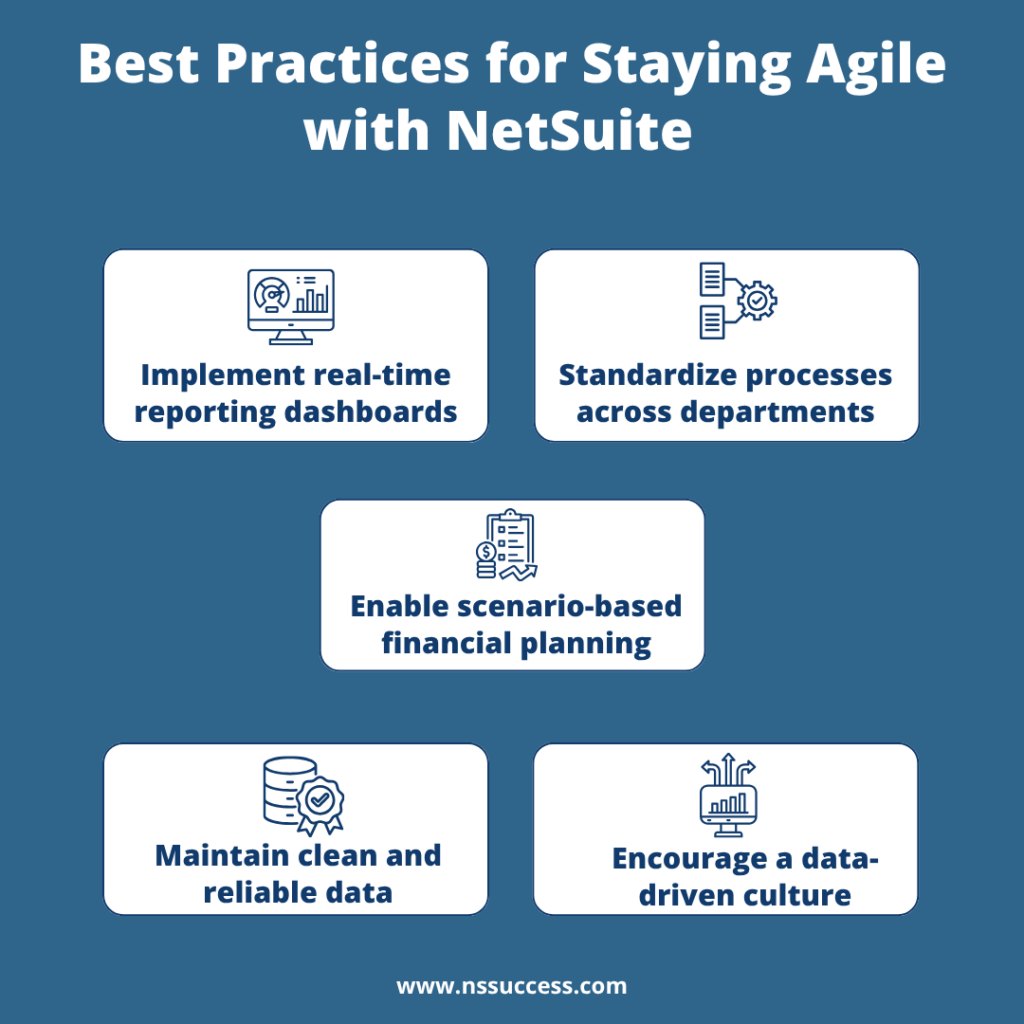
Best Practices for Staying Agile with NetSuite
Organizations can maximize the benefits of NetSuite by following several best practices.
- Implement real-time reporting dashboards: Ensure leadership teams have access to real-time business insights.
- Standardize processes across departments: Consistent processes improve operational efficiency.
- Enable scenario-based financial planning: Scenario planning helps organizations prepare for uncertainty.
- Maintain clean and reliable data: Accurate data ensures reliable analytics and decision-making.
- Encourage a data-driven culture: Leaders should promote data-based decision-making across the organization.
The Strategic Role of NetSuite ERP in Market Adaptability
Modern ERP systems like NetSuite play a much larger role than traditional business software.
They serve as platforms for digital transformation and strategic growth.
ERP systems help organizations:
- Integrate business processes
- Improve operational efficiency
- Support innovation and expansion
When technology aligns with business strategy, organizations can respond more effectively to market changes.
Why Partnering with Dhruvsoft / NsSuccess Matters
Successful ERP implementation requires the right expertise and industry knowledge.
Dhruvsoft helps organizations maximize the value of Oracle NetSuite through:
- Expert NetSuite implementation services
- Industry-specific ERP solutions
- Scalable architectures that support business growth
With the right implementation partner, businesses can accelerate their digital transformation and improve operational agility.
Conclusion
Market agility has become a critical requirement for modern organizations. Businesses must be able to respond quickly to changing customer expectations, economic conditions, and operational challenges.
With real-time insights, integrated operations, and scalable infrastructure, Oracle NetSuite provides a strong digital foundation for agile organizations.
Leadership teams gain the visibility and intelligence needed to make faster, more confident decisions. Organizations that invest in agile systems today will be better prepared to navigate tomorrow’s market changes.
Ready to Build a More Agile Organization?
Dhruvsoft helps businesses implement Oracle NetSuite to gain real-time insights and respond confidently to changing market conditions. Your organization can also quickly adapt to Market Changes with Oracle NetSuite and stay agile.
Connect with our experts today to start building a more agile and resilient organization.
 “NS Success” is the NetSuite Consulting Practice of Dhruvsoft Services Private Limited – a leading NetSuite Solution Provider Partner from India – providing services worldwide …