
Enterprise Resource Planning systems were once viewed as back-office technology—tools designed mainly to support accounting, inventory, and basic operations. Those days are long gone. Today, ERP sits at the centre of business strategy, influencing how organizations grow, manage risk, scale operations, and respond to market change.
For boards and executive leadership teams, ERP decisions are no longer routine IT upgrades. They are long-term strategic investments with multi-year financial, operational, and risk implications. A poorly chosen or poorly implemented ERP can slow growth, increase compliance exposure, and lock the organization into rigid processes. A well-chosen ERP, on the other hand, becomes a foundation for resilience, agility, and sustained value creation.
Boards now expect more than technical justifications. They want clarity on how ERP investments support growth, reduce risk, improve governance, and deliver measurable ROI. Presenting ERP as a “system replacement” focused on features, modules, or infrastructure costs is no longer sufficient. Leadership teams must reframe ERP as a business capability platform that enables long-term outcomes.
This is where Oracle NetSuite shines and stands apart from other ERP systems. Designed as a cloud-native ERP, NetSuite is built to support long-term business impact—not just transactional efficiency. This article explores how leadership teams can build a compelling, board-ready ERP investment case by aligning NetSuite’s capabilities with strategic priorities, addressing board-level concerns, and clearly articulating long-term value.
Understanding the Board’s Perspective
Before presenting an ERP proposal, it is critical to understand how boards evaluate major investments. Board members operate at a strategic altitude. Their focus is not on system configuration or feature lists but on outcomes, risks, and long-term value.
What Board Members Typically Care About
Boards consistently prioritise a few core dimensions when evaluating large investments:
- Long-term value and return on investment: Boards want to understand how the ERP will generate value over five to seven years. This includes cost savings, revenue enablement, efficiency gains, and competitive advantage—not just short-term benefits.
- Risk reduction and compliance: ERP systems play a critical role in financial control, audit readiness, data security, and regulatory compliance. Boards are keenly aware that weak systems increase exposure to financial misstatements, regulatory penalties, and reputational damage.
- Scalability and future readiness: Boards think in terms of growth trajectories. They want assurance that today’s ERP investment will support future expansion, new business models, global operations, and acquisitions without repeated system overhauls.
- Cost predictability and governance:Uncontrolled IT costs, surprise upgrades, and unpredictable maintenance expenses raise red flags at the board level. Predictable cost structures and strong governance models inspire confidence.
Why Technical Details Alone Fail to Convince Boards
Technical presentations often fail because they focus on how the system works rather than why it matters. Discussions around architecture, databases, or customizations may be important for IT teams, but they rarely resonate with board members.Boards respond to strategic narratives. They want to hear how ERP supports growth plans, strengthens controls, enables faster decisions, and protects the organization from future risk. Successful ERP proposals translate technology into business outcomes and risk mitigation—not system diagrams.
Common Triggers That Force ERP Discussions at the Board Level
ERP initiatives often reach the board because of pressure points rather than proactive planning. Understanding these triggers helps leadership teams frame ERP investment as a strategic response, not a reactive expense.
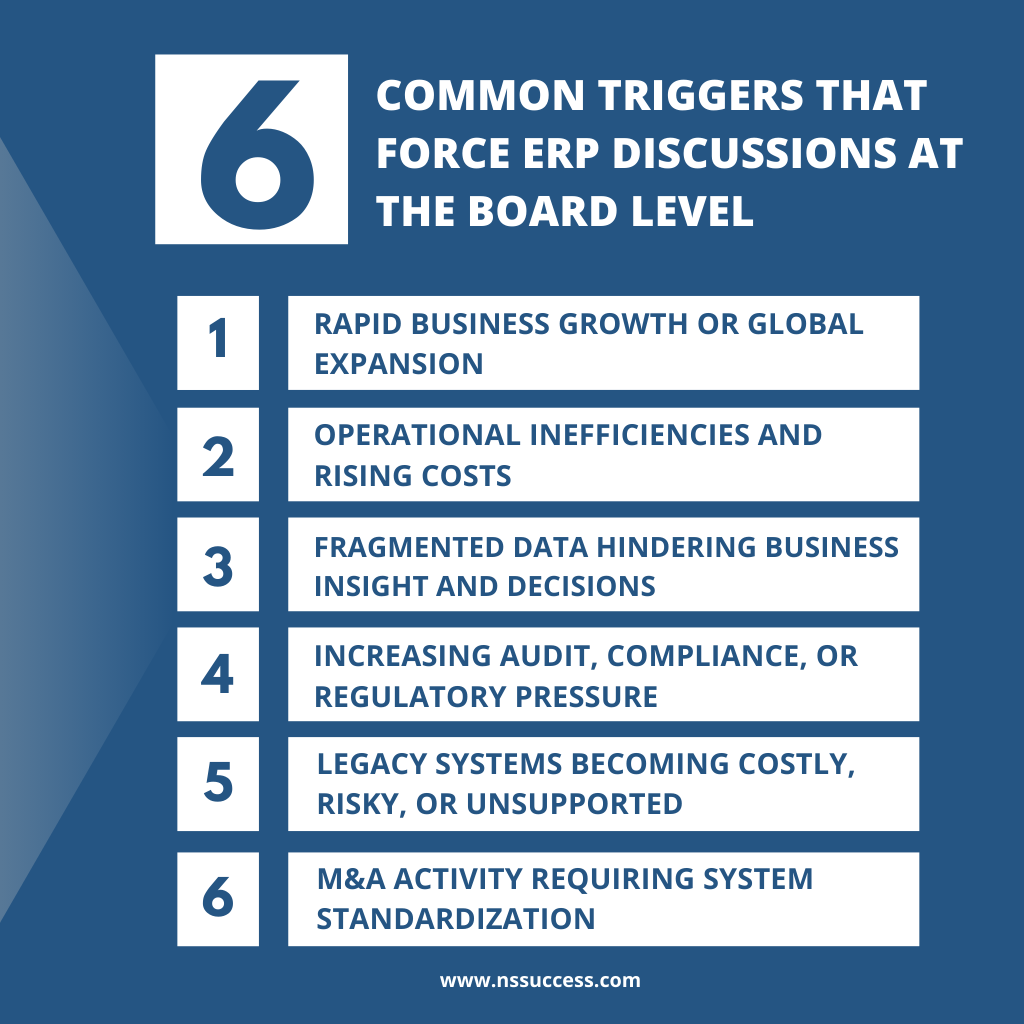
Rapid Business Growth or Global Expansion
As organizations grow, legacy systems struggle to keep pace. Manual processes, fragmented reporting, and inconsistent controls become barriers to scale. Global expansion introduces complexities around multi-entity accounting, currencies, taxation, and compliance that older systems cannot handle effectively.
Operational Inefficiencies and Rising Costs
Disconnected systems lead to duplicated work, reconciliation delays, and heavy reliance on spreadsheets. Over time, operational inefficiencies translate into higher labour costs, slower closes, and missed opportunities—issues boards cannot ignore.
Fragmented Data Hindering Business Insight and Decisions
When finance, operations, and sales operate on separate systems, leadership lacks a single version of the truth. Boards increasingly expect real-time visibility into performance metrics, forecasts, and risk indicators.
Increasing Audit, Compliance, or Regulatory Pressure
Regulatory scrutiny is intensifying across industries. Weak audit trails, inconsistent controls, and manual processes elevate compliance risk. Boards often mandate ERP modernization when audit findings or regulatory concerns escalate.
Legacy Systems Becoming Costly, Risky, or Unsupported
Ageing ERP systems carry hidden risks—unsupported versions, security vulnerabilities, and high maintenance costs. Over time, the cost of maintaining outdated systems often exceeds the cost of replacement.
M&A Activity Requiring System Standardization
Mergers and acquisitions demand system integration and standardised processes. Without a scalable ERP foundation, post-merger integration becomes slow, expensive, and risky.
Reframing ERP: From Cost Center to Strategic Asset
One of the biggest challenges leadership teams face is shifting the ERP narrative. Too often, ERP is presented as a necessary expense rather than a value-generating investment.
ERP as an Enabler of Growth and Resilience
Modern ERP platforms enable organizations to respond quickly to change. They provide real-time data, standardised processes, and scalable architectures that support growth without adding complexity. When positioned correctly, ERP becomes a growth enabler—not a constraint.
How Oracle NetSuite Supports Strategic Outcomes
- Faster decision-making: NetSuite provides real-time dashboards and analytics that give leaders immediate insight into financial and operational performance.
- Operational efficiency: Automation reduces manual work, shortens cycle times, and lowers operational costs across finance and operations.
- Financial control and transparency: Built-in controls, audit trails, and role-based access strengthen governance and compliance.
- Long-term scalability: NetSuite’s cloud-native design supports growth, acquisitions, and global expansion without system sprawl.
The conversation must shift from “how much does it cost to implement?” to “what capabilities does this enable over the next decade?”
The Long-Term Business Value of Oracle NetSuite
Financial Visibility and Control
Strong financial governance is a top board priority. NetSuite delivers real-time financial reporting that enables leadership teams to monitor performance continuously rather than relying on month-end snapshots.
Controllers and CFOs benefit from faster close cycles, improved forecasting accuracy, and better cash flow visibility. For boards, this translates into confidence—confidence that decisions are based on accurate, timely data and that financial risks are well-managed.
Scalable Growth Without System Sprawl
Many organizations accumulate multiple systems as they grow—one for finance, another for inventory, another for subsidiaries. This system sprawl increases cost and complexity.
NetSuite eliminates this fragmentation by supporting multi-entity, multi-currency, and multi-country operations within a single platform. Boards see this as a long-term advantage: fewer systems, lower integration risk, and consistent governance across the organization.
Operational Efficiency and Automation
Manual processes are costly, error-prone, and difficult to scale. NetSuite standardises and automates processes across finance, procurement, supply chain, and operations.
Over time, these efficiencies translate into measurable cost savings. Reduced reliance on spreadsheets lowers risk, improves accuracy, and frees teams to focus on higher-value activities.
Risk Reduction and Compliance
NetSuite’s built-in controls, audit trails, and permission frameworks strengthen internal governance. Boards are increasingly focused on risk—financial, operational, and regulatory.
By replacing aging systems with a secure, continuously updated cloud ERP, organizations reduce exposure to security vulnerabilities and compliance gaps. This risk reduction alone often justifies ERP investment at the board level.
Technology Longevity and Innovation
Unlike on-premise systems that require disruptive upgrades, NetSuite delivers continuous innovation through regular updates. Boards value this longevity. The ERP evolves with the business, protecting the investment from obsolescence and ensuring access to new capabilities over time.
Addressing Board-Level Concerns Head-On
Cost and Budget Control
NetSuite’s subscription-based pricing model offers predictability. Boards appreciate knowing what the ERP will cost year over year without surprise infrastructure or upgrade expenses. Compared to on-premise systems, long-term total cost of ownership is often significantly lower.
Implementation Risk
ERP failures are a common board concern. NetSuite addresses this through phased implementation approaches and proven methodologies such as SuiteSuccess, which reduces risk by leveraging industry best practices and preconfigured processes.
Change Management and Adoption
Technology alone does not deliver value—people and processes do. Boards want assurance that adoption risks are managed. Strong governance, executive sponsorship, training, and change management are essential components of a successful ERP program.
Building a Strong ERP Business Case for the Board
Step 1: Align ERP Objectives with Business Strategy
ERP objectives must directly support strategic goals—whether that is growth, expansion, efficiency, compliance, or transformation. This alignment ensures the ERP is seen as a strategic enabler, not an isolated IT initiative.
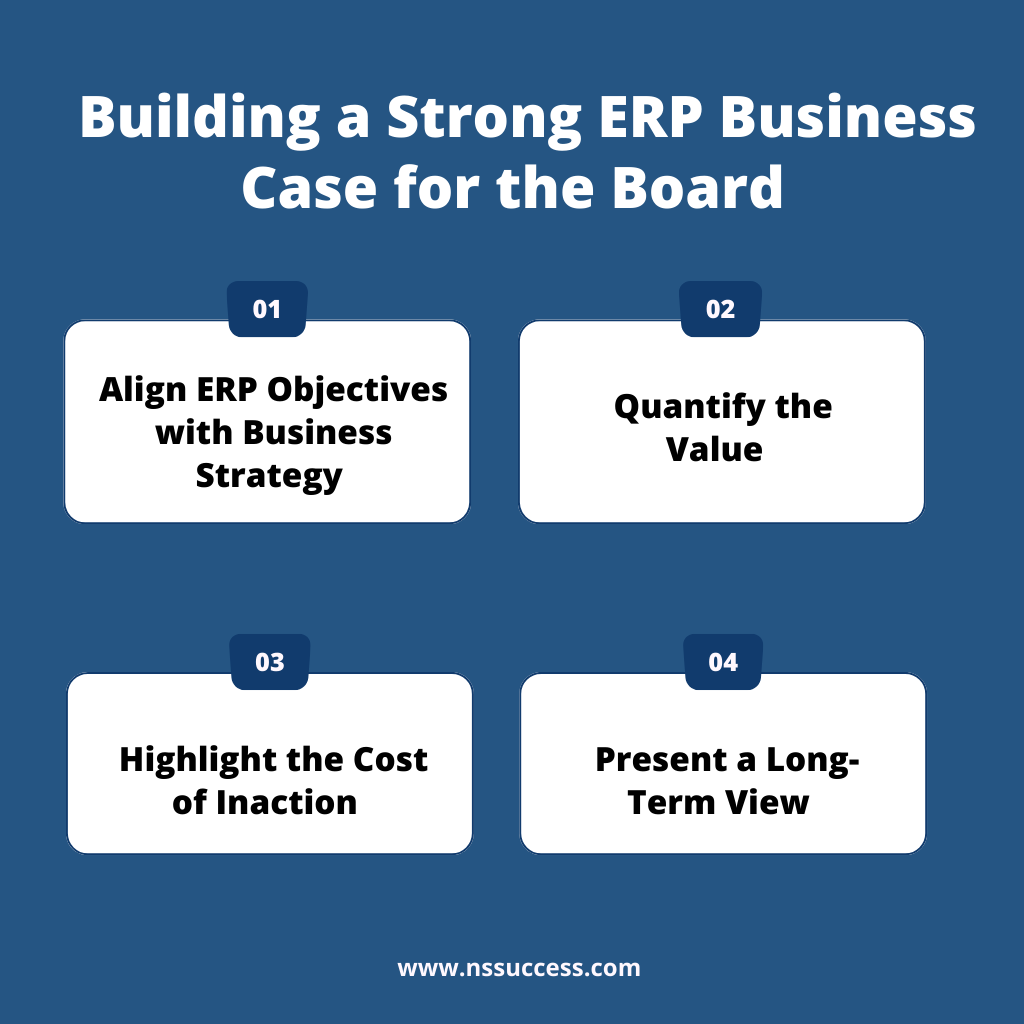
Step 2: Quantify the Value
Boards respond to numbers. Leadership teams should quantify cost savings from automation, revenue enablement through faster time-to-market, and reduced audit and compliance risk. While not every benefit is easily measured, credible estimates strengthen the case.
Step 3: Highlight the Cost of Inaction
Doing nothing is also a decision—with consequences. Rising maintenance costs, increasing risk exposure, and lost opportunities due to slow decision-making must be clearly articulated.
Step 4: Present a Long-Term View
Boards think long-term. A five- to seven-year view that focuses on total cost of ownership and cumulative ROI resonates far more than a narrow year-one budget discussion.
The Role of the Right NetSuite Partner in Board Confidence
Boards often look beyond the software itself and evaluate who will deliver the transformation. An experienced implementation partner reduces risk, ensures realistic timelines, and aligns the ERP program with business outcomes.
NSSuccess (the NetSuite practice of Dhruvsoft) works closely with leadership teams to translate ERP strategy into board-ready business cases. From initial justification through implementation and post-go-live optimization, the focus remains on long-term value realisation—not just system deployment.
Conclusion: Winning Board Approval with the Right Story
ERP investment success begins with the right narrative. When positioned as a strategic enabler rather than a technical upgrade, ERP earns board-level support. Oracle NetSuite delivers long-term value across finance, operations, risk management, and growth.
With a clear strategy, quantified value, and the right partner, leadership teams can confidently present ERP as an investment the board can stand behind—today and for years to come.
Looking to build a board-ready ERP investment case?
NSSuccess helps leadership teams articulate, justify, and deliver the long-term value of Oracle NetSuite. Connect with our experts today.

 “NS Success” is the NetSuite Consulting Practice of Dhruvsoft Services Private Limited – a leading NetSuite Solution Provider Partner from India – providing services worldwide …