
Finance teams today operate in an environment of growing complexity. Organizations manage multiple departments, subsidiaries, product lines, and markets, often spread across different regions and currencies. With increasing transaction volumes and expanding operational scope, financial data flows across many systems and processes.
Traditional reporting methods—typically based on spreadsheets or periodic reports—are no longer sufficient for modern finance leaders. Monthly or quarterly reports provide historical insights but often fail to capture real-time changes in business performance. By the time the data reaches decision-makers, the situation may have already changed.
For CFOs, controllers, and finance managers, this delay can lead to missed opportunities or delayed responses to financial risks. Decision-making requires timely access to accurate financial information that reflects the current state of the organization.
This is where Oracle NetSuite financial dashboards become valuable. NetSuite dashboards provide finance teams with real-time insights into key financial metrics, operational performance, and financial trends. Instead of waiting for static reports, leaders can monitor financial performance continuously and make proactive decisions based on up-to-date data.
Financial dashboards transform raw financial data into clear, visual insights. By consolidating key metrics, charts, and reports in one place, they enable finance teams to monitor performance, identify risks, and guide strategic decisions with greater confidence.
The Role of Financial Dashboards in Strategic Decision-Making
Financial dashboards play an increasingly important role in modern financial management. They act as a centralised hub where finance leaders can view critical performance indicators, monitor trends, and evaluate financial health across the organization.
Dashboards are not just visualisation tools—they are decision-support systems that provide continuous insights into financial performance.
From Static Reports to Real-Time Insights
Traditional financial reporting relies heavily on static reports that are generated periodically. While these reports are useful for historical analysis, they do not support real-time decision-making.
Modern organizations require continuous visibility into financial performance. Financial dashboards provide live updates as transactions occur within the system. This means finance leaders can monitor revenue trends, expenses, cash flow, and profitability at any time.
With dashboards, decision-makers no longer have to wait until the end of the month to understand business performance. Instead, they can identify issues early and take corrective actions before problems escalate.
Key Benefits of Financial Dashboards
Financial dashboards offer several advantages for finance teams and executive leadership.
- Instant access to critical KPIs: Dashboards present the most important financial metrics in a single interface, making it easier for finance leaders to track performance.
- Improved transparency across the organization: By providing real-time visibility into financial data, dashboards help ensure that leadership teams operate with a shared understanding of financial performance.
- Faster identification of financial risks and opportunities: Finance leaders can quickly detect unusual trends, cost overruns, or declining profitability and take action immediately.
Understanding Oracle NetSuite Dashboard Capabilities
The dashboard functionality within Oracle NetSuite is designed to give users personalized views of their most relevant financial and operational data. Dashboards are flexible, customizable, and role-based, ensuring that each user sees the information most relevant to their responsibilities.
Role-Based Dashboards
NetSuite dashboards can be customized for different user roles within an organization. CFOs, finance managers, controllers, and executives can each have dashboards designed around their specific decision-making needs.
For example:
- CFO dashboards may focus on revenue performance, profitability trends, cash flow forecasts, and financial KPIs.
- Finance manager dashboards may emphasise operational metrics such as accounts receivable aging, budget performance, and expense tracking.
- Executive dashboards often provide high-level summaries of financial and operational performance to support strategic decision-making.
Role-based dashboards ensure that users are not overwhelmed by irrelevant information and can focus on the insights most important to their role.
Real-Time Data and Reporting
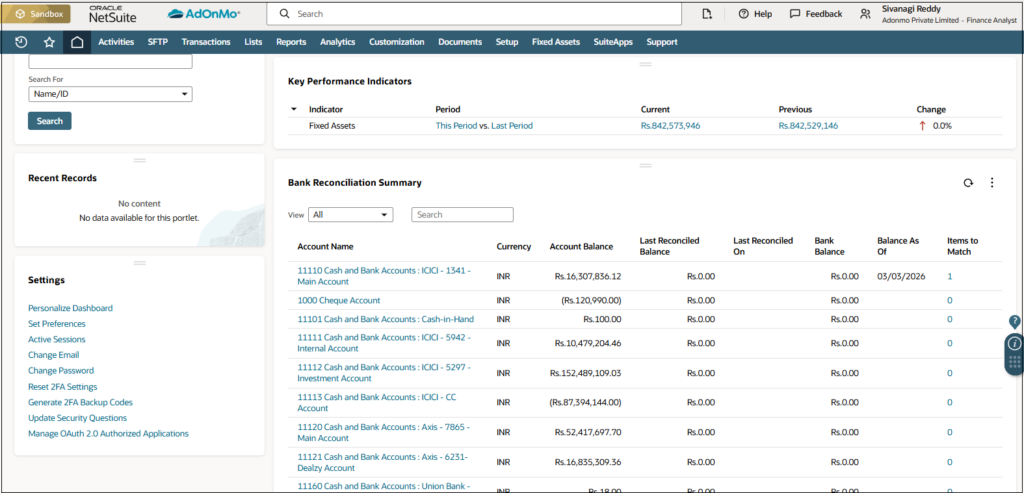
One of the most powerful aspects of NetSuite dashboards is their ability to display real-time financial data. As transactions are recorded within the system, the dashboard automatically updates to reflect the latest information.
This eliminates the need for manual data consolidation or spreadsheet updates. Finance teams no longer have to collect data from multiple systems to generate reports.
Instead, NetSuite provides a single source of truth for financial information, ensuring that everyone in the organization works with consistent and accurate data.
Customizable Widgets and KPIs
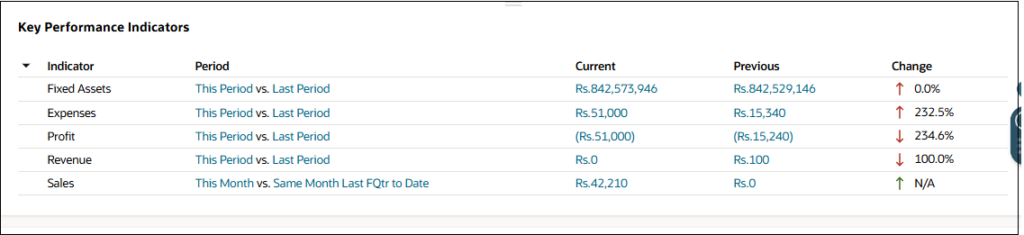
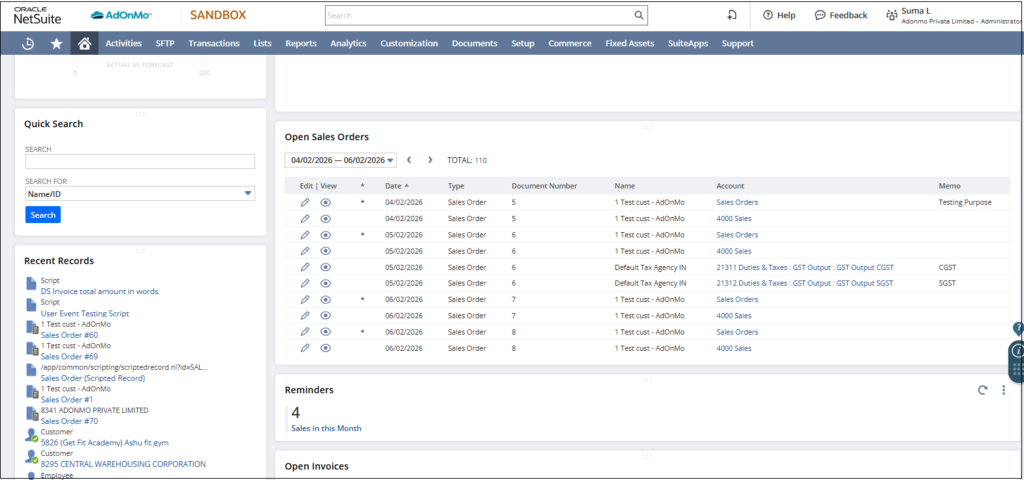
NetSuite dashboards use modular components known as portlets, which allow users to display different types of information such as charts, KPI meters, reminders, and reports.
These widgets can display a wide range of financial metrics, including:
- Revenue trends
- Expense summaries
- Profit margins
- Cash balances
- Accounts receivable aging
- Budget performance
Organizations can also create custom KPIs that reflect their unique business priorities. For example, a subscription-based company may track recurring revenue metrics, while a manufacturing organization may monitor production costs and inventory turnover.
Key Financial Metrics to Track Using NetSuite Dashboards
Finance teams rely on dashboards to monitor the most important financial indicators that influence business performance. By tracking these metrics in real time, organizations can detect issues early and maintain strong financial control.
Revenue and Profitability
Revenue growth is one of the most important indicators of business success. NetSuite dashboards allow finance leaders to track revenue trends across different dimensions such as product lines, regions, and business units.
Profitability metrics such as gross margin and operating profit provide insights into how efficiently the organization is generating value. Dashboards help identify areas where margins may be declining or operational costs are increasing.
Cash Flow and Liquidity
Cash flow management is a critical responsibility for finance teams. NetSuite dashboards provide real-time visibility into cash balances, inflows, and outflows.
Finance leaders can monitor accounts receivable and accounts payable aging to understand how quickly customers are paying and how liabilities are being managed. Cash flow projections help organizations plan for future financial needs and avoid liquidity challenges.
Budget vs Actual Performance
Budget tracking is essential for maintaining financial discipline. NetSuite dashboards allow finance teams to compare planned budgets with actual financial performance in real time.
By monitoring budget variances, finance leaders can quickly identify cost overruns or revenue shortfalls and take corrective action.
This level of visibility ensures that organizations remain aligned with financial plans and strategic objectives.
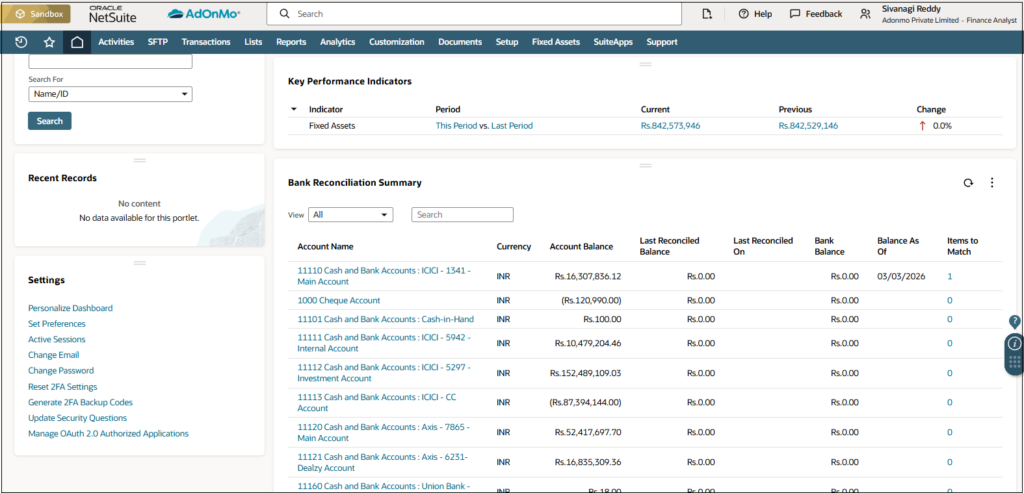
Financial Close and Operational Efficiency
Month-end close processes can be time-consuming and complex. NetSuite dashboards help finance teams track the progress of closing activities and ensure that tasks are completed on time.
Dashboards can also monitor operational metrics such as expense trends, departmental spending, and cost efficiency. This helps organizations maintain control over operational expenses while improving financial performance.
How Finance Leaders Can Use NetSuite Dashboards Effectively
While dashboards provide powerful capabilities, their effectiveness depends on how they are used. Finance leaders must design dashboards thoughtfully and integrate them into daily decision-making processes.
Set Up Role-Based Financial Dashboards
- Organizations should configure dashboards tailored to specific leadership roles. CFO dashboards should focus on strategic financial metrics, while operational dashboards should provide detailed insights for finance managers.
- This ensures that each user sees the most relevant information for their responsibilities.
Use Drill-Down Capabilities for Deeper Analysis
- One of NetSuite’s most valuable features is its drill-down capability. Users can click on a dashboard metric to view the underlying transactions or detailed reports.
- For example, if revenue declines in a particular region, finance leaders can drill down to identify which customers or products are responsible.
- This makes it easier to identify root causes and make informed decisions quickly.
Monitor Financial Performance in Real Time
- Instead of relying on monthly reporting cycles, finance leaders can use dashboards to monitor performance continuously.
- Daily monitoring of financial KPIs allows organizations to detect trends early and respond quickly to emerging challenges or opportunities.
Share Insights Across Departments
- Financial insights should not remain limited to the finance team. NetSuite dashboards can be shared with executives and operational leaders, enabling cross-functional collaboration.
- When departments have access to real-time financial insights, they can align their decisions with overall business objectives.
Best Practices for Designing Effective NetSuite Financial Dashboards
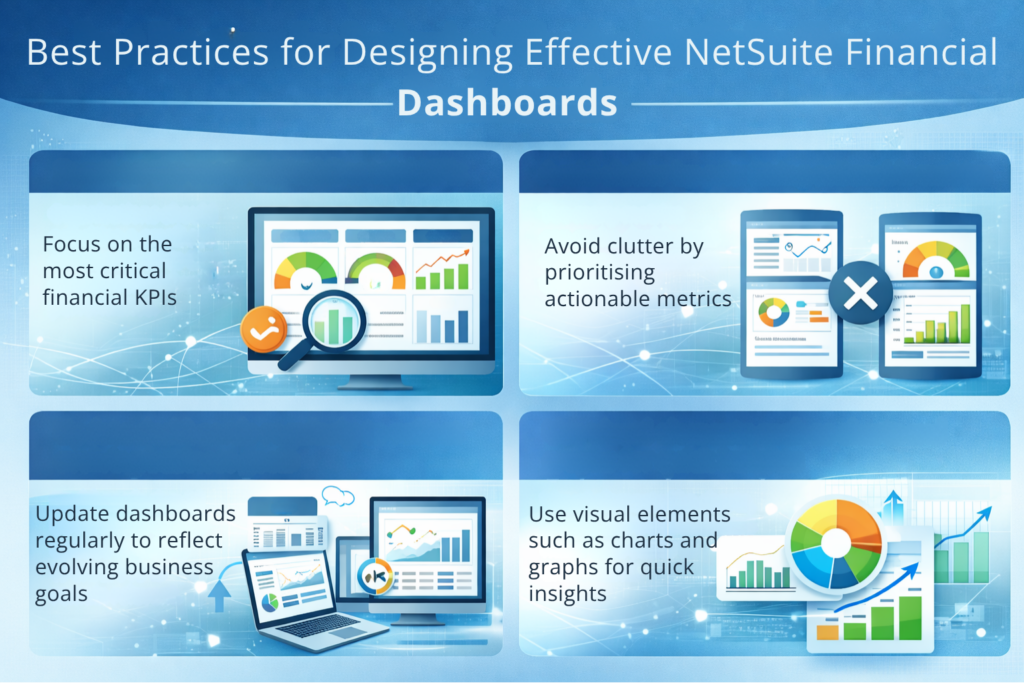
- Focus on the most critical financial KPIs: Organizations should prioritise a small set of financial KPIs that directly reflect business performance. Tracking the most critical metrics helps leadership focus on outcomes that matter. This ensures financial monitoring remains meaningful and actionable.
- Avoid clutter by prioritising actionable metrics: Too many metrics can make dashboards confusing and difficult to interpret. By focusing only on actionable data points, teams can quickly identify trends and performance gaps. Simpler dashboards improve clarity and decision-making.
- Update dashboards regularly to reflect evolving business goals: Business priorities change as organizations grow or shift strategies. Dashboards should be reviewed and updated regularly to ensure KPIs remain relevant. This keeps financial reporting aligned with current objectives.
- Use visual elements such as charts and graphs for quick insights: Visual elements like charts, graphs, and trend indicators make data easier to understand. They allow leaders to quickly identify patterns, risks, and opportunities. Well-designed visuals improve the speed and effectiveness of decision-making.
Common Challenges When Using Financial Dashboards
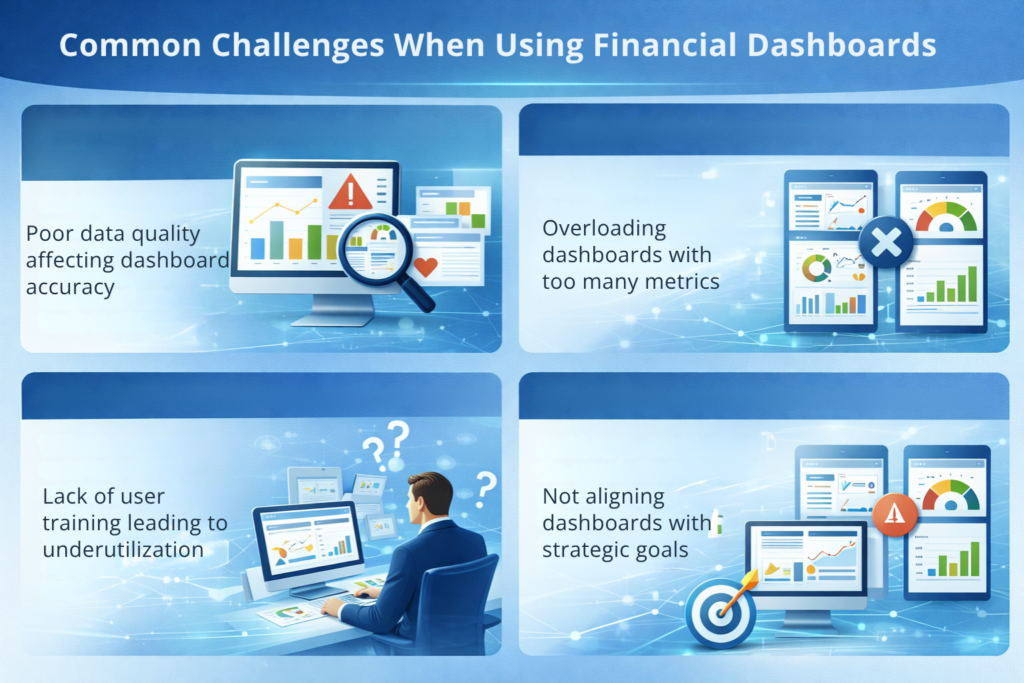
- Poor data quality affecting dashboard accuracy: Dashboards are only as reliable as the data behind them. Incomplete, inconsistent, or outdated data leads to misleading insights. Maintaining strong data quality and validation processes is essential for accurate reporting.
- Overloading dashboards with too many metrics: Including too many metrics can make dashboards difficult to interpret. Users may struggle to identify the most important insights. Focused dashboards with key performance indicators improve clarity and decision-making.
- Lack of user training leading to underutilization: Without proper training, users may not fully understand how to use dashboards effectively. This results in limited adoption and missed insights. Providing training ensures teams can confidently interpret and act on data.
- Not aligning dashboards with strategic goals: Dashboards should reflect the organization’s strategic priorities. If metrics are not aligned with business goals, insights become less meaningful. Aligning dashboards with objectives ensures data supports better decision-making.
Real-World Scenario: Using NetSuite Dashboards for Financial Decision-Making
- The Challenge: A finance team was struggling with delayed financial insights due to manual reporting and fragmented systems. Leadership lacked real-time visibility into revenue, expenses, and cash flow. This made forecasting and strategic planning difficult.
- The Solution: The organization implemented financial dashboards using Oracle NetSuite. Real-time dashboards were configured to monitor key metrics such as revenue performance, operating expenses, and cash flow trends. This centralised financial data into a single, easily accessible view.
- The Result: Finance teams gained faster access to accurate financial insights and significantly reduced reporting cycles. Forecasting improved with better visibility into financial trends. Leadership was able to make more informed and strategic business decisions.
The Future of Financial Intelligence with NetSuite
Increasing Role of Analytics and Automation in Financial Dashboards
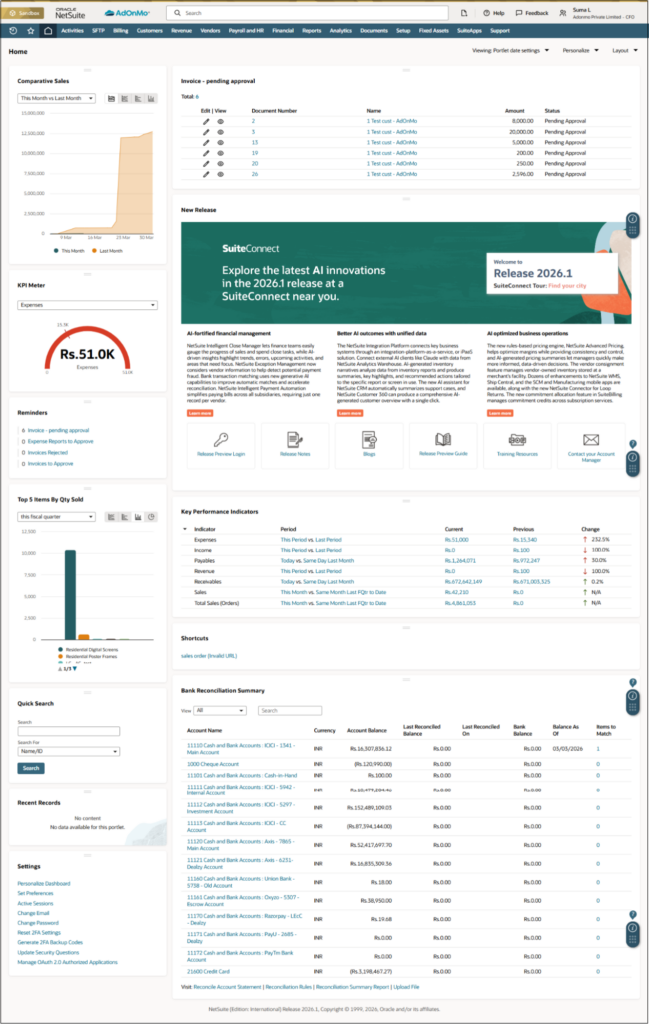
- Modern financial dashboards are increasingly powered by advanced analytics and automation. Automated data collection and processing reduce manual reporting efforts and improve accuracy.
- This allows finance teams to focus more on analysis and strategic decision-making rather than routine data preparation.
Predictive Insights and AI-Driven Financial Forecasting
- With the integration of analytics and AI capabilities in platforms like Oracle NetSuite, organizations can move beyond historical reporting. Predictive insights help forecast revenue trends, expenses, and cash flow more accurately.
- This enables finance leaders to anticipate risks and opportunities before they impact business performance.
How Modern ERP Dashboards Support Proactive Financial Leadership
- Modern ERP dashboards provide real-time financial visibility and actionable insights for executives. Leaders can monitor performance, identify trends, and respond quickly to market changes.
- These capabilities empower finance teams to shift from reactive reporting to proactive financial leadership and strategic planning.
Conclusion
Financial dashboards have become an essential tool for modern finance teams. They provide real-time visibility into financial performance, enabling faster decision-making and stronger financial governance.
By leveraging the dashboard capabilities within Oracle NetSuite, organizations can transform financial data into actionable insights that support strategic decision-making.
Companies that use financial dashboards effectively gain better financial control, improved operational efficiency, and stronger strategic agility.
Looking to optimize your financial reporting with Oracle NetSuite dashboards?
NSSuccess helps organizations design and implement customized NetSuite dashboards that empower finance teams with real-time insights and smarter decision-making. Connect with our experts to unlock the full potential of your NetSuite financial dashboards.

 “NS Success” is the NetSuite Consulting Practice of Dhruvsoft Services Private Limited – a leading NetSuite Solution Provider Partner from India – providing services worldwide …