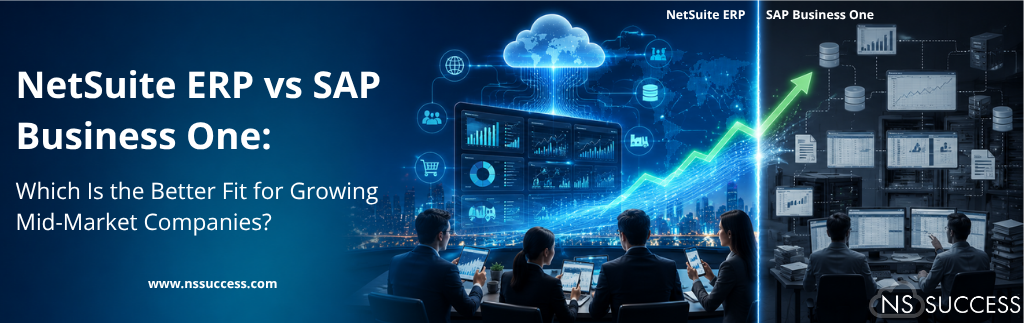
Growing mid-market companies often reach a point where spreadsheets, disconnected tools, and basic accounting systems are no longer enough. As operations become more complex, businesses need an ERP platform that can support finance, inventory, sales, reporting, procurement, and future growth without breaking under the weight of scale.
Two popular ERP options many businesses evaluate are Oracle NetSuite and SAP Business One. Both platforms are well-known in the ERP market, but they are designed with different strengths, architectures, and long-term goals in mind. In this article, we compare NetSuite ERP and SAP Business One across following parameters:
- Scalability
- Deployment model
- Financial management
- Manufacturing and inventory
- Reporting and analytics
- Customization and integrations
- Total cost of ownership
- Ease of use
- Long-term business growth
This guide will help CEOs, CFOs, COOs, and IT leaders make a more informed ERP decision.
Understanding the Needs of a Growing Mid-Market Business
Mid-market businesses face unique challenges. They are growing fast but often have limited resources compared to large enterprises. A company scaling rapidly cannot afford costly ERP failures, prolonged implementations, or systems that require a full-time IT department to maintain. Common operational issues include:
- Manual processes slow productivity across departments
- Poor visibility leading to decisions made on stale or incomplete data
- Difficulty managing inventory and supply chains, resulting in excess stock and missed sales
- Delayed financial reporting that stretches month-end close cycles well beyond acceptable timelines
- Disconnected systems requiring expensive middleware or custom integrations
- Challenges supporting multiple entities or international locations
To solve these problems, businesses need an ERP platform that is scalable, flexible, easy to use, cost-effective, cloud-ready, and future-proof against evolving regulatory requirements. This is why comparing NetSuite ERP and SAP Business One becomes critically important before committing to a multi-year investment.
Overview of NetSuite ERP
What is NetSuite ERP?
Oracle NetSuite is a cloud-native ERP platform designed for fast-growing businesses and enterprises. First launched in 1998 and acquired by Oracle in 2016, NetSuite today serves tens of thousands of organizations across more than 200 countries and territories. NetSuite provides:
- Financial management and multi-entity consolidation
- CRM and customer management
- Inventory and warehouse management
- Procurement and vendor management
- Supply chain management
- Manufacturing support (light and advanced)
- Project management and resource allocation
- Built-in reporting and business intelligence
NetSuite is widely chosen by companies looking for scalability without re-implementation, global operations support, immediate access to financial and operational data, and a cloud-first infrastructure with no on-premise hardware costs.
Overview of SAP Business One
What is (SAP B1) SAP Business One?
SAP Business One is an ERP solution developed by SAP — the world’s largest ERP vendor — and is designed primarily for small and mid-sized businesses at earlier stages of growth. SAP Business One supports:
- Core accounting, financial reporting, and banking
- Sales and purchasing management
- Inventory management and warehouse operations
- Basic manufacturing and production orders
- Standard reporting and dashboards
It is available both as an on-premise deployment (requiring dedicated server infrastructure) and as a cloud-hosted deployment through SAP-certified partners. It is often chosen by companies already familiar with the SAP ecosystem or those in industries where SAP partner networks are well established.
Cloud ERP vs Traditional ERP Approach
One of the biggest architectural differences between NetSuite and SAP Business One is their deployment model — and this difference has significant financial and operational implications.
| Feature | NetSuite ERP | SAP Business One |
|---|---|---|
| Deployment | True cloud-native | Primarily on-premise (cloud via partner) |
| Infrastructure Cost | Included in subscription | Requires dedicated server investment |
| Updates | Automatic, twice yearly | Manual upgrades requiring planned projects |
| Accessibility | Anywhere, any device | Depends on VPN/remote desktop setup |
| Scalability | Highly scalable, on-demand | Moderate — requires hardware upgrades |
| IT Staff Required | Minimal | Dedicated IT resource is typically needed |
| Disaster Recovery | Built-in and included | Requires separate setup and investment |
Why Cloud Architecture Matters Financially
For a growing mid-market company, the hidden costs of an on-premise ERP go far beyond the initial software license. Server hardware, ongoing maintenance, IT staffing, periodic upgrade projects, and downtime during those upgrades all add significantly over time.
A true cloud ERP like NetSuite eliminates most of these costs. With automatic updates deployed twice per year at no additional charge, companies avoid disruptive upgrade projects entirely. NetSuite was built for the cloud from day one, while SAP Business One was originally architected as an on-premise solution. Even cloud-hosted versions of SAP Business One run on partner infrastructure and carry the limitations of software not designed natively for the cloud.
Financial Management Comparison
Finance is the heart of every ERP system, and the sophistication of financial management tools often determines long-term ERP viability as companies grow.
NetSuite Financial Strengths
NetSuite offers a robust financial suite that supports the full spectrum from startup to enterprise-level complexity:
- Real-time financial dashboards — dramatically reduce month-end reporting cycles
- Multi-entity consolidation — manage multiple subsidiaries on one platform, eliminating inter-company reconciliation spreadsheets
- Multi-currency support — transact in virtually any currency with real-time exchange rate feeds
- Automated revenue recognition — compliant with ASC 606 and IFRS 15, reducing manual effort and audit risk
- Advanced financial planning and budgeting — integrated planning tools that replace disconnected spreadsheet models
- Faster financial close — NetSuite customers consistently report significant improvements in close cycle times
For companies with international operations, NetSuite’s built-in global tax engine reduces the compliance burden that would otherwise require significant external consulting support.
SAP Business One Financial Strengths
SAP Business One covers the essentials for smaller, simpler operations:
- Core general ledger, accounts payable, and accounts receivable
- Basic bank reconciliation and cash flow tracking
- Standard profit and loss, balance sheet, and cash flow statements
- Financial reporting through Crystal Reports integration
For companies with straightforward, single-entity financials at earlier revenue stages, SAP Business One’s financial capabilities are often sufficient. However, businesses frequently find themselves investing in additional partner add-ons or customizations to handle more complex scenarios such as multi-entity consolidation, advanced revenue recognition, or inter-company transactions.
Winner for Growing Companies
For businesses planning expansion beyond a single entity or into international markets, NetSuite provides measurably more advanced, scalable, and cost-efficient financial management. The multi-entity and multi-currency capabilities alone can justify the platform for companies anticipating acquisition activity or global expansion.
Inventory and Supply Chain Management
For product-based businesses, inventory accuracy directly impacts profitability. Carrying excess inventory ties up capital while stock-outs cost real revenue.
NetSuite Capabilities
NetSuite provides end-to-end supply chain visibility that addresses both overstocking and stock-out risks:
- Real-time inventory visibility across all warehouses and locations
- Demand planning and forecasting to reduce overstock carrying costs
- Advanced warehouse management, including bin, lot tracking, and serial number management
- Procurement automation to dramatically reduce manual purchase order processing effort
- Multi-location inventory management across any number of warehouse locations
- Supply chain analytics to identify supplier performance issues before they impact production
SAP Business One Capabilities
SAP Business One provides solid foundational inventory management for smaller operations:
- Basic inventory tracking with bin and warehouse support
- Purchasing management and vendor price lists
- Standard warehouse receiving and goods issue
- Inventory valuation (FIFO, LIFO, moving average, standard cost)
- Reporting on inventory levels and turnover
For a business managing inventory across a small number of locations with a manageable product catalog, SAP Business One’s inventory tools are workable. However, businesses that grow beyond this threshold frequently encounter limitations and require third-party warehouse management add-ons, adding further cost and implementation complexity.
Manufacturing Capabilities
Manufacturing companies require deep production management tools, and inefficiency in manufacturing — whether through downtime, material waste, or scheduling errors — directly erodes margins.
NetSuite for Manufacturing
NetSuite’s manufacturing module provides a comprehensive suite for discrete and process manufacturers:
- Multi-level Bills of Materials (BOMs) for complex product assemblies
- Work orders and production scheduling
- Manufacturing routing to track labor and machine time at each production step
- Production cost tracking with actual vs. standard cost visibility
- Demand forecasting to align production schedules with sales pipeline data
- Quality management to track defect rates and initiate corrective actions
NetSuite for manufacturing is particularly well-suited for companies with significant production complexity that would overwhelm a basic ERP.
SAP Business One for Manufacturing
SAP Business One handles light manufacturing scenarios adequately:
- Single-level and multi-level BOMs
- Basic production orders and goods issues
- Inventory consumption tracking during production
- Standard costing support
For companies with simple, repetitive manufacturing processes, SAP Business One’s capabilities may be sufficient. However, manufacturers expecting to add product lines, expand into contract manufacturing, or integrate with Manufacturing Execution Systems (MES) will quickly find the native capabilities limiting. Advanced manufacturing functionality typically requires partner add-ons that introduce additional cost and third-party dependency.
Reporting and Analytics
Real-time business intelligence is no longer a luxury — it is a competitive necessity. Companies that make decisions based on real-time data consistently outperform those relying on periodic, manually assembled reports.
NetSuite Analytics
NetSuite’s reporting and analytics capabilities are embedded throughout the platform:
- Real-time dashboards showing KPIs relevant to each user’s role upon login
- KPI monitoring with threshold alerts when key metrics cross defined boundaries
- Custom saved searches and reports built without IT involvement
- Role-based dashboards tailored to each function (finance, operations, warehouse, etc.)
- SuiteAnalytics for advanced analysis with pivot tables, trend analysis, and data visualization
- Connected financial and operational analytics that link performance to its underlying drivers
SAP Business One Analytics
SAP Business One includes reporting tools that cover standard business needs:
- Pre-built financial and operational reports
- Interactive dashboard widgets
- SAP Crystal Reports integration for custom formatted reports
- SAP HANA analytics (available in the HANA edition) for in-memory processing
Crystal Reports provides powerful formatted reporting, but creating custom reports typically requires a trained specialist. The SAP HANA edition, while powerful, comes at a premium compared to the standard edition.
Scalability for Business Growth
This is arguably the most important consideration for any growing mid-market company. Replacing an ERP system mid-growth is extraordinarily disruptive and expensive — accounting for implementation, data migration, retraining, and lost productivity. Choosing a platform that grows with the business eliminates this risk entirely.
NetSuite Scalability
NetSuite is architected to grow alongside the business — from an early-stage company to a large enterprise — on the same platform:
- Support for multi-country operations with localized compliance across 200+ countries
- Multi-subsidiary management — add new entities quickly without a separate project
- Global tax compliance across VAT, GST, withholding tax, and more
- Rapid user expansion with no professional services required for standard user additions
- Support for new business models — subscription billing, project billing, eCommerce — without re-implementation
NetSuite has supported companies through IPOs, international expansions, and substantial revenue growth without requiring a platform change. This “grow-in-place” capability has significant financial value by eliminating the cost and disruption of a future ERP replacement.
SAP Business One Scalability
SAP Business One can scale to a certain extent, but growing organizations frequently encounter constraints:
- Performance can degrade with large concurrent user counts
- High-volume transaction processing can create issues in on-premise deployments
- Infrastructure scaling requires hardware investment
- As companies grow past a certain revenue threshold, SAP Business One often requires significant partner add-ons to match the native capabilities of enterprise-grade ERPs
Many companies using SAP Business One eventually migrate to SAP S/4HANA — a large-scale migration project that is costly and disruptive by nature.
Ease of Use and User Experience
ERP adoption is only as good as user acceptance. Research consistently shows that poor user adoption is a primary cause of ERP implementations failing to meet their objectives. The cost of low adoption — including workarounds, shadow IT, and maintained manual processes — can eliminate any efficiency gains the ERP was intended to create.
NetSuite User Experience
- Modern, browser-based web interface — no client software installation required
- Mobile-responsive design — accessible from smartphones and tablets
- Role-based personalization — users see only the information and tools relevant to their role
- Guided onboarding and in-app help to reduce training time
- SuiteSuccess methodology — pre-configured industry-specific setups reduce implementation time significantly
SAP Business One User Experience
- Traditional Windows client interface — familiar to users with prior SAP experience but can feel dated compared to modern cloud applications
- Web client available, though some features remain Windows-only
- Structured workflow that follows traditional ERP process flows, requiring more formal training
- Training investment is typically higher per user compared to modern cloud ERP platforms
For companies hiring employees accustomed to modern cloud applications, NetSuite’s interface presents a lower adoption barrier.
Customization and Integration
No ERP works perfectly out of the box for every business. The ability to customize workflows and integrate with other business systems is critical for mid-market companies that have already invested in specialized tools.
NetSuite Customization and Integration
- SuiteScript — JavaScript-based development platform for custom business logic
- SuiteFlow — visual workflow automation for creating approval processes without coding
- SuiteBuilder — drag-and-drop form and field customization for non-developers
- REST and SOAP APIs — industry-standard integration interfaces supported by virtually all middleware platforms
- SuiteApp marketplace — hundreds of certified partner applications for specialized functions
- Native integrations — pre-built connectors for Salesforce, Shopify, Amazon, Avalara, and many other platforms
NetSuite’s open, well-documented API framework makes integrations with third-party systems more straightforward and generally less costly than on platforms with more proprietary architectures.
SAP Business One Customization and Integration
- SAP Business One SDK — .NET-based development framework for custom extensions
- DI API and UI API — programmatic access to data and interface components
- Service Layer — RESTful API introduced in recent versions
- Add-On marketplace — SAP partner ecosystem with a wide range of certified add-ons
SAP Business One’s customization is well-supported but typically requires specialized SAP developers, which can be a smaller talent pool compared to the broader developer community familiar with JavaScript-based platforms like NetSuite.
Total Cost of Ownership (TCO)
ERP pricing is rarely as simple as the license or subscription fee. A proper TCO analysis must account for all costs over a multi-year period — the typical planning horizon for an ERP investment.
Key Cost Factors for NetSuite
- Subscription-based model that scales with the organization
- No hardware infrastructure costs
- No periodic upgrade project costs — updates are delivered automatically
- Reduced IT staffing requirements compared to on-premise alternatives
- Implementation costs reflecting the scope and complexity of the deployment
- Ongoing customization and support investment depending on business needs
Key Cost Factors for SAP Business One
- Software licensing (perpetual or subscription depending on model chosen)
- Annual maintenance fees on perpetual licenses
- Server hardware and infrastructure investment for on-premise deployments
- Periodic upgrade projects and associated consulting costs
- Partner add-on licensing for functionality beyond the core product
- IT staffing to manage and maintain infrastructure
- Implementation and customization investment
TCO Verdict
While SAP Business One’s upfront licensing can appear lower on the surface, the total multi-year cost of ownership — when accounting for infrastructure, IT staffing, maintenance, upgrade projects, and partner add-ons — often proves higher than NetSuite for a comparable deployment. Growing companies in particular should model these costs over a five-year horizon rather than focusing on initial license fees alone.
Implementation Timeline and Risk
Implementation time and project risk are often overlooked in ERP evaluations, yet a failed or delayed implementation can cost a mid-market company significantly in lost productivity, consulting overruns, and delayed business benefits.
NetSuite Implementation
- SuiteSuccess methodology with pre-configured industry templates reduces time to go-live
- Standard implementations typically complete within three to six months; complex multi-entity deployments may take longer
- Cloud deployment eliminates infrastructure risk from the project scope
- Frequent milestone releases reduce overall project risk
SAP Business One Implementation
- Implemented exclusively through SAP-certified partners
- Standard implementations typically complete within two to four months; complex or heavily customized deployments can take longer
- On-premise infrastructure setup, data migration complexity, and customization scope are primary risk drivers
Industry-Specific Capabilities
NetSuite Industry Verticals
NetSuite offers pre-built, industry-specific configurations (SuiteSuccess editions) for:
- Software and SaaS
- Wholesale distribution
- Manufacturing
- Retail and eCommerce
- Professional services
- Nonprofit
Each industry edition comes pre-configured with relevant workflows, KPIs, and reports, reducing implementation time and configuration effort significantly.
SAP Business One Industry Verticals
SAP Business One is supported by a broad partner ecosystem offering industry add-ons for:
- Manufacturing and production
- Retail and distribution
- Construction and real estate
- Professional services
- Food and beverage
Industry-specific functionality in SAP Business One typically requires certified partner add-ons, which carry additional licensing costs and are maintained by third-party vendors rather than SAP directly — introducing additional risk if a partner discontinues or changes a product.
Which ERP Is Better for a Growing Mid-Market Company?
The answer ultimately depends on where your business is today and where it intends to go.
Choose NetSuite If You Need:
- Cloud-first ERP with zero on-premise infrastructure
- Rapid scalability to support significant revenue growth on the same platform
- Global operations across multiple entities, currencies, or countries
- Advanced financial management including revenue recognition and multi-entity consolidation
- Real-time visibility for faster, data-driven decision-making
- Strong manufacturing and supply chain capabilities without expensive add-ons
- Lower long-term TCO compared to on-premise alternatives
- Minimal IT dependency and infrastructure investment
Best for: Companies in the mid-market range planning growth, international expansion, or increasing operational complexity.
Choose SAP Business One If You Need:
- Basic, reliable ERP functionality for a single-entity operation
- Smaller operational scope with simple financial and inventory processes
- Alignment with an existing SAP partner network or ecosystem
- Traditional on-premise deployment preference
Best for: Smaller companies with stable, predictable operations and no near-term plans for significant growth or expansion.
Real-World ROI Indicators
Companies that implement NetSuite commonly report the following measurable outcomes within the first one to two years of go-live:
- Significantly reduced financial close cycles — from weeks to just a few business days
- Lower inventory carrying costs through better demand planning
- Reduced manual processing effort across procurement and operations
- Elimination of manual reporting burden across finance and operations teams
- Reduced IT infrastructure and maintenance overhead
For growing mid-market companies, these combined efficiency gains typically produce strong ROI with payback often achievable within two to three years of go-live.
Final Thoughts
Both Oracle NetSuite and SAP Business One are capable, proven ERP platforms with large installed bases and strong partner networks.
However, for growing mid-market businesses — particularly those planning to cross meaningful revenue milestones — NetSuite provides:
- Better scalability without re-implementation
- Stronger cloud architecture with no infrastructure overhead
- More advanced financial tools for complex, multi-entity operations
- Lower total cost of ownership over a multi-year period
- Greater flexibility for long-term growth, new business models, and international expansion
SAP Business One remains a solid choice for smaller businesses with straightforward operations and a strong preference for the SAP ecosystem — but businesses planning aggressive growth will likely outgrow it faster than expected, ultimately facing a costly migration to SAP S/4HANA or a competing platform.
The cost of choosing the wrong ERP — and replacing it within five years — is substantial for any mid-market company. Getting it right the first time pays dividends for a decade or more.
Conclusion
Choosing the right ERP is one of the most important strategic investments a growing company will make — often ranking alongside hiring decisions and capital expenditure in terms of long-term business impact.
The best ERP is not just the one that solves today’s problems. It is the one that supports tomorrow’s growth without requiring a costly, disruptive platform change at exactly the moment when your business can least afford the distraction.
For organizations prioritizing scalability, cloud flexibility, operational visibility through real-time analytics, and long-term cost efficiency, Oracle NetSuite consistently emerges as the stronger strategic choice for mid-market companies with growth ambitions.
Evaluating ERP platforms for your growing business? Dhruvsoft / NSSuccess helps organizations assess, implement, and optimize Oracle NetSuite for long-term growth and operational efficiency. Our team of certified NetSuite consultants has guided companies from their first ERP implementation through multi-entity global roll-outs. Connect with our NetSuite experts today to get a customized analysis and find the right ERP strategy for your business.

 “NS Success” is the NetSuite Consulting Practice of Dhruvsoft Services Private Limited – a leading NetSuite Solution Provider Partner from India – providing services worldwide …