

Why you need an ERP that Supports Business Growth and Global Expansion
Growth Demands a Scalable ERP Foundation
Business growth brings opportunity, but it also exposes weaknesses in systems, processes, and data management. Many organizations begin with simple accounting tools or entry-level ERP systems that work well during early stages. However, as the business grows—by adding customers, locations, products, or entities—these systems struggle to keep up.
Growth increases transaction volumes, reporting requirements, compliance obligations, and the need for real-time visibility. When systems are not designed to scale, growth creates friction instead of momentum. Finance teams become reactive, operations lose efficiency, and leadership decisions are delayed.
Why Scaling Businesses Outgrow Legacy Systems
Legacy systems are usually designed for stable, single-entity operations. They rely heavily on manual work, custom scripts, and offline spreadsheets to fill functional gaps. As the business scales, these limitations become critical risks. Data duplication increases, reconciliation takes longer, and system performance degrades.
Instead of enabling growth, legacy systems slow it down by increasing operational overhead and reducing decision confidence.
Challenges of Expansion
Expansion introduces:
- Data silos, where finance, sales, inventory, and operations operate on disconnected systems
- Manual processes, which increase error rates and reduce efficiency
- Limited visibility making it difficult to understand profitability, cash flow, and performance across regions
Without a scalable ERP, leadership lacks a single, reliable version of the truth.
ERP as a Growth Enabler
A modern ERP must go beyond transaction processing. It must:
- Support growth without reimplementation
- Provide real-time insights
- Enable global operations
- Reduce risk through automation and controls
Oracle NetSuite was designed specifically to meet these requirements.
Common Challenges Businesses Face During Expansion
Expansion magnifies existing inefficiencies. What was manageable at a smaller scale becomes a serious obstacle as volume and complexity increase.
Operational Complexity Increases with Growth
- Multiple Entities, Locations, and Business Units: As companies grow, they often operate through multiple legal entities, subsidiaries, or divisions. Each entity may have its own reporting requirements, currencies, tax structures, and operational workflows.
- Managing these separately leads to inconsistency and inefficiency. Without a centralised system, teams struggle to coordinate activities across entities, leading to delays and errors.
- Disconnected Finance, Sales, Inventory, and Operations: When departments use different systems, information does not flow smoothly. Sales forecasts may not align with inventory availability. Finance may not have real-time visibility into operational performance. This disconnect creates operational blind spots that limit scalability.
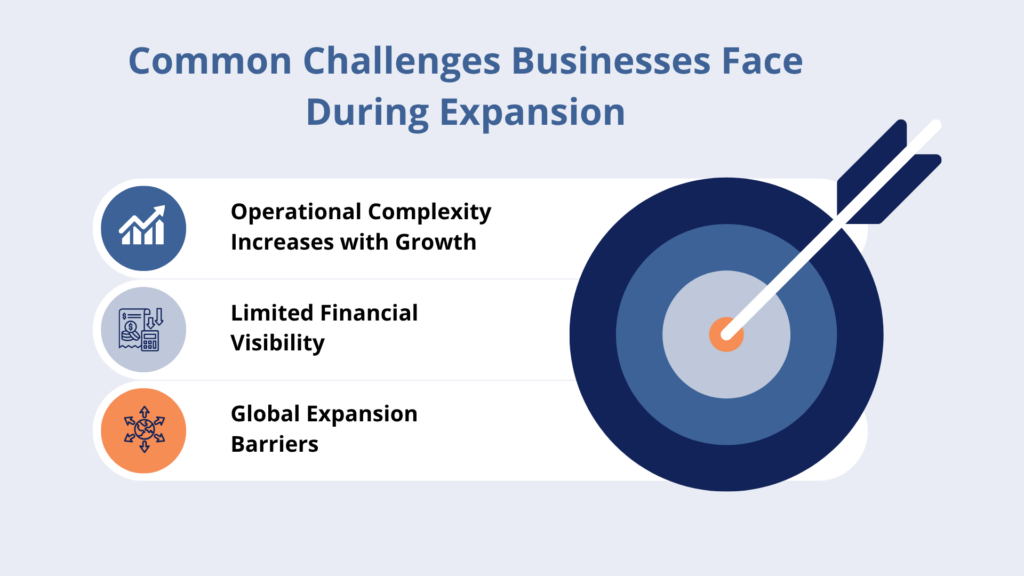
Limited Financial Visibility
- Delayed Consolidation: Manual consolidation across subsidiaries often takes weeks. By the time reports are ready, the data is already outdated, limiting its usefulness for decision-making.
- Inaccurate Forecasting: Without real-time, unified data, forecasts are based on assumptions rather than actual performance. This increases financial risk, especially during expansion.
- Manual Reporting: Heavy reliance on spreadsheets increases errors, reduces consistency, and consumes valuable finance resources that should focus on strategy.
Global Expansion Barriers
- Multi-Currency and Multi-Tax Compliance: Operating across borders introduces currency volatility and complex tax rules. Manual handling increases the risk of misstatements and penalties.
- Country-Specific Regulations: Each country has its own statutory reporting, audit, and compliance requirements. Managing these without automation creates operational strain.
- Lack of Standardized Processes: Without standardisation, each region operates differently, making global oversight difficult and reducing efficiency.
Why Oracle NetSuite is Designed for Scaling Businesses
Technology that Support Scale & Expansion
Cloud-Native, Unified ERP Platform
- Single Source of Truth Across Departments : NetSuite integrates finance, CRM, inventory, procurement, and operations into a single platform. This eliminates data silos and ensures everyone works from the same data set.
- Real-Time Data Access for Leadership : Executives can access live dashboards showing revenue, profitability, cash flow, and operational KPIs. This enables faster and more confident decisions.
- No Infrastructure Limitations : Because NetSuite is cloud-native, businesses can scale users, transactions, and entities without worrying about hardware, upgrades, or system performance.
Modular Architecture
- Start Small, Scale Functionality as Business Grows : Organizations can implement only what they need today and expand functionality as requirements evolve. This reduces upfront cost and implementation risk.
- Finance, CRM, Inventory, Procurement, PSA, and More ; Each module integrates seamlessly, ensuring that expansion does not create new silos.
Built for High-Growth and Global Companies
- Supports Startups, Mid-Market, and Enterprises: NetSuite adapts to different growth stages, allowing companies to remain on the same ERP platform as they scale.
- Used by Fast-Scaling and Multinational Organizations: Its architecture is proven across industries and regions, making it a long-term ERP choice.
Supporting Multi-Entity and Multi-Subsidiary Growth
OneWorld for Global Operations
- Multi-Subsidiary Management: NetSuite OneWorld allows multiple subsidiaries to operate within a single system while maintaining local compliance.
- Real-Time Consolidation: Financial results are consolidated automatically, providing immediate visibility across the organization.
- Shared Services Model: Finance, procurement, and HR can be centralised while supporting local operations.
Multi-Currency and Multi-Tax Capabilities
- Automated Currency Conversion: NetSuite manages exchange rates automatically, reducing manual effort and errors.
- Local Tax Compliance: Country-specific tax rules are built into the system, supporting accurate reporting.
- Country-Specific Reporting: Local statutory reports can be generated without manual adjustments.
Standardization Across Entities
- Consistent Chart of Accounts: A standardised Chart of Accounts ensures uniform financial reporting across all entities. This improves consolidation accuracy and simplifies multi-entity management. Leadership gains reliable global visibility with consistent financial data.
- Centralized Governance with Local Flexibility: Corporate policies, controls, and compliance standards are maintained centrally. Simultaneously, regional teams retain flexibility to meet local regulatory and operational requirements. This balance supports global oversight without limiting local agility.
Scaling Financial Operations with NetSuite
Faster Financial Close
- Automated Journal Entries: With Oracle NetSuite, recurring and complex journal entries are automated based on predefined rules. This reduces repetitive manual posting and minimises accounting errors. Finance teams gain consistency and accuracy across reporting periods.
- Inter-company Eliminations: Transactions between subsidiaries are automatically identified and eliminated during consolidation. This ensures accurate financial statements without manual adjustments. Multi-entity reporting becomes faster and more reliable.
- Reduced Manual Effort: Automation streamlines reconciliation, validation, and reporting processes. Finance teams spend less time on corrections and more time on analysis. As a result, books are closed faster with improved accuracy and control.
Real-Time Financial Visibility
- Consolidated Dashboards: With Oracle NetSuite, leadership gains instant access to consolidated financial dashboards. Performance across regions, subsidiaries, and business units can be monitored in real time. This enables faster strategic decisions based on accurate, up-to-date data.
- Profitability Analysis: NetSuite provides detailed profitability insights by product, region, customer, or business unit. Decision-makers can analyse margins, costs, and revenue drivers at multiple levels. This level of visibility supports smarter investments and improved financial performance.
Planning and Forecasting for Growth
- Scenario-Based Forecasting: With Oracle NetSuite, organizations can model multiple growth and expansion scenarios using real-time financial data. Leaders can assess the impact of new markets, product launches, or acquisitions before making commitments. This enables proactive planning and reduces financial risk.
- Budgeting Aligned to Expansion Plans: Budgets can be dynamically adjusted as growth strategies evolve. Forecasts, revenue projections, and expense plans stay aligned with changing business priorities. This ensures financial planning remains flexible, accurate, and strategically driven.
Supporting Operational and Supply Chain Expansion
Inventory and Warehouse Scalability
- Multi-Location Inventory Tracking: With Oracle NetSuite, inventory levels are tracked in real time across multiple warehouses, locations, and regions. Businesses gain full visibility into stock availability and movement. This reduces stockouts, overstocking, and fulfilment delays.
- Demand Planning and Replenishment: NetSuite supports intelligent demand planning based on historical trends and sales forecasts. Automated replenishment ensures optimal stock levels as operations scale. This helps balance supply and demand while maintaining operational efficiency.
Order Management Across Regions
Global Order Processing: With Oracle NetSuite, orders are processed consistently across countries, subsidiaries, and currencies. Standardized workflows ensure accuracy from order capture to invoicing. This provides global visibility while maintaining local operational control.
Cross-Border Fulfilment: NetSuite supports complex fulfilment models, including multi-warehouse and international shipping. Orders can be routed based on inventory availability, region, or logistics rules. This enables efficient cross-border operations while maintaining customer satisfaction.
Vendor and Procurement Expansion
- Global Supplier Management: With Oracle NetSuite, vendor information and procurement activities are centralised across entities and regions. Organizations gain a single view of supplier performance, contracts, and purchase history. This improves negotiation power, consistency, and supplier accountability.
- Cost Control and Spend Visibility: NetSuite provides real-time visibility into procurement spending across departments and subsidiaries. Approval workflows and budget controls ensure disciplined purchasing practices. As procurement scales, organizations maintain financial control and prevent cost leakage.
Enabling Global Compliance and Governance
Built-In Compliance Frameworks
- Audit Trails: With Oracle NetSuite, every transaction is automatically recorded and traceable. Changes to financial records are logged with user details and timestamps. This ensures full transparency and simplifies internal and external audits.
- Role-Based Access: Access to data and system functions is controlled based on user roles and responsibilities. Employees only see and act on information relevant to their position. This strengthens governance and reduces operational risk.
- Financial Controls: Automated approval workflows enforce segregation of duties and authorization limits. Transactions must pass predefined control checkpoints before completion. This reduces the risk of errors, fraud, and policy violations.
Regulatory Readiness
- Local Statutory Reporting: With Oracle NetSuite, organizations can generate country-specific statutory reports aligned with regional regulations. Financial data is structured to meet local compliance standards without manual adjustments. This simplifies regulatory reporting across multiple jurisdictions.
- Tax and Audit Support: NetSuite supports automated tax calculations and structured audit trails. Financial records remain transparent, consistent, and easily traceable. This reduces audit effort, minimises compliance risk, and improves overall financial governance.
Security and Data Governance
- Centralized Controls: With Oracle NetSuite, governance policies and system controls are managed centrally across all entities. Standardized rules ensure consistent enforcement of financial, operational, and access policies. This strengthens oversight while maintaining global compliance.
- Secure Access Across Geographies: NetSuite enables secure system access for users across different countries and locations. Data is protected through controlled permissions, authentication, and secure infrastructure. This ensures business information remains safeguarded, regardless of where teams operate.
Supporting Mergers, Acquisitions, and New Market Entry
Rapid Onboarding of New Entities
- Faster System Integration: With Oracle NetSuite, newly acquired or formed entities can be integrated into the existing ERP environment quickly. Standardized templates and multi-entity configurations accelerate setup. This reduces the time required to align financials, processes, and reporting structures.
- Minimal Disruption to Operations: Integration is managed without interrupting ongoing business activities. Core processes such as billing, procurement, and reporting continue smoothly during onboarding. This ensures business continuity while enabling structured expansion.
Post-Merger Financial Integration
- Unified Reporting: With Oracle NetSuite, financial data from merged entities is consolidated into a single reporting structure. Leadership gains a unified view of performance across all business units. This improves transparency, alignment, and strategic decision-making.
- Consolidated Financial Statements: NetSuite automates multi-entity consolidation, including intercompany eliminations and currency adjustments. Accurate post-merger financial statements can be generated without manual reconciliation. This ensures compliance, consistency, and confidence in reporting after integration.
Case Study: How Consulting Firm Scaled and Expanded with Oracle NetSuite
Real-world examples help illustrate how NetSuite supports growth in practical, measurable ways. This case study reflects a common situation faced by fast-growing organizations across industries such as IT services, SaaS, professional services, and distribution.
Business Challenge
Rapid Geographic Expansion
The organization was expanding into multiple regions within a short period. New offices and subsidiaries were being set up across different countries, each with its own currency, tax rules, and reporting requirements. While revenue was growing, the lack of a unified system made it difficult to manage expansion efficiently.
Leadership struggled to answer basic questions such as:
- How is each region performing financially?
- Which markets are profitable?
- What is the true cost of expansion?
Without centralised systems, growth decisions carried high risk.
Manual Financial Consolidation
Each subsidiary maintained its own accounting records using separate systems and spreadsheets. At month-end, finance teams manually consolidated data, often taking several weeks to close the books.
This delay meant:
- Reports were outdated by the time they reached leadership
- Errors were common due to manual handling
- Finance teams were overburdened with reconciliation work
Instead of supporting strategic planning, finance was stuck in operational firefighting.
Disconnected Systems
Sales, finance, and operations used different tools that did not integrate well. Sales forecasts were not aligned with financial projections. Operational costs were not visible in real time. This disconnect reduced confidence in decision-making and limited the organization’s ability to scale predictably.
NetSuite Implementation Approach
OneWorld Deployment
The organization implemented NetSuite OneWorld to manage all subsidiaries within a single ERP platform. Each entity was configured to meet local statutory and tax requirements while still rolling up into a centralised financial structure.
This approach allowed:
- Local compliance without sacrificing global visibility
- Faster onboarding of new entities
- Centralized financial governance
Standardized Financial and Operational Processes
Core finance and operational processes were standardised across all regions. This included:
- A consistent chart of accounts
- Standard revenue recognition rules
- Unified procurement and expense workflows
Standardization reduced confusion, improved reporting accuracy, and enabled shared services across regions.
Real-Time Analytics for Leadership
Executive dashboards were configured to provide real-time insights into:
- Revenue and profitability by region
- Cash flow and working capital
- Operational KPIs
Leadership gained immediate visibility into business performance, enabling faster and more confident decisions.
Business Outcomes
- Faster Close Cycles: With automated consolidations and intercompany eliminations, the month-end close cycle was reduced from weeks to days. Finance teams could focus on analysis rather than data preparation.
- Improved Global Visibility: Leadership gained a single, reliable view of the business across all regions. Performance issues were identified early, and corrective actions were taken before problems escalated.
- Scalable Foundation for Continued Growth: Most importantly, the organization built an ERP foundation that could support future expansion without reimplementation. New entities, markets, and business models could be added seamlessly.
Key Best Practices for Scaling & Expansion with Oracle NetSuite
Each best practice ensures long-term success:
- Designing for future growth avoids rework
- Standardization across subsidiaries, geography, and functions improves efficiency
- Automation reduces cost and risk
- Analytics enable proactive leadership
- Training ensures adoption
Why Partner with Dhruvsoft
Scaling NetSuite successfully requires experience. Dhruvsoft provides:
- Deep NetSuite expertise
- Capability to support Global projects
- Industry-aligned solutions
- Ongoing optimization and support
Conclusion
Growth without scalable systems creates risk. Oracle NetSuite provides a future-ready ERP platform that grows with your business.
Want to Scale and Expand with Oracle NetSuite? With the right partner, organizations can expand confidently, efficiently, and securely.
 “NS Success” is the NetSuite Consulting Practice of Dhruvsoft Services Private Limited – a leading NetSuite Solution Provider Partner from India – providing services worldwide …