
For many years, business success was measured almost entirely by growth. Revenue increases, market expansion, customer acquisition, and rapid scaling were the primary indicators of performance. Today, that definition has fundamentally changed. Growth alone is no longer enough—businesses are expected to grow responsibly and sustainably.
Regulators are introducing stricter environmental and compliance requirements. Investors are increasingly evaluating organizations based on ESG (Environmental, Social, and Governance) performance. Customers are choosing brands that demonstrate ethical practices, transparency, and long-term responsibility. Employees, too, want to work for organizations that align with sustainable values.
As a result, leadership teams are under pressure to balance aggressive growth targets with environmental responsibility, operational efficiency, and governance standards. However, many organizations struggle to achieve this balance. Rapid growth often introduces inefficiencies, higher costs, fragmented systems, and limited visibility into resource usage.
This is where Oracle NetSuite plays a critical role. As a cloud-based ERP platform, NetSuite enables organizations to scale while maintaining transparency, control, and sustainability. It connects finance, supply chain, procurement, and operations into a single system, making sustainable growth measurable, manageable, and achievable.
In this article, we explore:
- Why sustainability and growth are often seen as competing goals
- The challenges growing organizations face
- How Oracle NetSuite supports sustainability initiatives
- Practical strategies for achieving scalable, responsible growth
- Why the right NetSuite partner matters for long-term success
The Sustainability–Growth Challenge for Modern Enterprises
Why Fast Growth Often Creates Sustainability Problems
Fast-growing organizations often prioritise speed and expansion over efficiency. While this approach may deliver short-term gains, it can also introduce long-term risks:
- Higher operational costs
- Excess inventory and waste
- Manual processes that do not scale
- Compliance gaps and reporting challenges
Without strong systems in place, growth can lead to inefficiency instead of value creation.
The Myth: Sustainability Slows Down Growth
A common misconception is that sustainability initiatives slow down business growth or increase costs. Many leaders view sustainability as a compliance burden or a reporting requirement rather than a strategic advantage.
The Reality: Sustainable Operations Enable Long-Term Growth
In reality, sustainability supports long-term resilience. Organizations that manage resources efficiently, reduce waste, and improve visibility are better positioned to scale. Sustainable operations lead to:
- Better cost control
- Improved risk management
- Stronger brand trust
- Long-term profitability
The Role of ERP Systems
ERP systems play a central role in aligning growth with sustainability. By standardising processes and centralising data, ERP platforms enable organizations to grow without losing control. Oracle NetSuite, in particular, provides the foundation needed to connect operational efficiency with sustainability goals.
Key Sustainability Challenges Faced by Growing Organizations
As organizations scale, sustainability challenges become more complex and harder to manage.
Limited Visibility into Resource Usage
Many organizations lack real-time insight into how resources are consumed across departments and locations. This makes it difficult to identify waste, inefficiencies, or improvement opportunities.
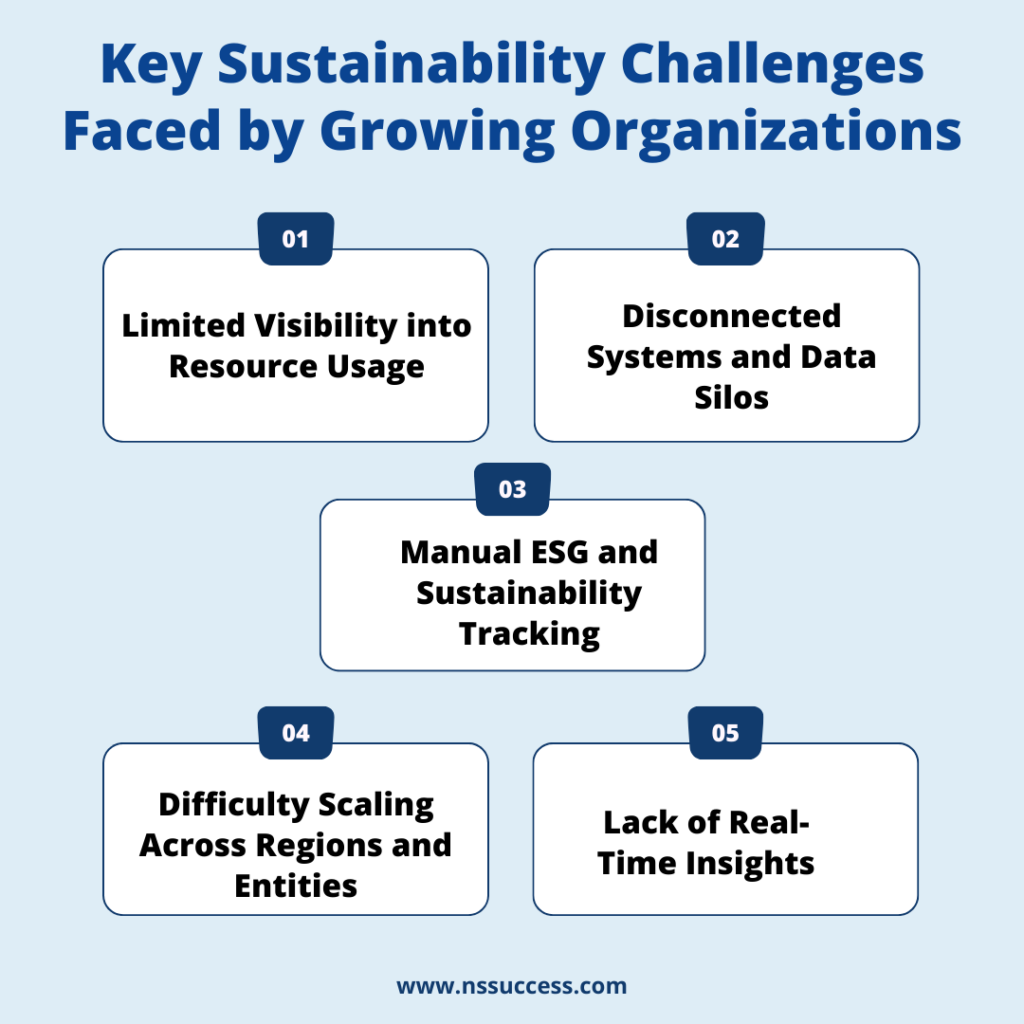
Disconnected Systems and Data Silos
Finance, supply chain, procurement, and operations often operate on separate systems. This fragmentation prevents organizations from understanding the full impact of sustainability initiatives.
Manual ESG and Sustainability Tracking
Tracking ESG metrics using spreadsheets or manual processes is time-consuming, error-prone, and difficult to scale. It also increases audit and compliance risk.
Difficulty Scaling Across Regions and Entities
As companies expand globally, managing sustainability consistently across subsidiaries, currencies, and regulatory environments becomes a major challenge.
Lack of Real-Time Insights
Without real-time dashboards and analytics, leadership teams struggle to measure whether sustainability initiatives are delivering meaningful results.
Why Oracle NetSuite Is Critical for Sustainable Growth
A Single Source of Truth (SSOT)
Oracle NetSuite acts as a single source of truth across finance, supply chain, procurement, and operations. This unified view enables better decision-making and reduces data inconsistencies.
Cloud-Native and Energy Efficient
As a cloud ERP, NetSuite reduces the need for energy-intensive on-premise infrastructure. This lowers IT overhead while supporting environmentally responsible operations.
Standardized Yet Scalable Processes
NetSuite enables standardised workflows across the organization while still supporting rapid expansion. This consistency is critical for sustainable growth.
Real-Time Visibility for Leadership
With real-time dashboards and analytics, leadership teams can make informed decisions that consider both growth and sustainability impacts.
How Oracle NetSuite Supports Sustainability Initiatives
Resource Optimization and Waste Reduction
NetSuite helps organizations use resources more efficiently by aligning supply with actual demand.
Inventory and demand planning reduce overproduction and excess stock.
Better forecasting minimises waste across procurement and operations.
Real-time inventory visibility helps avoid overstocking and shortages.
By reducing waste and improving planning accuracy, organizations can lower costs while supporting sustainability goals.
Sustainable Supply Chain Management
Supply chains play a major role in sustainability outcomes.
NetSuite enables organizations to:
- Track supplier performance and compliance centrally
- Improve sourcing transparency and accountability
- Support responsible procurement practices
With centralised supplier data, organizations can make informed decisions about ethical sourcing and long-term partnerships.
Financial Transparency for Sustainability Decisions
Sustainability initiatives must be financially measurable to gain leadership support.
NetSuite allows organizations to:
- Measure the financial impact of sustainability programs
- Link cost control, efficiency gains, and sustainability outcomes
- Justify sustainability investments with accurate data
This transparency helps finance leaders connect sustainability with profitability.
ESG and Regulatory Reporting Enablement
As ESG requirements evolve, reporting accuracy becomes critical.
NetSuite provides:
- Centralized, accurate data for audit and ESG reporting
- Reduced manual effort and reporting risk
- Support for changing regulatory and compliance requirements
This ensures organizations are always prepared for audits and disclosures.
How NetSuite Enables Scalable, Responsible Growth
Standardized Processes Across the Organization
Standardized processes ensure consistency as organizations grow.
NetSuite enables:
- Consistent workflows across departments and geographies
- Faster onboarding of new subsidiaries and business units
- Reduced operational risk during expansion
Real-Time Analytics and Forecasting
Growth without visibility creates risk.
NetSuite analytics help organizations:
- Monitor growth trends and operational strain
- Track resource utilization
- Identify risks early and take corrective action
Automation for Operational Efficiency
Automation is key to scaling responsibly.
NetSuite automates:
- Finance and accounting processes
- Procurement and approvals
- Operational workflows
This reduces manual effort, errors, and overhead while improving efficiency.
A Practical Framework: Balancing Sustainability and Growth with NetSuite
Balancing growth and sustainability requires a clear framework. Organizations need structure, data, and continuous visibility. Oracle NetSuite provides the foundation to manage both together.
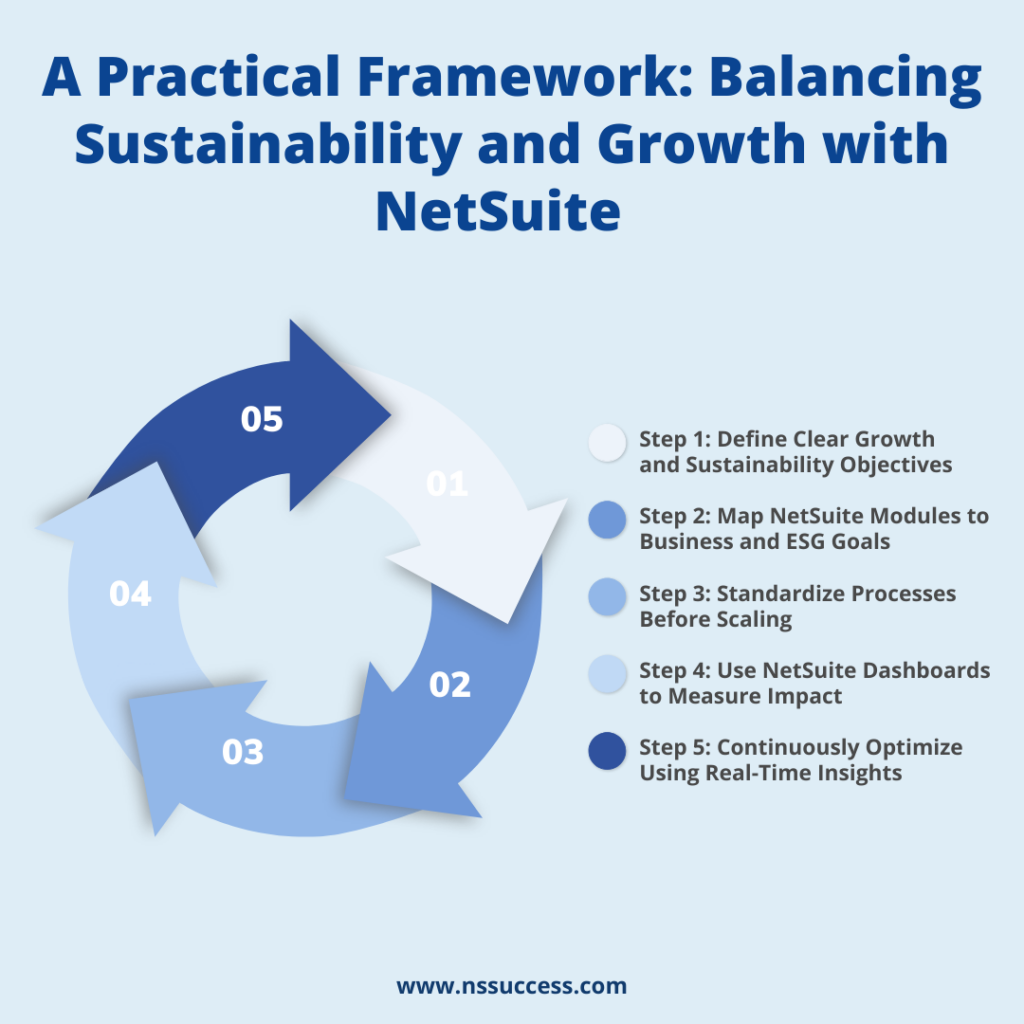
Step 1: Define Clear Growth and Sustainability Objectives
The first step is leadership alignment. Growth and sustainability goals must be defined together, not separately.
This includes:
- Revenue and market expansion goals
- Cost control and efficiency targets
- Environmental and ESG commitments
- Compliance and reporting requirements
When leadership agrees on shared objectives, NetSuite can be configured to support both business growth and responsible operations from the start.
Step 2: Map NetSuite Modules to Business and ESG Goals
Each NetSuite module should serve a clear purpose. Growth and sustainability goals must be translated into system usage.
For example:
- Financial Management tracks profitability, cost control, and reporting
- Supply Chain modules improve sourcing efficiency and reduce waste
- Inventory management helps avoid overstock and excess consumption
- Project and resource tracking supports efficient utilization
This ensures NetSuite is not just an ERP system, but a business and sustainability enablement platform.
Step 3: Standardize Processes Before Scaling
Scaling without standard processes creates inefficiency and risk. Before expanding, organizations must standardise how work is done.
NetSuite helps standardise:
- Financial close and reporting
- Procurement and vendor management
- Inventory and order fulfilment
- Approval workflows and controls
Standardization reduces errors, improves compliance, and ensures consistent execution as the business grows.
Step 4: Use NetSuite Dashboards to Measure Impact
You cannot manage what you cannot measure. NetSuite interactive dashboards provide real-time visibility into performance and impact.
Dashboards help track:
- Revenue growth and margins
- Operating costs and efficiency
- Resource usage and waste
- Compliance and sustainability metrics
This allows leaders to see the impact of decisions clearly and make adjustments early.
Step 5: Continuously Optimize Using Real-Time Insights
Sustainable growth is not a one-time project. It is an ongoing process.
With real-time NetSuite data, organizations can:
- Identify inefficiencies quickly
- Adjust processes as the business evolves
- Improve cost control without slowing growth
- Strengthen sustainability performance over time
NetSuite supports continuous improvement by turning data into action, not just reports.
Common Mistakes Organizations Make
Many sustainability initiatives fail not because of lack of intent but because of avoidable execution mistakes. When using Oracle NetSuite, organizations must be careful to avoid the following issues.
- Treating sustainability as a reporting-only activity
Some organizations track sustainability only for compliance reports. They do not connect it to daily operations. This limits real impact and long-term value. - Scaling without standardised ERP processes
Growth without standard processes creates inefficiency and risk. Without standard workflows in NetSuite, sustainability efforts become inconsistent and hard to manage. - Over-customizing NetSuite and reducing flexibility
Too much customization makes the system complex. It becomes difficult to adapt as the business grows or regulations change. Simple and scalable designs work best. - Ignoring user adoption and change management
Even the best system fails if people do not use it properly. Lack of training and communication leads to poor data and weak execution. - Failing to link sustainability metrics with financial KPIs
Sustainability data must connect to cost, revenue, and profitability. When ESG metrics are isolated from financial KPIs, leadership cannot see real business value.
Avoiding these mistakes is essential for building sustainable, scalable, and measurable growth.
Leadership’s Role in Driving Sustainable ERP Adoption
Successful and sustainable ERP adoption is not just a technology decision. It requires strong leadership alignment across the organization. When leaders work together, Oracle NetSuite delivers long-term value, not just short-term efficiency.
CEOs and COOs
CEOs and COOs set the overall direction for the business. Their role is to ensure that growth plans do not compromise operational discipline or sustainability goals.
They must:
- Align business growth with responsible operations
- Balance speed with control and compliance
- Make sustainability part of core business strategy
When leadership sets the right tone, ERP adoption supports both growth and long-term stability.
CFOs
CFOs play a key role in making sustainability measurable and meaningful. Sustainability initiatives must be financially visible and justified.
Their focus includes:
- Linking sustainability goals to financial KPIs
- Tracking cost savings and efficiency gains
- Ensuring transparency and audit readiness
This helps leadership see sustainability as a business value driver, not just a cost.
CIOs
CIOs are responsible for building the right technology foundation. With NetSuite, this means creating an architecture that is secure, scalable, and ready for future needs.
Their responsibilities include:
- Ensuring system scalability as the business grows
- Maintaining data security and compliance
- Supporting integrations and future enhancements
A strong technical foundation ensures ERP can support sustainability over the long term.
Cross-Functional Collaboration
Sustainable ERP success cannot be owned by one department alone. Finance, operations, supply chain, IT, and leadership must work together.
Cross-functional collaboration ensures:
- Shared goals and consistent execution
- Better data quality across departments
- Faster decision-making and issue resolution
When teams collaborate around a single ERP platform, sustainability becomes part of daily operations—not a separate initiative.
Why the Right NetSuite Partner Matters
Technology alone does not deliver sustainable growth. The way Oracle NetSuite is designed, implemented, and used makes the real difference.
The right NetSuite partner helps organizations move beyond basic ERP usage and build systems that support long-term growth and sustainability.
The right NetSuite partner:
- Designs ERP systems around sustainability and scalability
The system is built to support growth while maintaining control, efficiency, and responsible operations. - Aligns NetSuite configuration with business strategy
ERP workflows, reports, and dashboards are designed to match real business goals, not generic templates. - Ensures long-term optimization and regulatory readiness
The system stays flexible and compliant as regulations, reporting needs, and business models change.
Dhruvsoft/ NsSuccess NetSuite Services
NSSuccess helps organizations get long-term value from NetSuite, not just a successful go-live.
NSSuccess supports organizations through:
- NetSuite assessment and roadmap planning
We evaluate your current processes and define a clear plan for growth and sustainability. - End-to-end NetSuite implementation
We design, configure, and deploy NetSuite to match your business and ESG goals. - Optimization and performance improvement
We continuously improve processes, reporting, and system performance as your business evolves. - Ongoing support and advisory services
We provide long-term guidance to ensure NetSuite continues to support growth, compliance, and efficiency.
Conclusion: Sustainable Growth Is a NetSuite-Enabled
Sustainability and growth are not opposing goals. When supported by the right ERP strategy, they reinforce each other.
Oracle NetSuite provides the visibility, control, and scalability organizations need to grow responsibly. By aligning ERP capabilities with sustainability objectives, businesses can build long-term resilience, trust, and competitive advantage.
Looking to grow sustainably with Oracle NetSuite? Connect with NSSuccess to design an ERP strategy that balances growth, efficiency, and responsibility—today and into the future.

 “NS Success” is the NetSuite Consulting Practice of Dhruvsoft Services Private Limited – a leading NetSuite Solution Provider Partner from India – providing services worldwide …