
How Oracle NetSuite Helps Finance Leaders Drive Sustainability Initiatives
Over the last decade, the role of finance in organizations has changed significantly. Earlier, finance teams focused mainly on tracking revenue, managing costs, and ensuring compliance. Today, their responsibilities go far beyond numbers. They are now expected to contribute to long-term business sustainability.
Sustainability is no longer just a corporate social responsibility initiative. It has become a core business priority. Governments, all over the world, are introducing stricter environmental regulations. Investors are evaluating companies based on ESG (Environmental, Social, and Governance) committment and performance. Customers are choosing brands that are responsible and transparent.
Because of this shift, finance leaders—especially CFOs—are now at the centre of sustainability initiatives. They are expected to measure environmental impact, track sustainability metrics, and ensure that sustainability efforts are aligned with financial goals. This creates a new challenge: how do organizations balance profitability with environmental and social responsibility?
This is where Oracle NetSuite becomes highly valuable. NetSuite provides a unified platform that connects financial data with operational data. It offers real-time visibility, automation, and advanced reporting capabilities. These features allow finance teams to integrate sustainability into everyday financial operations instead of treating it as a separate activity. In this article, we will explore how NetSuite enables finance leaders to:
- Track ESG metrics alongside financial KPIs
- Improve cost efficiency through sustainable practices
- Make data-driven decisions that support long-term growth
- Build transparent and compliant sustainability reporting systems
Why Sustainability Matters in Financial Operations
The CFO’s Expanding Role in ESG
The modern Chief Finance Officers (CFOs) are no longer just a financial gatekeepers. They are now a strategic leaders responsible for driving business transformation. One of the most important areas of this transformation is ESG. Finance leaders are increasingly responsible for:
- Preparing ESG reports for stakeholders
- Ensuring compliance with global sustainability standards
- Tracking environmental and social impact metrics
- Aligning ESG goals with financial performance
This shift is happening because finance teams already manage data, reporting, and compliance—making them the natural owners of ESG reporting. For example, tracking carbon emissions often requires data from procurement, operations, and logistics. Finance teams can bring all this data together and connect it to financial outcomes. As a result, CFOs are becoming key drivers of sustainable business strategies.
Why Sustainability is Linked to Financial Performance
One common misconception is that sustainability increases costs. In reality, when implemented correctly, sustainability can improve financial performance. Let’s understand how:
- Cost Optimization: Sustainable practices often lead to reduced resource consumption. For example:
- Lower energy usage reduces utility costs
- Efficient inventory management reduces waste
- Optimized logistics reduce fuel expenses
These improvements directly impact the bottom line.
- Improved Investor Confidence: Investors today prefer companies with strong ESG performance. Such companies are seen as:
- Lower risk
- More future-ready
- Better managed
This can lead to better funding opportunities and higher valuations.
- Risk Reduction: Non-compliance with environmental regulations can lead to penalties and reputational damage. By tracking and managing sustainability metrics, organizations can reduce these risks.
- Long-Term Value Creation: Sustainability helps organizations build resilience. Businesses that manage resources efficiently and follow responsible practices are better prepared for future challenges.
Challenges Finance Teams Face in Driving Sustainability
Even though sustainability is important, many organizations struggle to implement it effectively.
Lack of Centralized Data
Sustainability data is often spread across different departments. Without a centralised system, it becomes difficult to get a complete view.
- Energy usage data in operations
- Supplier data in procurement
- Financial data in accounting systems
Manual Tracking of Sustainability Metrics
Many organizations still track ESG metrics using spreadsheets. This leads to:
- Errors and inconsistencies
- Time-consuming processes
- Lack of real-time insights
Difficulty Linking ESG to Financial Outcomes
Finance leaders often struggle to answer questions like the following. Without integrated data, these connections are hard to establish.
- How does reducing energy usage impact profitability?
- What is the ROI of sustainability initiatives?
Disconnected Systems
Different departments often use different systems, leading to data silos. This makes it difficult to:
- Share information
- Ensure data accuracy
- Generate unified reports
Complex Compliance Requirements
Global ESG regulations are constantly changing and evolving with time. Organizations must comply with multiple frameworks and standards, which increases complexity.
How Oracle NetSuite Enables Sustainable Financial Operations
Unified Data for Financial and ESG Reporting
One of the biggest advantages of NetSuite is its ability to centralise data. It integrates:
- Financial data
- Procurement data
- Operational data
This allows organizations to:
- Track sustainability metrics alongside financial KPIs
- Improve data accuracy
- Eliminate duplication and inconsistencies
With a single source of truth, finance teams can generate reliable ESG reports.
Real-Time Financial and Operational Visibility
NetSuite provides real-time dashboards that display:
- Financial performance
- Resource usage
- Operational efficiency
The financial and operational visibility helps finance leaders with:
- Identify inefficiencies quickly
- Take corrective action
- Make proactive decisions
For example, if energy costs suddenly increase, teams can investigate and take action immediately.
Automation to Reduce Waste and Inefficiency
Automation plays a key role in sustainability. NetSuite automates:
- Financial processes
- Procurement workflows
- Inventory management
This leads to:
- Reduced manual errors
- Faster processing
- Lower resource consumption
For example, automated procurement ensures that orders are optimised, reducing excess inventory and waste.
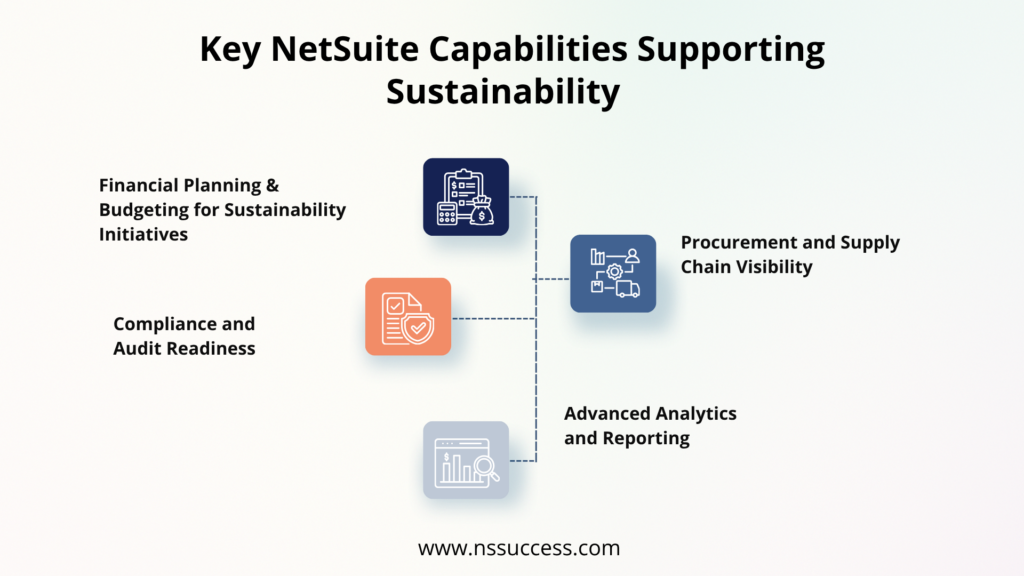
Key NetSuite Capabilities Supporting Sustainability
Financial Planning & Budgeting for Sustainability Initiatives
Sustainability initiatives in organizations require investments. Finance teams need to plan and allocate budgets effectively. NetSuite allows organizations to:
- Create budgets for sustainability projects
- To track the spending in real time
- Measure ROI
For example, if a company invests in energy-efficient equipment, NetSuite can help track cost savings over time.
Procurement and Supply Chain Visibility
Supply chains play a major role in sustainability. NetSuite helps organizations:
- Evaluate supplier performance
- Track compliance with sustainability standards
- Make responsible sourcing decisions
This ensures that sustainability extends beyond the organization to its entire ecosystem.
Compliance and Audit Readiness
Compliance is a critical aspect of sustainability. NetSuite provides:
- Detailed audit trails
- Automated reporting
- Standardized processes
This makes it easier to:
- Prepare ESG reports
- Meet regulatory requirements
- Avoid penalties
Advanced Analytics and Reporting
NetSuite’s analytics capabilities allow organizations to:
- Monitor sustainability KPIs
- Analyse trends
- Generate detailed reports
This helps in:
- Communicating performance to stakeholders
- Making informed decisions
- Identifying areas for improvement
Integrate Sustainability into Your Organization’s Financial Decision-Making
Sustainability should not be treated as a separate initiative or project. It should be part of everyday decision-making at all levels of the company. NetSuite enables this integration by:
- Combining ESG and financial data in one place
- Providing dashboards that show both impacts
- Supporting data-driven decision-making with the help of its analytical capabilities
For example, before approving a new supplier, finance teams can evaluate following to ensure balanced decision-making:
- Cost
- Environmental impact
- Compliance with sustainability standards
Practical Steps for Finance Leaders to Drive Sustainability with NetSuite
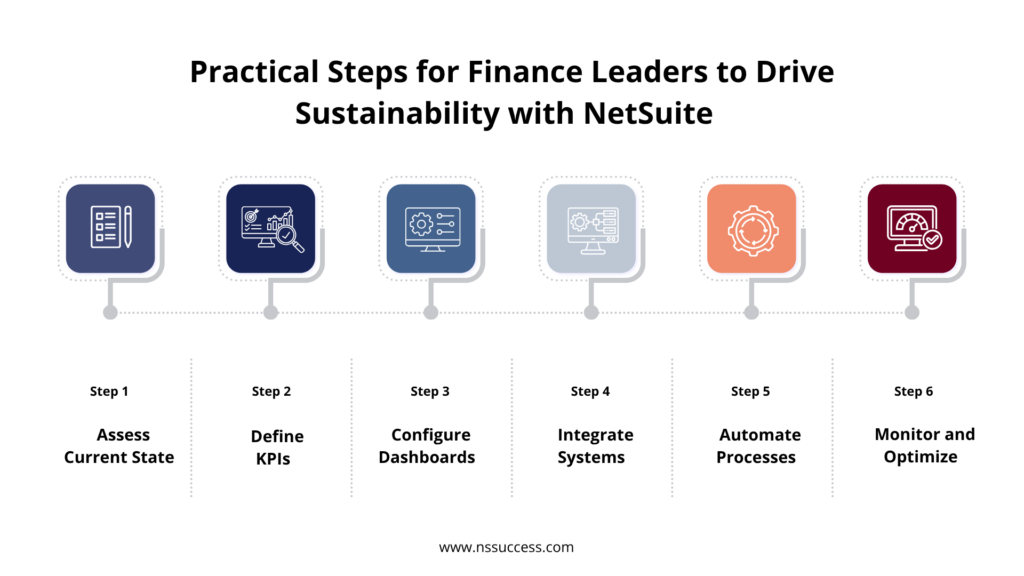
Step 1: Assess Current State
Start by evaluating the following and identifying gaps and areas for improvement:
- Existing systems
- Data availability
- Reporting capabilities
Step 2: Define KPIs
Set clear and measurable KPIs, such as:
- Energy consumption
- Carbon emissions
- Waste reduction
- Cost savings
Step 3: Configure Dashboards
Use NetSuite dashboards to track the following and get real-time visibility:
- Financial metrics
- Sustainability metrics
Step 4: Integrate Systems
Ensure that all departments are connected. This includes:
- Finance
- Procurement
- Operations
Step 5: Automate Processes
Reduce manual work by automating:
- Data collection
- Reporting
- Compliance processes
Step 6: Monitor and Optimize
Continuously track performance and make improvements.
Case Study: Finance-Led Sustainability Transformation
The Business Context: Consider a mid-sized manufacturing company aiming to improve its sustainability performance while maintaining financial efficiency. The finance team was expected to lead ESG reporting and align sustainability with business goals.
- Challenges: ESG-related data was scattered across multiple systems, making consolidation difficult. Reporting processes were largely manual, time-consuming, and prone to errors. Limited visibility into sustainability metrics made it hard for leadership to track progress and make informed decisions.
- Solution: The organization implemented Oracle NetSuite to centralize financial and operational data. Automated workflows and reporting capabilities streamlined ESG data collection and analysis. This created a single source of truth for both financial and sustainability metrics.
- Results: The accuracy of ESG reporting improved significantly with structured and automated data management. Operational waste was reduced through better visibility into resource usage and processes. The company achieved stronger cost control and enabled more informed, data-driven decision-making.
This example highlights how finance teams can play a central role in driving sustainability initiatives while improving overall business performance.
Best Practices for Sustainable Financial Operations
- Align sustainability goals with financial objectives: Sustainability initiatives should be directly linked to financial planning and business outcomes. Aligning these goals ensures that environmental and social efforts also drive long-term profitability. This creates a balanced approach to growth and responsibility.
- Ensure data accuracy and governance: Reliable data is critical for both financial and sustainability reporting. Strong governance frameworks help maintain data consistency, accuracy, and compliance. This builds trust with stakeholders and supports better decision-making.
- Use automation to improve efficiency: Automation reduces manual effort in data collection, reporting, and compliance processes. It improves accuracy and frees up teams to focus on strategic initiatives. Efficient operations are key to sustaining long-term financial and ESG performance.
- Monitor performance regularly: Organizations should continuously track financial and sustainability metrics. Regular monitoring helps identify gaps, risks, and opportunities early. This ensures timely actions and continuous improvement.
- Encourage cross-functional collaboration: Sustainable financial operations require collaboration across finance, operations, procurement, and leadership teams. Sharing insights and aligning goals improves overall effectiveness. This integrated approach supports long-term, sustainable growth.
These best practices create a strong foundation for building resilient, efficient, and sustainable financial operations.
The Future of Sustainable Finance with Oracle NetSuite
The future of finance is increasingly tied to sustainability, where financial performance and environmental, social, and governance (ESG) goals go hand in hand. Organizations are expected to move beyond traditional reporting and adopt systems that support transparency, accountability, and long-term impact.
- AI and Predictive Analytics: AI-driven insights will help organizations forecast sustainability outcomes alongside financial performance. Businesses can model the impact of environmental initiatives, resource usage, and operational changes. This enables smarter, data-driven decisions that balance profitability with sustainability goals.
- Increased Transparency: Stakeholders, investors, and regulators are demanding more detailed ESG disclosures. Organizations must provide clear, accurate, and timely sustainability data. NetSuite supports this need by enabling structured reporting and better data visibility across operations.
- Integration with Business Strategy: Sustainability is no longer a separate initiative—it is becoming part of core business strategy. Financial planning, procurement, and operations must align with sustainability objectives. NetSuite enables organizations to embed these considerations into everyday decision-making.
- Advanced Reporting Standards: Global ESG and sustainability reporting standards are continuously evolving. Organizations must adapt quickly to remain compliant and competitive. NetSuite’s flexible reporting capabilities help businesses align with changing regulatory and industry requirements.
NetSuite continues to evolve to support sustainable finance initiatives, helping organizations stay competitive while building responsible and future-ready business models
Conclusion: Finance as the Driver of Sustainable Growth
Sustainability is no longer optional—it is essential. Finance leaders play a critical role in driving the sustainability within the organization. By integrating ESG into financial operations, they can create value for both the business and society. Oracle NetSuite enables organizations to:
- Centralize data
- Automate processes
- Improve visibility
- Make responsible decisions
Organizations that embrace sustainable financial operations will achieve long-term success and resilience. Looking to align your financial operations with sustainability goals?NSSuccess (Dhruvsoft) helps organizations leverage Oracle NetSuite to build sustainable, data-driven financial strategies. Connect with our experts today and start your journey toward sustainable growth.

 “NS Success” is the NetSuite Consulting Practice of Dhruvsoft Services Private Limited – a leading NetSuite Solution Provider Partner from India – providing services worldwide …