

Are you looking to achieve Operational Efficiency with Oracle NetSuite? To answer that first understand why Operational Efficiency Is a Competitive Advantage?
In today’s fast-moving business environment, operational efficiency is no longer simply an internal performance metric—it is a primary source of competitive advantage. Organizations that operate efficiently can price more aggressively, respond more quickly to market changes, scale without proportional cost increases, and free up capital to invest in growth. Those that do not are perpetually on the back foot, spending their resources firefighting the consequences of fragmented, manual, and slow operations.
The pressure on modern organizations is unrelenting. Margins are being squeezed from multiple directions: rising input costs, increasingly demanding customers, supply chain volatility, and the constant threat of disruption from leaner, more agile competitors. Against this backdrop, the ability to do more with fewer resources—while maintaining quality and speed—is not merely desirable. It is existential.
Yet despite the strategic urgency, many organizations continue to operate on a patchwork of disconnected legacy systems, manual spreadsheets, and siloed processes that were designed for a different era. These systems generate friction at every handoff, create delays in decision-making, and consume enormous amounts of human effort on tasks that add no strategic value.
Oracle NetSuite changes this equation fundamentally. As a unified, cloud-based ERP platform purpose-built for growing organizations, NetSuite consolidates finance, operations, procurement, inventory, and CRM into a single, integrated system.
The result is a streamlined operational architecture that reduces complexity, eliminates duplication, accelerates processes, and provides the real-time visibility that modern business leaders need to make fast, confident decisions. This article explores how, and where, NetSuite unlocks efficiency gains that translate directly into business performance.
What Operational Efficiency Means in a Modern Enterprise
Operational efficiency is many times misunderstood as a simple cost-cutting initiative i.e. doing the same things for less money. In reality, it is a far more strategic concept: maximising the output your organization generates from every unit of input, whether that input is time, money, people, or technology. In a modern enterprise context, operational efficiency rests on four interconnected pillars:
- Process optimization: Identifying and eliminating unnecessary steps, hand-offs, and friction points in core business workflows—from order processing to financial close to procurement approvals.
- Data visibility: Ensuring that the right data is available to the right people at the right time, in a format that enables action rather than requiring additional interpretation or manipulation.
- Automation: Replacing manual, repetitive tasks with system-driven processes that execute reliably, at speed, without the errors and delays inherent in human-dependent workflows.
- Cross-functional alignment: Ensuring that different teams and departments operate from a shared data foundation and aligned processes, rather than in independent silos that create duplication and inconsistency.
Together, these pillars create an organization that moves faster, wastes less, and makes better decisions. Operational efficiency, in this sense, is not just about reducing costs—it is about creating the structural capacity for sustainable, profitable growth. Organizations that achieve it can scale without a proportional increase in operational overhead, respond to market opportunities faster than their peers, and build the resilience to weather disruption without structural damage.
Common Operational Inefficiencies in Growing Organizations
Before exploring how NetSuite addresses inefficiency, it is worth clearly naming the operational challenges that growing organizations most commonly face. These are not abstract problems—they are the day-to-day realities that slow teams down, consume leadership bandwidth, and ultimately constrain performance.
- Disconnected systems and data silos: When finance operates in one system, operations in another, and sales in a third, data must be manually reconciled, exported, and re-entered across platforms. This creates delays, introduces errors, and means that no single team ever has a complete picture of organizational performance.
- Heavy reliance on spreadsheets and manual processes: Spreadsheets are flexible but fragile. They break, they diverge between users, they cannot be audited reliably, and they require continuous manual maintenance. Organizations that have outgrown their systems often fall back on spreadsheets as a coping mechanism—with significant operational and risk implications.
- Delayed reporting and decision-making: When data consolidation is a manual process, financial and operational reports are always historical rather than current. Leaders make decisions based on information that may be days or weeks old—long after the window for optimal action has passed.
- Lack of standardisation across departments: When teams develop their own processes, naming conventions, and approval workflows independently, the result is operational inconsistency that makes it impossible to manage performance coherently or scale effectively.
- Inefficient inventory and supply chain management: Without real-time visibility into stock levels, supplier performance, and demand patterns, organizations oscillate between costly overstocking and service-damaging stock outs. Both represent significant operational waste.
- Limited visibility into performance metrics: Without a unified system and real-time dashboards, operational KPIs are difficult to track, slow to produce, and subject to contestation between departments working from different data sources.
These challenges are not unique to any one industry or size of organization—they are the predictable consequences of growth that outpaces the operational infrastructure designed to support it. NetSuite is specifically designed to resolve them.
How Oracle NetSuite Transforms Operational Efficiency
Unified Platform for End-to-End Operations
- The most fundamental transformation that NetSuite delivers is structural: it replaces a fragmented ecosystem of disconnected systems with a single, unified platform that covers the full scope of business operations.
- Finance, procurement, inventory management, order management, CRM, and project tracking all exist within one system, with one data model and one source of truth.
- This unification has cascading benefits. Data no longer needs to be manually exported and reconciled between systems. Processes that cross departmental boundaries—such as order-to-cash or procure-to-pay—flow seamlessly without manual hand-offs. And leaders at every level of the organization operate from the same underlying data, eliminating the conflicts and delays that arise when different teams are working from different numbers.
Real-Time Data and Visibility
- NetSuite’s live dashboards and reporting capabilities give every stakeholder—from C-suite executives to operations managers to individual team members—real-time visibility into the metrics that matter most to their role. These dashboards are configurable, role-specific, and updated continuously as transactions are processed and data is entered.
- The operational impact of real-time visibility is profound. Leaders can identify emerging issues before they escalate, capitalise on opportunities while they are still current, and make confident resource allocation decisions without waiting for end-of-month reports.
- The lag between event and awareness—which in many organizations stretches to days or weeks—collapses to near-zero. This acceleration in the decision-making cycle is one of the most valuable efficiency gains NetSuite delivers.
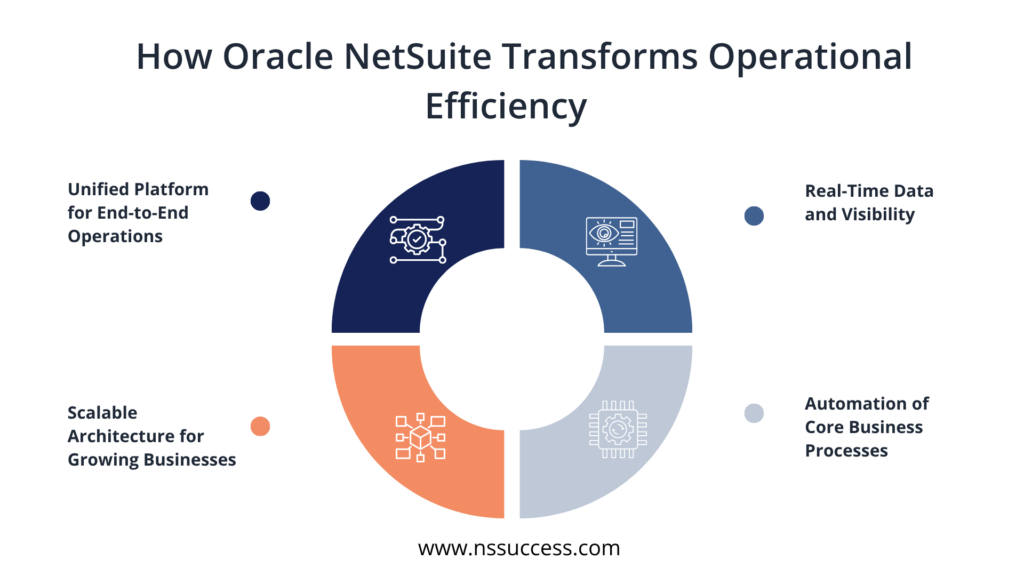
Automation of Core Business Processes
- NetSuite’s workflow automation capabilities transform the operational rhythm of the organization by removing human intervention from the routine, repetitive processes that consume enormous amounts of time and generate significant error risk.
- Invoice processing, purchase order approvals, order fulfilment routing, inter-company reconciliation, and expense approvals can all be configured to execute automatically based on predefined business rules.
- The benefits extend beyond time savings. Automated processes execute consistently, every time—without the variability introduced by manual handling. Approval bottlenecks are eliminated because the system enforces routing rules automatically and escalates unactioned items in real time.
- Error rates drop because data entered once flows through the system rather than being re-keyed at each stage of a process. The cumulative effect across an organization’s core workflows is a significant reduction in operational cost and a substantial improvement in processing speed.
Scalable Architecture for Growing Businesses
- One of the most strategically important characteristics of NetSuite is its ability to scale with the organization.
- Many ERP platforms become operational constraints as organizations grow—requiring expensive re-implementations as transaction volumes increase, new business units are added, or international expansion creates new compliance and currency requirements.
- NetSuite’s cloud-based architecture is designed to absorb growth without structural disruption. New subsidiaries can be added within the existing system. Multi-currency and multi-entity consolidation are native capabilities.
- New business models—subscription billing, project-based revenue, eCommerce integration—can be accommodated within the platform without rebuilding from scratch. This scalability means that the operational infrastructure built on NetSuite today remains fit for purpose as the organization evolves.
Key Areas Where NetSuite Improves Efficiency
Financial Operations
- Finance is where inefficiency is often felt most acutely—and most expensively. Slow financial closes, manual reconciliation, fragmented reporting, and compliance overhead all represent significant operational cost. NetSuite addresses each of these systematically.
- The financial close process is accelerated through automated reconciliation, inter-company eliminations, and period-end routines that reduce the time and manual effort required to produce accurate financial statements. Compliance tracking—tax, audit, regulatory reporting—is embedded in the system rather than managed through separate processes.
- Real-time financial dashboards give CFOs and finance teams instant visibility into cash position, revenue performance, and cost trends—without waiting for month-end consolidation. Organizations implementing NetSuite consistently report significant reductions in their financial close cycle, with many moving from weeks to days.
Supply Chain and Inventory Management
- For organizations managing physical inventory—whether manufacturers, distributors, or retailers—supply chain inefficiency represents one of the largest sources of operational waste. Excess stock maintained by companies ties up the working capital. Stock outs damage customer relationships and revenue. And without accurate demand forecasting, organizations perpetually oscillate between the two extremes.
- NetSuite’s demand planning and inventory optimization tools give operations teams the visibility and analytical capability to manage inventory with precision. Real-time stock level monitoring across multiple locations, automated reorder triggers based on configurable min/max parameters, and demand forecasting informed by historical sales patterns all work together to reduce both excess inventory and stock-out risk.
- Supplier lead times, landed cost tracking, and vendor performance metrics provide the additional context needed to make confident procurement decisions.
Procurement and Vendor Management
- Procurement is an area where manual, paper-based processes persist in many organizations—generating approval delays, compliance risks, and cost control challenges. NetSuite digitises and automates the full procurement lifecycle: purchase requisitions, approval workflows, purchase order generation, goods receipt, and invoice matching all flow through a single, auditable system.
- Vendor management capabilities allow organizations to track supplier performance, manage contract terms, and analyse spend patterns across the supplier base.
- This visibility enables strategic procurement decisions—consolidating spend with preferred suppliers, negotiating better terms, and identifying cost reduction opportunities that are invisible in fragmented, manual procurement environments.
Order-to-Cash and Procure-to-Pay Processes
- The order-to-cash (O2C) and procure-to-pay (P2P) cycles are the operational heartbeat of most businesses—and they are also among the most common sources of inefficiency. In organizations without a unified ERP, these cycles involve multiple system hand-offs, manual data re-entry, and approval processes that create delays and errors at every stage.
- NetSuite automates both cycles end-to-end. Orders entered in the sales system flow automatically into fulfilment, invoicing, and revenue recognition without manual intervention.
- Purchase orders flow through automated approval workflows and are matched electronically against supplier invoices and goods receipts. The result is dramatically faster cycle times, improved cash flow management through faster invoicing and collections, and a significant reduction in the manual effort that these processes historically required.
Dhruvsoft’s Approach to Improve Operational Efficiency with NetSuite
Deploying NetSuite is a significant investment—and like any ERP implementation, the returns depend heavily on the quality of the implementation approach. Organizations that achieve the greatest efficiency gains follow a structured, disciplined path. Dhruvsoft (NSSuccess) has well defined approach to improve the Operational Efficiency with Oracle NetSuite:
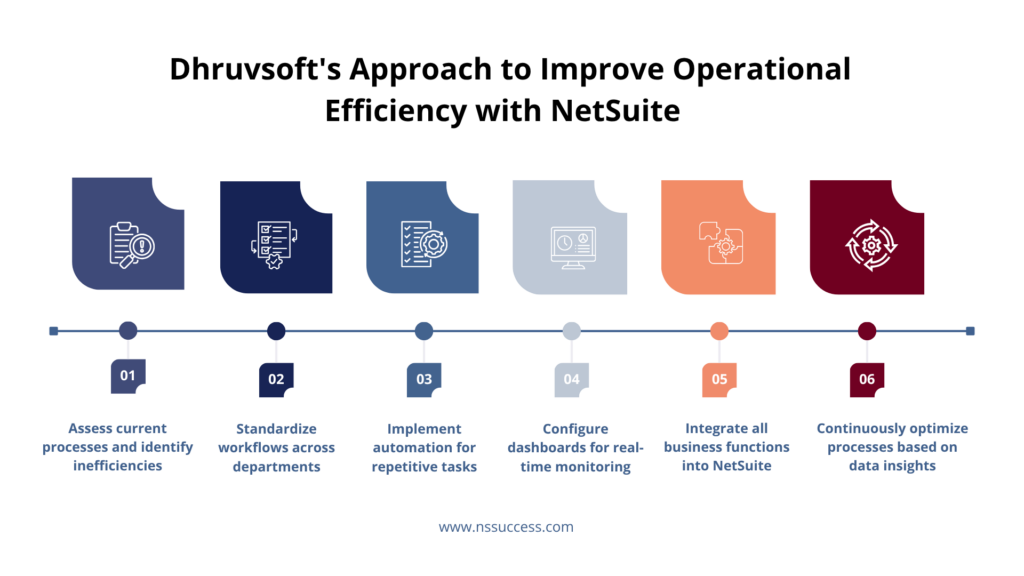
- Assess current processes and identify inefficiencies: Before configuring the system, we conduct a thorough process audit to understand where delays, errors, and manual effort are concentrated. This baseline assessment determines where NetSuite’s capabilities will have the greatest impact and informs prioritisation.
- Standardize workflows across departments: NetSuite’s power lies in shared data and consistent processes. Before implementation, our consultants at Dhruvsoft resolve the process inconsistencies and departmental variations that have accumulated over time. Standardization is the prerequisite for automation.
- Implement automation for repetitive tasks: Our NetSuite Success consultants map the high-volume, rules-based tasks in your current process landscape and configure NetSuite’s workflow engine to handle them automatically. We start with the highest-effort, highest-error processes—approvals, reconciliation, order routing—for the fastest return.
- Configure dashboards for real-time monitoring: Next we invest time in designing role-specific dashboards that give each stakeholder the real-time visibility they need to manage their area of responsibility. Well-designed dashboards reduce the need for manual reporting and accelerate response to emerging issues.
- Integrate all business functions into NetSuite: We recommend resisting the temptation to maintain parallel systems or manual interfaces alongside NetSuite. The platform’s efficiency benefits compound when all business functions are fully integrated—and diminish significantly when important data flows remain outside the system.
- Continuously optimize processes based on data insights: Implementation is not the end of the journey—it is the beginning. We use NetSuite’s analytics capabilities to monitor process performance, identify bottlenecks, and drive continuous improvement. We help you build a regular cadence of process review into your operational rhythm.
Case Study: Efficiency Gains with NetSuite
Challenge
Learn how NSSuccess (your NetSuite Success partner) has helped a mid-market distribution company achieve remarkable efficiency gains.
- The client had operations across three regions and a product catalogue of several thousand SKUs. The organization had grown rapidly through a combination of organic expansion and acquisition, but its operational infrastructure had not kept pace.
- Finance ran on a legacy accounting system, inventory was managed through a combination of a separate warehouse management tool and a complex network of spreadsheets, and procurement approvals were handled entirely by email.
- The consequences were significant. Month-end financial close took three weeks, during which the finance team worked at capacity and leadership operated without reliable performance data.
- Inventory accuracy was a concern — meaning stock outs were frequent, and excess stock was tying up working capital across all three locations. Purchase orders were routinely delayed because the email-based approval process had no escalation mechanism, and vendor invoices were regularly mismatched against purchase orders, requiring time-consuming manual resolution.
Solution
- The company engaged an experienced NetSuite implementation partner to design and deploy a unified NetSuite environment covering financial management, multi-location inventory, procurement, and order management.
- The implementation was phased over six months: finance and reporting went live first, followed by inventory and procurement, and finally order management and customer portal integration.
- Key configuration decisions included automated three-way matching for all purchase orders above a defined threshold, real-time inventory dashboards for warehouse managers at each location, automated reorder triggers based on demand history and supplier lead times, and role-specific executive dashboards providing live visibility into key financial and operational KPIs.
- Training was delivered in two phases—initial system training at go-live, and a follow-up optimization workshop three months later once teams had developed practical familiarity with the platform.
Results
- The operational improvements were measurable and substantial. The financial close cycle compressed from three weeks to six days—a reduction of more than 70%—enabling leadership to make strategic decisions from current financial data rather than historical approximations.
- Inventory accuracy improved to 97%, reducing both stock-out frequency and working capital tied up in excess stock. Purchase order processing time fell by 65%, with automated approval workflows eliminating the delays previously caused by unactioned email requests. And the elimination of manual invoice matching freed the accounts payable team to focus on supplier relationship management and payment terms optimization rather than transactional processing.
“After implementing NetSuite, client finally had one version of the truth across the entire business. The time they used to spend reconciling data between systems is now spent on decisions that actually move the business forward.”
Challenges to Watch During Implementation
A successful NetSuite implementation requires more than good technology—it requires disciplined project management, clear executive sponsorship, and proactive management of the organizational dynamics that determine user adoption. The most common implementation challenges include:
- Resistance to process standardisation: NetSuite works best when processes are standardised across departments. Teams that have developed their own ways of working often resist this standardisation. Strong change management and clear communication of the business rationale are essential to overcoming this resistance before it becomes an implementation blocker.
- Data migration and quality issues: Every ERP implementation involves migrating historical data from legacy systems—and legacy systems are rarely clean. Poor data quality discovered late in an implementation cycle causes delays and budget overruns. Investing in a thorough data audit and cleansing exercise early in the project pays significant dividends.
- Over-customization reducing system efficiency: NetSuite’s standard capabilities are extensive, and the temptation to customize the system to replicate legacy processes exactly should be firmly resisted. Customizations increase implementation complexity, extend timelines, complicate upgrades, and often eliminate the efficiency gains that standard processes would have delivered. Wherever possible, adapt processes to NetSuite’s standard functionality rather than the reverse.
- Lack of user adoption and training: Technology cannot deliver efficiency gains if the people who use it do not know how to use it well—or resist using it at all. Invest appropriately in training at go-live and in ongoing support as users develop proficiency. Change champions within each department accelerate adoption significantly.
Best Practices for Unlocking Operational Efficiency with Oracle NetSuite
Organizations that achieve the greatest operational efficiency gains from NetSuite share a number of consistent characteristics in how they approach the platform and its implementation:
- Focus on business processes before technology: The most successful implementations start with a clear understanding of current processes, their inefficiencies, and the desired future state—before any system configuration begins. Technology configures to process; not the other way around.
- Avoid unnecessary customization: Use NetSuite’s standard features wherever they meet business requirements. Reserve customization for genuinely unique business requirements that cannot be met any other way. Every customization has a cost—in implementation time, maintenance effort, and upgrade complexity.
- Invest in user training and change management: The return on a NetSuite investment is directly proportional to the quality of adoption across the user base. Treat training and change management as strategic investments, not optional line items to be cut when budgets tighten.
- Monitor KPIs and continuously improve processes: Configure NetSuite’s analytics and reporting tools to provide ongoing visibility into operational performance. Establish a regular process review cadence that uses these insights to drive continuous improvement rather than treating the implementation as a finished deliverable.
- Align ERP implementation with long-term business strategy: NetSuite should be configured not just for today’s operational requirements but for the operational model you are building toward. This requires involving strategic leadership in key design decisions—not just the operational and finance teams managing the day-to-day implementation.
The Future of Operational Efficiency with NetSuite
The capabilities that define operational efficiency are not static—they are advancing rapidly, driven by the integration of artificial intelligence, predictive analytics, and increasingly intelligent automation into ERP platforms. Oracle NetSuite is investing significantly in these capabilities, and the organizations that are building their operational foundation on NetSuite today are well positioned to benefit from this evolution.
- Increasing role of automation and AI in operations: The scope of what can be automated is expanding beyond rule-based workflows to include pattern recognition, anomaly detection, and intelligent decision support. AI-powered exception management, for example, can automatically identify and flag transactions that deviate from expected patterns, reducing audit effort and controlling risk simultaneously.
- Predictive analytics for demand and resource planning: Advanced forecasting capabilities are moving from statistical models based on historical averages toward machine learning models that incorporate a much wider range of signals—market trends, seasonal patterns, supplier lead time variability, and customer behaviour—to produce more accurate, actionable demand and resource plans.
- Continuous innovation through cloud ERP updates: One of the most underappreciated advantages of a cloud ERP platform is that innovation is delivered continuously through automatic updates, without the disruptive and costly upgrade cycles associated with on-premise systems. Organizations on NetSuite automatically benefit from new features and capabilities as Oracle releases them.
- Data-driven operations as a competitive differentiator: As data literacy and analytical capability become more widespread, the organizations that will differentiate themselves are those that have built the operational data foundation to act on insights at speed. NetSuite provides that foundation.
Conclusion: Efficiency as a Growth Enabler
Operational efficiency is not a secondary concern for growing organizations—it is a primary strategic priority. The gap between organizations that operate efficiently and those that do not is measured not just in cost, but in speed, resilience, and the capacity to invest in growth rather than managing operational complexity.
Oracle NetSuite provides the technology foundation to close that gap. By unifying operations on a single platform, delivering real-time visibility across every business function, automating core workflows, and scaling without friction as the organization grows, NetSuite transforms operational efficiency from an aspiration into a measurable, sustainable reality.
Organizations that embrace this transformation—that invest in the implementation quality, change management, and continuous improvement discipline it requires—gain a structural advantage that compounds over time. Every efficiency gain frees resources that can be redeployed toward growth. Every improvement in decision-making speed creates a sharper competitive edge. And every reduction in operational complexity creates space for the strategic thinking that drives the business forward.
The question for business leaders is not whether to invest in operational efficiency—it is whether to invest now, while the competitive window is still open, or later, when the cost of inaction has already taken its toll.
Ready to Improve Operational Efficiency with Oracle NetSuite?
NSSuccess helps organizations streamline processes, reduce operational costs, and achieve the scalable efficiency that drives sustainable growth. Whether you are evaluating NetSuite for the first time or looking to maximize the return on an existing implementation, our team has the expertise to accelerate your journey.
Connect with our NetSuite Success experts today and take the first step toward a leaner, faster, and more competitive operation.
We bring deep NetSuite implementation experience across manufacturing, distribution, retail, and professional services—combined with a practical, outcomes-focused approach that prioritises business results over technical complexity.

 “NS Success” is the NetSuite Consulting Practice of Dhruvsoft Services Private Limited – a leading NetSuite Solution Provider Partner from India – providing services worldwide …