
Every finance team knows the moment. It is week three of the quarter, the annual budget is already three assumptions out of date, and the CFO is asking for numbers that reflect what is actually happening in the business right now, not what a spreadsheet predicted eleven months ago. This is the gap that rolling forecasts are built to close, and it is why more finance leaders are moving away from static annual budgeting toward continuous, driver-based planning inside Oracle NetSuite Planning and Budgeting.
This guide walks through what a rolling forecast is, why it has become the standard for modern finance teams, and exactly how to build one inside NetSuite, step by step, using live ERP data instead of manual spreadsheet updates. Whether you are evaluating NetSuite Planning and Budgeting for the first time or looking to get more value out of a module you already own, the goal here is the same: a forecasting process that keeps pace with the business instead of trailing behind it.
Why Traditional Annual Budgeting Is No Longer Enough
Annual budgets were designed for a slower, more predictable business environment. They assume that the assumptions you make in November will still hold true the following October. In practice, very few businesses operate that way anymore. Market volatility, inflation, shifting customer demand, and ongoing supply chain disruption mean that a budget built once a year is often outdated before the ink is dry.
This is where Oracle NetSuite Planning and Budgeting changes the equation. Instead of locking finance teams into a single static plan, it enables agile, continuous financial planning that keeps pace with the business rather than lagging behind it. In the sections that follow, you will learn what rolling forecasting actually means, the specific challenges it solves, and a practical step-by-step approach to building one inside NetSuite.
Understanding Rolling Forecasting
What Is a Rolling Forecast?
A rolling forecast is a financial planning approach that continuously extends and updates projections based on the latest available business data rather than fixing a single forecast at the start of the year and revisiting it only during formal budget cycles. Instead of planning once for a twelve-month period that runs from January to December, a rolling forecast might always look eighteen months ahead, refreshing every month or every quarter as new actuals come in.
The core idea is simple. As one period closes, a new one is added to the end of the planning horizon, so the organization is always working from a current, forward-looking view rather than a fixed point in time that grows staler with every passing month.
Rolling Forecast vs Traditional Budget
A traditional annual budget is fixed. It is built once, approved once, and typically only revisited formally at quarter-end or year-end reviews. A rolling forecast, by contrast, is dynamic. It is built to flex with changing business conditions, giving finance teams better financial visibility and, ultimately, better decision-making capability throughout the year rather than only at scheduled checkpoints.
Why CFOs Prefer Rolling Forecasts
- Faster response to market changes, since the forecast reflects current conditions rather than last year’s assumptions
- Better cash flow planning, with visibility that extends continuously rather than resetting at year-end
- More accurate revenue and expense forecasting, grounded in actual business drivers
- Reduced planning risk because assumptions are revisited and corrected on a regular cadence instead of being locked in for twelve months
Challenges Finance Teams Face Without Rolling Forecasts
Most finance teams do not lack effort. They lack the right tooling and process to keep planning current. Without a rolling forecast approach, common problems tend to compound over the course of the year:
- Annual budgets that are outdated within a few months of being finalized
- Heavy dependence on disconnected spreadsheets that are difficult to audit and easy to break
- Manual forecasting processes that consume days of finance team time every month
- Weak collaboration between finance and the business units that actually drive the numbers
- Limited visibility into future financial performance beyond the current quarter
- Delayed management decisions because the data behind them is already out of date
- Difficulty planning confidently for growth, expansion, or economic uncertainty
Each of these issues is a symptom of the same root cause: planning that happens too infrequently and relies on data that is disconnected from the ERP system where the actuals actually live. When forecasts are built outside the ERP, someone has to manually pull numbers, reconcile them against actuals, and rebuild the model from scratch every cycle. That process is slow, error-prone, and almost guarantees the forecast is out of date before it reaches the executive team.
The fix is not simply working harder inside the same spreadsheets. It is moving the entire forecasting process onto a platform where actuals, drivers, and forecasts all live in one connected system, which is exactly the gap Oracle NetSuite Planning and Budgeting is built to close.
How Oracle NetSuite Planning and Budgeting Solves These Challenges
Centralized Financial Planning
NetSuite Planning and Budgeting brings budgeting, forecasting, and reporting into a single platform. Instead of finance teams maintaining a maze of disconnected spreadsheets that need to be manually reconciled every month, everything lives in one system with a single, auditable source of truth.
Real-Time Financial Data
Because the planning module sits on top of live ERP data, forecasts automatically reflect actual business performance as it happens. There is no lag between what is happening on the ground and what shows up in the forecast, which means finance leaders are always working from current numbers rather than a snapshot from weeks earlier.
Driver-Based Planning
Rather than forecasting a single top-line revenue number in isolation, NetSuite allows finance teams to build forecasts around the actual operational drivers that move the business, including sales growth, customer demand, headcount, production volumes, and operating expenses. This makes forecasts far more defensible because every number can be traced back to a business driver rather than a top-down guess.
Scenario Modeling
NetSuite also supports scenario modeling across best-case, expected, and worst-case outcomes, so leadership can evaluate the financial impact of a decision before committing to it. This is particularly valuable when planning for expansion, new hiring, or responding to an unexpected shift in demand.
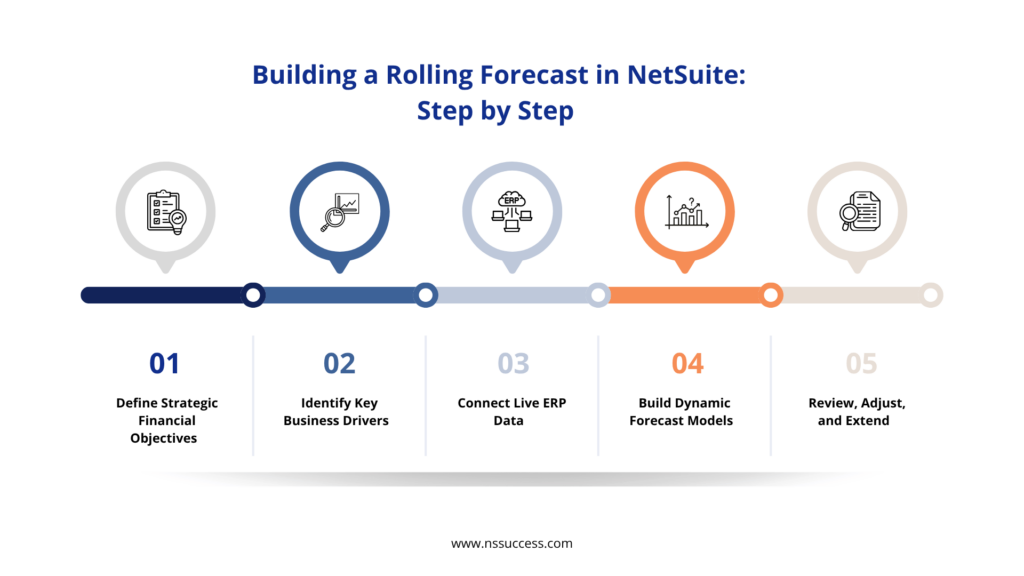
Building a Rolling Forecast in NetSuite: Step by Step
Step 1: Define Strategic Financial Objectives
Before any numbers go into the system, the finance team needs clarity on what the forecast is actually meant to support. This usually includes revenue growth targets, profitability goals, cash flow objectives, and investment priorities for the period ahead. These objectives become the benchmark against which every subsequent forecast is measured.
Step 2: Identify Key Business Drivers
Next, identify the operational drivers that most directly influence financial outcomes. For most organizations, this includes the sales pipeline, customer acquisition trends, inventory levels, procurement costs, and workforce planning. These drivers become the building blocks of the forecast model rather than relying on flat percentage growth assumptions.
Step 3: Connect Live ERP Data
A rolling forecast is only as good as the data feeding it. Connecting the planning module to live ERP data, including financial actuals, sales data, procurement information, inventory movements, and project performance, ensures the forecast updates automatically rather than requiring manual data entry every month.
Step 4: Build Dynamic Forecast Models
With objectives, drivers, and live data in place, the finance team can build out the actual forecast models. This typically includes monthly rolling forecasts, quarterly outlooks, department-level planning, and, for organizations with multiple entities, multi-entity forecasting that consolidates cleanly across subsidiaries.
Step 5: Review, Adjust, and Extend
A rolling forecast is never finished. Each month or quarter, the finance team reviews actual results against the forecast, runs variance analysis to understand where and why the numbers diverged, updates assumptions accordingly, and extends the forecast horizon forward so the organization is always looking the same distance ahead.
Key Features of NetSuite Planning and Budgeting
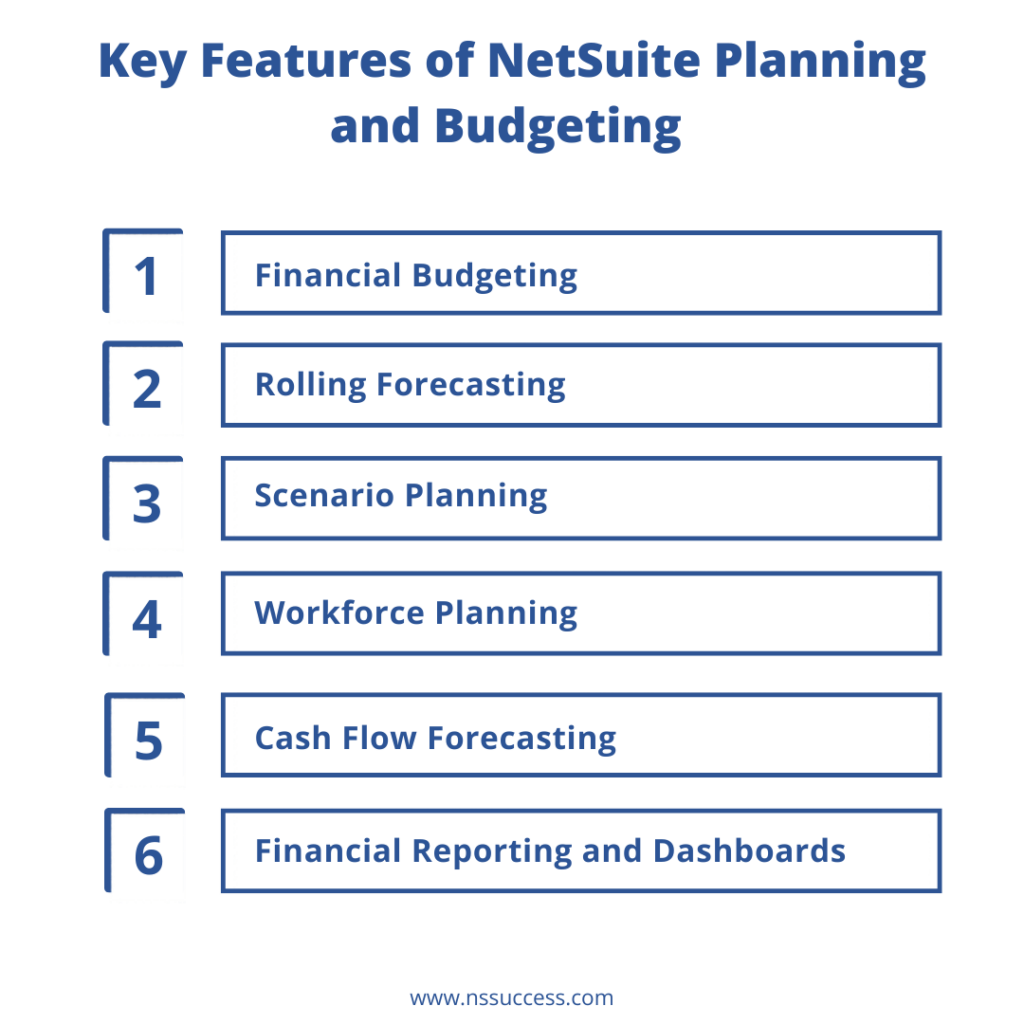
- Financial Budgeting: Supports department-level budgets, project-based budgets, and capital expenditure planning, all within the same system used for actuals.
- Rolling Forecasting: Enables continuous planning with automatic forecast updates, improving forecast accuracy over time as the model is refined against real outcomes.
- Scenario Planning: Helps finance teams prepare for economic uncertainty, business expansion, cost optimization initiatives, and market fluctuations by modeling multiple outcomes side by side.
- Workforce Planning: Covers hiring plans, salary forecasting, and resource allocation, connecting headcount decisions directly to the financial forecast.
- Cash Flow Forecasting: Supports liquidity planning, working capital management, and payment forecasting, giving finance leaders forward visibility into cash position rather than reacting after the fact.
- Financial Reporting and Dashboards: Provides executive dashboards, KPI monitoring, and budget-versus-actual and forecast-versus-actual reporting, so leadership can see performance against plan at a glance.
Benefits of Rolling Forecasts with NetSuite
Beyond the reasons CFOs prefer rolling forecasts in the first place, moving the process onto NetSuite unlocks a few additional advantages that are difficult to achieve with spreadsheets alone:
- Greater cross-functional collaboration, with finance, sales, HR, procurement, and operations working from the same data
- Reduced spreadsheet dependency, cutting down on manual effort and the errors that come with it
- Improved executive confidence since strategic decisions are grounded in current information rather than outdated projections
Common Forecasting Mistakes CFOs Should Avoid
Even with the right platform in place, forecasting can go wrong if the underlying process is flawed. Some of the most common mistakes finance teams make include:
- Treating the rolling forecast like a copy of the annual budget instead of a living, continuously updated model
- Using outdated assumptions that no longer reflect current market or operating conditions
- Ignoring operational business drivers in favor of simple top-down growth percentages
- Relying heavily on spreadsheets even after implementing a dedicated planning system
- Not involving department leaders who own the operational data behind the numbers
- Reviewing forecasts only quarterly rather than on a consistent monthly cadence
- Focusing solely on revenue while overlooking profitability and cash flow
Best Practices for Successful Rolling Forecasting
- Update forecasts monthly rather than waiting for a formal quarterly cycle
- Use live ERP data instead of manually re-entering numbers each period
- Standardize planning assumptions across departments so forecasts are comparable
- Build driver-based forecasting models tied to real operational metrics
- Track forecast accuracy regularly and use variance analysis to improve the model over time
- Create executive dashboards that give leadership visibility without needing to dig through raw data
- Integrate forecasting with broader strategic planning so financial plans and business strategies move together
Rolling Forecasts and Multi-Entity Organizations
For organizations operating across multiple subsidiaries, regions, or business units, rolling forecasts carry an added layer of complexity. Currency differences, inter-company transactions, and varying local reporting requirements can all complicate a consolidated view of financial performance. NetSuite Planning and Budgeting handles this natively, since it draws on the same multi-entity structure already used for financial consolidation elsewhere in NetSuite.
This means a rolling forecast can be built at the subsidiary level and rolled up automatically into a consolidated group forecast, without finance teams needing to manually reconcile currency conversions or inter-company eliminations outside the system. For businesses expanding into new markets or managing acquisitions, this consolidated forecasting capability is often one of the strongest arguments for moving off spreadsheets entirely.
How Rolling Forecasts Support Faster, More Confident Growth Decisions
One of the most underrated benefits of rolling forecasting is what it does for the speed and confidence of decision-making outside the finance function itself. When sales, operations, and HR leaders know that finance is working from a forecast that reflects current business conditions rather than an assumption set from months earlier, they trust the numbers finance brings to the table. That trust translates directly into faster approvals for hiring, faster sign-off on new investments, and fewer cycles spent debating whether the underlying data is even current.
This is particularly important during periods of rapid growth or market disruption, when the cost of a slow or inaccurate forecast is measured in missed opportunities rather than just an inconvenient budget variance. A rolling forecast built on live ERP data gives leadership the confidence to move quickly because the numbers behind the decision are current rather than historical.
Why the Right NetSuite Implementation Partner Matters
NetSuite Planning and Budgeting is a powerful platform, but its value depends heavily on how well it is implemented. The right implementation partner will design forecasting models that align with actual business objectives, configure planning dimensions and approval workflows correctly from the start, integrate the planning module cleanly with the broader ERP environment, train finance teams on forecasting best practices, and continue optimizing the system as the business grows and evolves.
How NsSuccess Helps
- NetSuite Planning and Budgeting implementation from the ground up
- Financial planning transformation, moving teams off spreadsheets and onto a unified platform
- Budgeting and forecasting optimization for organizations already live on NetSuite
- CFO dashboards and executive reporting built around the metrics leadership actually needs
- Ongoing support and advisory services as forecasting needs evolve
Conclusion: Move From Static Budgets to Continuous Forecasting
Annual budgets alone can no longer support the pace of change most businesses are dealing with today. Rolling forecasts give CFOs the agility to respond to uncertainty, adjust course quickly, and capitalize on new opportunities as they emerge, rather than waiting for the next scheduled budget cycle. Oracle NetSuite Planning and Budgeting brings this approach to life with real-time data, scenario planning, and collaborative forecasting built directly into the platform finance teams already use every day.
Organizations that make the shift to continuous planning consistently end up better positioned for sustainable growth, stronger financial control, and smarter strategic decisions across the board.
FAQs
1. What is a rolling forecast in NetSuite Planning and Budgeting?
It is a forecast that is regularly refreshed with the latest financial and operational data rather than fixed to the annual budget, enabling more accurate planning and faster decision-making.
2. How is a rolling forecast different from a traditional budget?
A traditional budget is typically created once a year and remains relatively fixed, whereas a rolling forecast is updated regularly to reflect changing business conditions. This gives finance leaders greater flexibility to respond to market changes, revenue fluctuations, and operational risks.
3. How often should a rolling forecast be updated?
Most organizations update their rolling forecasts monthly or quarterly. Businesses operating in rapidly changing industries may choose more frequent updates to improve forecasting accuracy and support proactive decision-making.
4. Can NetSuite Planning and Budgeting support multiple business entities?
Yes. NetSuite Planning and Budgeting supports multi-entity, multi-currency, and multi-department planning, allowing organizations to consolidate forecasts while maintaining visibility into individual business units and subsidiaries.
5. Does NetSuite Planning and Budgeting integrate with NetSuite ERP?
Yes. The solution integrates seamlessly with NetSuite ERP, automatically pulling actual financial data into planning models. This reduces manual data entry, improves forecast accuracy, and ensures finance teams always work with current information.
6. Can departments collaborate on the forecasting process?
Absolutely. NetSuite enables department managers to submit and update their own forecasts while finance teams maintain centralized control, approvals, and consolidated reporting across the organization.
7. How long does a NetSuite Planning and Budgeting implementation typically take?
Implementation timelines vary depending on business complexity, planning requirements, and the number of entities involved. Most implementations include discovery, solution design, data integration, model configuration, testing, user training, and go-live support.
8. Why should businesses implement NetSuite Planning and Budgeting with an experienced partner?
An experienced implementation partner such as Dhruvsoft can help organizations design driver-based planning models, configure workflows, migrate existing budgeting processes, and build accurate forecasting models. This accelerates deployment, improves user adoption, and helps finance teams maximize the value of their investment.
Ready to Build a Rolling Forecast Your CFO Will Trust?
NsSuccess helps organizations implement Oracle NetSuite Planning and Budgeting solutions that enable accurate forecasting, smarter financial planning, and confident executive decision-making. If your team is ready to move beyond spreadsheets and static annual budgets, our NetSuite experts can help you design and build a rolling forecasting strategy your CFO will trust and own. Contact NsSuccess today to get started.

 “NS Success” is the NetSuite Consulting Practice of Dhruvsoft Services Private Limited – a leading NetSuite Solution Provider Partner from India – providing services worldwide …