

NetSuite for Real Estate
Streamline property accounting, project management, financial operations, and reporting with a scalable NetSuite solution built for real estate businesses.
Real estate is a margin business built on timing — the timing of rent collections, lease renewals, capital calls, and closes. Yet many real estate developers, management firms, leasing companies, investment firms, and brokers still run that business on spreadsheets, disconnected property management tools, and legacy accounting software that were never built for multi-entity, multi-property complexity.
NetSuite for Real Estate brings accounting, financial management, revenue recognition, lease administration, and portfolio reporting into a single cloud platform — giving owners, operators, developers, and property managers one source of truth across every property, entity, and market.
As a NetSuite Solution Provider, Dhruvsoft (NsSuccess) helps real estate businesses implement, customize, and optimize NetSuite to fit how the industry actually works — not the other way around.
Industry Overview
The real estate industry spans several distinct types of businesses, each with its own operational rhythm: developers building and financing new projects, management firms running day-to-day property operations, leasing companies handling tenant relationships and rent rolls, investment firms managing capital and portfolio performance, and brokers driving transactions and commissions.
Despite their differences, these businesses share a common problem. As portfolios, deal volume, or client rosters grow, finance and operations teams need accurate information about revenue, expenses, occupancy, leases, capital expenditure, vendor spending, collections, and property-level profitability — and that information is often scattered across spreadsheets, siloed software, and disconnected accounting systems.
A modern ERP system can connect these processes and provide a single source of business information. NetSuite enables real estate organizations to bring financial and operational data together, helping management teams understand portfolio performance and respond faster to changing market conditions.
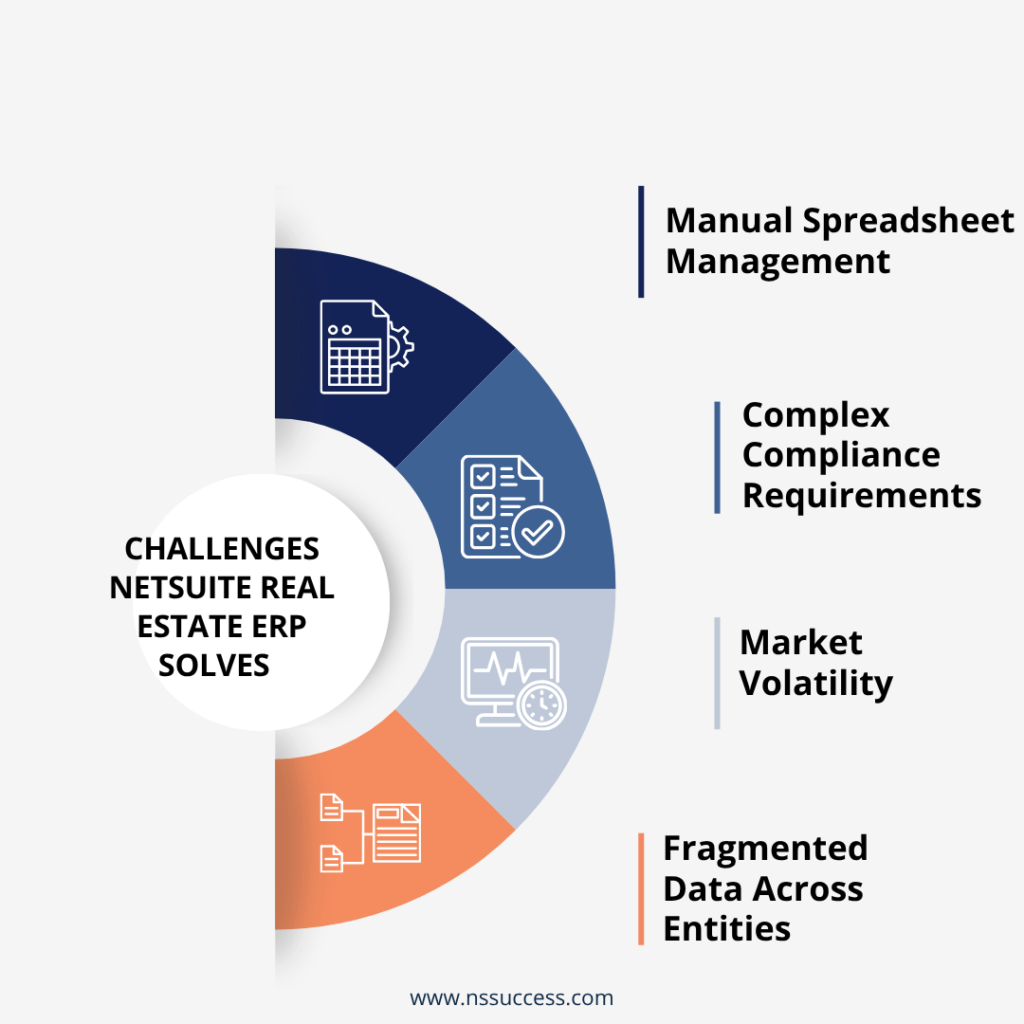
Challenges NetSuite Real Estate ERP Solves
- Manual Spreadsheet Management: Replace disconnected spreadsheets with centralized data and role-based dashboards. Get current visibility into occupancy, lease expirations, maintenance activities, collections, and property performance.
- Complex Compliance Requirements: Centralize financial and operational controls to improve compliance with revenue recognition, lease accounting, tax, and reporting requirements. Reduce errors and simplify audit preparation across entities and regions.
- Market Volatility: Use real-time data and performance KPIs to monitor changes in pricing, demand, costs, and cash flow. This helps real estate leaders adjust pricing, concessions, investments, and spending decisions more effectively.
- Fragmented Data Across Entities: Bring properties, subsidiaries, regions, and ownership structures onto one platform. Standardize financial processes, vendor management, and reporting while making consolidated portfolio performance easier to understand.
NetSuite Real Estate ERP Features
Project Budget
Manage project budgets from initial planning through completion, with budget groups, per-square-foot estimates, encumbrance tracking, BOQ integration, approvals, and real-time budget vs. actual visibility.
Departmental Budget
Plan and control departmental budgets across fiscal years, periods, cost centers, and spending categories. Real-time monitoring, encumbrance tracking, approvals, and version control improve financial accountability.
Bill of Quantities (BOQ)
Create accurate project BOQs using standardized rates, thumb-rule estimates, GFC drawings, BIM models, and Excel uploads. Track quantities, variations, material consumption, and rates while integrating BOQ data with budgets, procurement, and inventory.
Work Breakdown Structure (WBS)
Plan and manage complex real estate projects through structured deliverables, tasks, and sub-tasks. Assign responsibilities, resources, timelines, and track progress through dashboards, timelines, and Microsoft Project integration.
Inventory Management
Manage materials across warehouses and project sites with real-time stock visibility, material issues, transfers, consumption, and valuation. Integrate BOQ, procurement, and contracting to optimize inventory and reduce material wastage.
Liaisoning
Manage statutory approvals, NOCs, permits, compliance checklists, and government submissions in one system. Track file movements, responsibilities, deadlines, rejections, documents, and approval status with automated alerts and audit trails.
Contracting
Manage the complete contractor lifecycle, from contract creation and advances to RA bills, retention, variations, extra items, and final settlement. Integrated workflows and finance connectivity improve payment accuracy and project cost control.
Procurement & Supply Chain
Streamline procurement from vendor onboarding and quotations to purchase orders, material delivery, invoice matching, and returns. Integrated procurement, inventory, BOQ, and finance processes provide better spending and supply chain visibility.
Finance, Accounting & Taxation
Manage accounts payable, accounts receivable, general ledger, banking, taxation, fixed assets, and financial reporting in one system. Real-time project profitability, revenue recognition, and compliance reporting provide better financial visibility.
Rehabilitation & Redevelopment
Manage rehabilitation and redevelopment projects from property surveys and government approvals to agreements, rent payments, change requests, and possession. Centralized workflows improve stakeholder management and transaction visibility.
Lead Management
Capture, qualify, score, distribute, and nurture real estate leads from multiple channels in one system. Centralized interactions, site-visit tracking, source analytics, partner management, and intelligent assignment help sales teams manage the complete lead lifecycle.
Post-Sales CRM
Manage the complete customer journey after booking, from agreements and payments to registration, possession, handover, and service requests. Automated demand letters, documents, communications, online payments, and customer portals improve post-sales management and customer experience.
NetSuite Real Estate ERP Benefits
- Faster and More Accurate Financial Close: Automate reconciliations, approvals, and financial reporting to reduce manual work and close books faster with greater accuracy.
- Real-Time Portfolio Visibility: Get a complete view of occupancy, NOI, leasing activity, OpEx, CapEx, cash flow, and other key property metrics to support faster investment and asset management decisions.
- Scalable Multi-Entity Growth: Manage multiple properties, subsidiaries, and business entities from a single ERP platform. Standardize processes and controls as your real estate portfolio expands across markets and regions.
Why Your Real Estate Business Needs NetSuite
Beyond solving day-to-day data fragmentation, a connected ERP changes how quickly leadership can react to a shifting market. When occupancy, collections, expenses, and cash flow data live in one system instead of several, decisions about pricing, concessions, and new investments can be made on current numbers rather than a stale report pulled together the week before.
For growing real estate organizations, NetSuite can also provide a foundation for multi-entity operations and standardized processes. This makes it easier to expand the portfolio while maintaining financial control and operational visibility, no matter which side of the business you operate in.
NetSuite for Real Estate Business Segments
- Real Estate Developers: Manage project costs, construction budgets, financing, procurement, revenue recognition, and reporting through a centralized ERP platform, with visibility into project-level profitability from groundbreaking through sale or lease-up.
- Real Estate Management Firms: Improve visibility into tenant billing, CAM charges, expenses, collections, vendor spending, property-level financials, and day-to-day operational performance across a growing portfolio of managed properties.
- Real Estate Leasing Companies: Manage lease administration, renewals, rent escalations, tenant billing, and rent roll reporting in one system, with dashboards that surface upcoming renewals and the financial impact of leasing activity across commercial and residential portfolios.
- Real Estate Investment Firms: Gain consolidated visibility across investments, properties, entities, cash flows, expenses, and portfolio performance to support acquisition, hold, and disposition decisions with accurate, real-time data.
- Real Estate Brokers: Track commissions, deal pipelines, listing activity, and transaction-related expenses alongside financial reporting, giving brokerages a connected view of closed deals, pending commissions, and agent performance without relying on separate spreadsheets or standalone CRM exports.
Implementing NetSuite with NsSuccess
A successful NetSuite implementation starts with understanding how your real estate business operates today and where it needs to go, whether you’re a developer managing active construction projects, a management firm running daily property operations, a leasing company tracking rent rolls, an investment firm overseeing a portfolio, or a brokerage managing commissions and deal flow.
At NsSuccess (the NetSuite practice of Dhruvsoft), we work with your finance, operations, property management, and leadership teams to understand your existing processes and design a NetSuite environment aligned with your requirements. Our full step-by-step approach is outlined below in our implementation methodology.
Our NetSuite Services for Real Estate
- NetSuite Implementation: Implement NetSuite around your organization’s financial, property, leasing, billing, procurement, and reporting requirements.
- NetSuite Customization: Customize NetSuite workflows, dashboards, forms, fields, reports, and processes where standard functionality does not fully meet your requirements.
- NetSuite Integration: Connect NetSuite with property management applications, CRM platforms, payment systems, banking platforms, payroll systems, reporting tools, and other business applications.
- NetSuite Data Migration: Migrate financial, customer, vendor, property, transaction, and other relevant business data into NetSuite with appropriate validation and reconciliation.
- NetSuite Optimization: Improve an existing NetSuite environment by reviewing configurations, workflows, reporting, integrations, and user processes.
- NetSuite Support and Managed Services: Provide ongoing technical and functional support to help your team resolve issues, optimize processes, manage enhancements, and get more value from NetSuite.
Our NetSuite Implementation Methodology
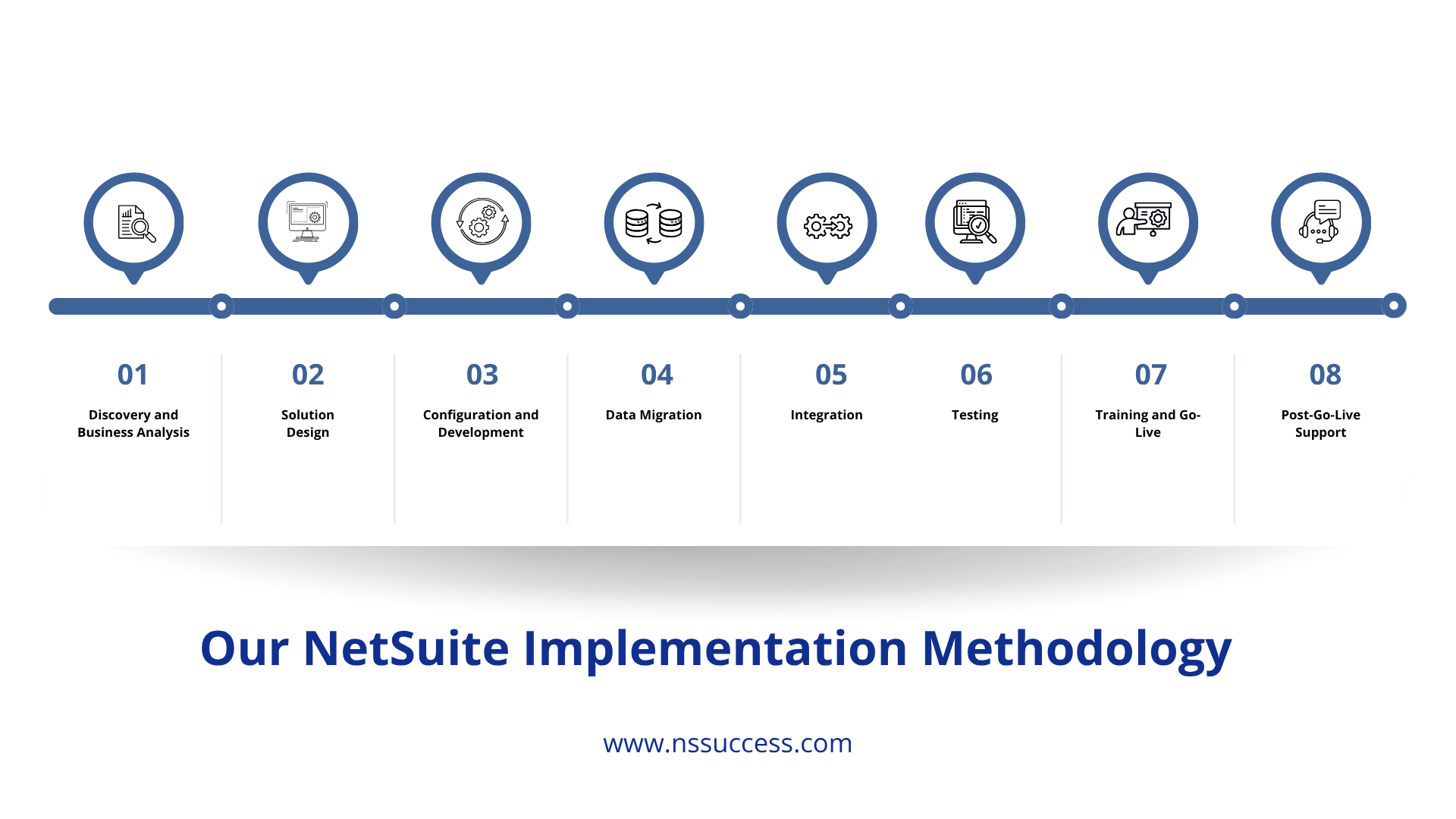
- Discovery and Business Analysis: We begin by understanding your current systems, processes, challenges, organizational structure, and future growth plans.
- Solution Design: Our consultants map your business requirements to NetSuite functionality and identify where configuration, customization, or integrations may be required.
- Configuration and Development: We configure NetSuite modules, workflows, roles, dashboards, reports, financial structures, and other required components.
- Data Migration: We plan and execute data migration while validating important financial and operational information before moving to production.
- Integration: Where required, we integrate NetSuite with your existing business applications to create a connected technology environment.
- Testing: We perform functional, integration, and user acceptance testing to identify and resolve issues before go-live.
- Training and Go-Live: We train users on relevant NetSuite processes and support your team through deployment and go-live.
- Post-Go-Live Support: After implementation, NsSuccess continues to support your NetSuite environment and helps you identify opportunities for further optimization.
Why Choose NsSuccess for NetSuite Real Estate ERP?
- NetSuite Implementation Expertise: NsSuccess specializes in NetSuite consulting and implementation, helping businesses adopt NetSuite based on their operational and financial requirements.
- Industry-Focused Approach: We understand that developers, management firms, leasing companies, investment firms, and brokers each have different requirements from standard trading or service organizations — and from each other. Our approach focuses on property-related financial processes, leasing, billing, project costs, commissions, entities, and portfolio reporting.
- Business Process Understanding: We focus on understanding your existing processes before recommending a solution. This helps ensure NetSuite supports the way your organization actually operates.
- Scalable Solutions: We design NetSuite environments that can support business expansion, additional entities, properties, users, and processes as your organization grows.
- Integration and Customization Capabilities: When standard NetSuite functionality is not enough, we can help design appropriate customizations and integrations to connect your wider technology ecosystem.
- Long-Term NetSuite Support: Our relationship does not have to end at go-live. We can continue supporting your NetSuite environment as your business, processes, and requirements evolve.
Frequently Asked Questions About NetSuite for Real Estate
1. What is NetSuite for the real estate industry?
NetSuite for real estate is a cloud-based business management platform that can help developers, management firms, leasing companies, investment firms, and brokers manage financials, billing, leasing-related processes, procurement, budgeting, revenue management, reporting, and multi-entity operations in one system.
2. How can NetSuite help real estate companies manage multiple properties?
NetSuite can organize financial and operational information across properties, entities, projects, and markets. Businesses can use reporting and dashboards to analyze property-level revenue, expenses, profitability, cash flow, and other performance indicators.
3. Can NetSuite manage real estate lease-related processes?
Yes. NetSuite provides lease and commission management capabilities that can help businesses track lease milestones, escalations, renewals, and commission activities. It also supports applicable lease accounting requirements, including ASC 842 and IFRS 16.
4. Can NetSuite automate tenant billing?
Yes. NetSuite can automate billing processes and support recurring charges, partial-period calculations, and other billing requirements. This can help reduce manual calculations, billing errors, and revenue leakage.
5. Can NetSuite support real estate developers?
Yes. Real estate developers can use NetSuite to manage financials, project-related costs, procurement, budgeting, revenue, billing, and reporting. The platform can also provide visibility into financial performance across projects and entities.
6. Can NetSuite handle multiple real estate entities and subsidiaries?
Yes. NetSuite supports multi-entity operations and consolidated financial reporting. This can help real estate groups manage multiple subsidiaries, properties, ownership structures, currencies, and geographical operations from a centralized platform.
7. Can NetSuite integrate with property management software?
Yes. NetSuite can be integrated with third-party applications where required. The specific integration approach depends on the property management system, data requirements, business processes, and integration architecture.
8. How does NetSuite help real estate businesses with budgeting and forecasting?
NetSuite enables businesses to create budgets, forecasts, and scenarios at different organizational levels. Teams can compare actual performance against planned figures and identify variances affecting property performance, expenses, margins, and cash flow.
9. Can NetSuite support real estate brokers and brokerages?
Yes. NetSuite can help brokerages track commissions, deal pipelines, and transaction-related expenses alongside standard financial reporting, giving brokerages a connected view of closed and pending business without maintaining that information separately from the general ledger.
10. How long does a NetSuite implementation take for a real estate company?
Implementation timelines vary depending on the size of the organization, number of entities and properties, required modules, data migration, integrations, customizations, and business processes. NsSuccess can assess your requirements and provide an implementation roadmap based on your specific environment.
11. Why should a real estate company choose NsSuccess for NetSuite implementation?
NsSuccess combines NetSuite implementation expertise with an understanding of the financial and operational requirements of growing businesses. We can support the full implementation lifecycle, including discovery, solution design, configuration, customization, data migration, integration, testing, training, go-live, and ongoing support.
Start Your NetSuite Real Estate Journey with NsSuccess
Your real estate business needs more than an accounting system. It needs connected financial and operational information that can help you understand property performance, control costs, manage leases, track commissions, improve billing, and make better decisions — whether you’re a developer, a management firm, a leasing company, an investment firm, or a brokerage.
With NetSuite and the right implementation strategy, you can replace fragmented processes with a centralized ERP platform designed to support your current operations and future growth.
Whether you are implementing NetSuite for the first time, replacing legacy systems, expanding into multiple entities, or looking to improve an existing NetSuite environment, our team can help you plan and execute the right solution.
Talk to NsSuccess about your NetSuite Real Estate ERP requirements.
 “NS Success” is the NetSuite Consulting Practice of Dhruvsoft Services Private Limited – a leading NetSuite Solution Provider Partner from India – providing services worldwide …