

NetSuite for Wholesale & Distribution
Streamline Wholesale & Distribution with NetSuite ERP
Wholesale distribution businesses operate in a fast-moving environment where inventory availability, purchasing, order fulfillment, pricing, customer relationships, and financial control all need to work together. Managing these processes across disconnected systems and spreadsheets can make it difficult to maintain accurate inventory, respond quickly to customers, and understand business performance.
NetSuite for Wholesale Distribution brings your critical business operations together on a unified cloud ERP platform. From purchasing and inventory management to sales, warehouse operations, financials, and reporting, NetSuite helps wholesale distributors create connected and more efficient business processes.
At NSSuccess, we help wholesale distribution companies implement, customize, integrate, and optimize NetSuite to support their operational requirements and long-term growth.
Industry Overview
Wholesale distribution businesses manage a wide range of activities, including purchasing, inventory, sales, order fulfillment, warehouse operations, and financial management. As product volumes, customer relationships, and distribution channels grow, managing these processes across separate systems can make it difficult to maintain accurate and consistent information.
NetSuite is a cloud-based ERP platform that helps wholesale distributors manage their core business operations through a centralized system. It connects finance, inventory, purchasing, sales, order management, and warehouse operations within a single ERP environment.
For wholesale distributors, this provides teams with access to consistent business information across departments. Sales teams can view customer and inventory information, purchasing teams can monitor supplier requirements, warehouse teams can manage orders and fulfillment, and finance teams can track revenue, receivables, payables, and profitability.
NetSuite can also support distributors as they expand into new markets, add warehouses, increase product volumes, introduce ecommerce channels, and manage increasingly complex customer and supplier relationships.
Business Challenges NetSuite Distribution ERP solves
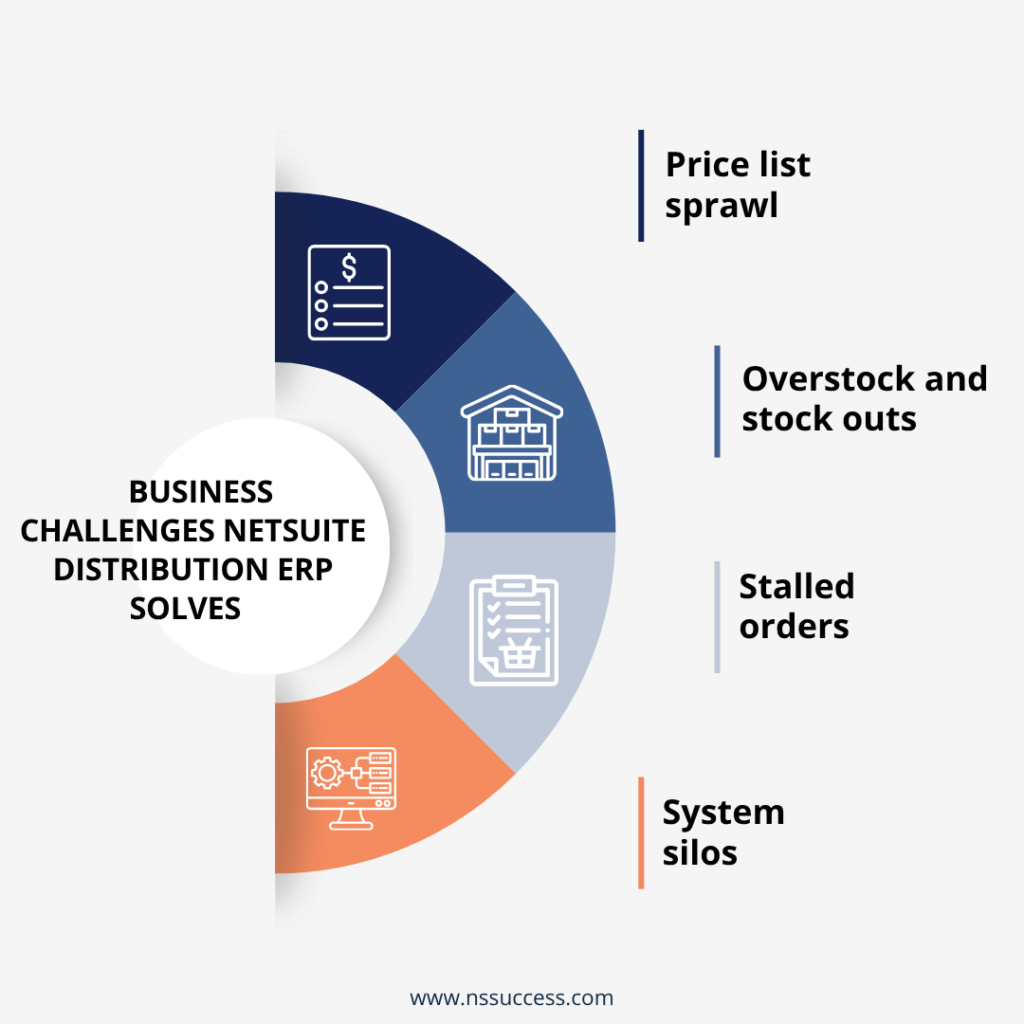
Wholesale distributors need to balance customer demand, inventory availability, supplier performance, operating costs, and profit margins. As the business grows, managing these areas becomes more challenging, especially when teams rely on disconnected systems and manual processes.
- Price list sprawl: Manage thousands of SKUs with customer-specific pricing, volume discounts, and promotions using flexible rules that automatically apply to quotes and sales orders.
- Overstock and stock outs: Balance demand forecasts, supplier lead times, and location-level inventory data to reduce stock outs and minimize excess inventory and tied-up working capital.
- Stalled orders: Use automated workflows to route approvals and apply business rules quickly, helping prevent orders from being delayed by manual processes or approval steps.
- System silos: Connect finance, warehouse, sales, and ecommerce operations through a shared, real-time system, reducing reconciliation delays and inconsistent business data.
Key Features of NetSuite for Wholesale & Distribution
NetSuite provides a broad set of ERP capabilities that can support the operational requirements of wholesale distribution businesses.
Inventory management
Track inventory across bins, lots, and multiple locations. Automate replenishment based on minimum and maximum levels, safety stock, and lead times. Inventory allocations and substitutions help reduce stock outs, while real-time inventory visibility helps control carrying costs.
Order management
Manage pricing and fulfillment for counter sales, ecommerce orders, and field orders. Support dropship and direct orders with accurate available-to-promise dates. Return information can also feed into quality and supplier scorecards to help identify and reduce recurring issues.
Sales and customer relationship management (CRM)
Give sales representatives access to customer order history, credit status, and current inventory levels so they can create accurate quotes and provide realistic delivery dates. Convert quotes into orders in a single step while automatically applying customer-specific pricing.
Warehouse management
Manage warehouse activities with mobile scanning, flexible picking methods, and directed put-away. Cartonisation and cycle counting help improve inventory accuracy, while cross-docking processes reduce handling and support faster fulfillment for time-sensitive orders.
Procurement
Compare suppliers while monitoring lead times, on-time delivery, and product quality. Three-way matching and vendor performance metrics provide useful information for supplier negotiations, while reorder priorities help maintain supply without over-purchasing or tying up excess working capital.
Supply chain management
Forecast demand using historical sales, seasonal patterns, and promotional cycles. Set reorder points based on lead-time variations and supplier performance. Scenario modelling helps businesses understand how changes in pricing, lead times, or demand could affect operations and financial results.
Financial management
Create budgets by channel, region, or distribution center using planning tools. Compare planned and actual performance through variance analysis. Cash flow dashboards bring together receivables, payables, and inventory turnover to help leaders manage and allocate capital effectively.
Global business management
Manage multi-entity operations with multicurrency capabilities, VAT compliance, landed cost management, and localized reporting. Centralize pricing across markets while consolidating real-time business results, making it easier for wholesalers to manage inventory and pricing across different regions.
Reporting and analytics
Monitor sales and margins by customer, channel, product, or order without creating every report from scratch. Role-based dashboards provide teams with the metrics relevant to their responsibilities, including fill rates, inventory turns, aging, and other key performance indicators.
NetSuite Wholesale Distribution ERP Benefits
- Right stock, right place. Location-based planning, inventory allocation, and replenishment help maintain the right products and quantities across warehouses while reducing excess inventory and tied-up working capital.
- More picks per shift. Optimized task assignments and picking strategies reduce warehouse travel time, minimize overtime, and help teams process more orders during each shift.
- Supplier scorecards. Lead-time, fill-rate, and supplier performance data help purchasing teams identify underperforming suppliers, support better negotiations, and reduce the risk of supply disruptions.
- Faster order-to-cash. Integrated order-to-invoice workflows, credit controls, and collections tools help accelerate billing, reduce days sales outstanding (DSO), and free up working capital for business growth.
Why Wholesale Distribution Companies Need NetSuite
Wholesale distribution has become increasingly complex. Customers expect faster fulfillment, accurate product availability, competitive pricing, and reliable service. At the same time, distributors need to control inventory costs, manage supplier relationships, protect margins, and maintain efficient operations.
Traditional systems may work when a business is small, but growing distributors often need greater automation, integration, and visibility.
NetSuite can help create a single source of business information across finance, sales, purchasing, inventory, warehouse operations, and customer management.With NetSuite, wholesale distributors can move from fragmented processes to a more connected operating model.
From:
- Multiple spreadsheets
- Separate accounting and inventory systems
- Manual order processing
- Limited inventory visibility
- Disconnected warehouse operations
- Time-consuming reporting
- Difficult multi-location management
To:
- Centralized ERP data
- Connected business processes
- Automated workflows
- Better inventory visibility
- Integrated order and fulfillment processes
- Real-time dashboards
- Scalable business operations
The result is a stronger foundation for managing today’s distribution operations while preparing the business for future growth.
NetSuite for Wholesale & Distribution – Business Segments
NetSuite can be configured to support different types of wholesale distribution businesses and their unique operational requirements.
- Food and Beverage Distribution: Manage products, inventory, purchasing, customer orders, fulfillment, and financial processes while supporting the operational requirements of food and beverage distributors.
- Industrial Distribution: Manage complex product catalogs, supplier relationships, inventory, purchasing, sales, and warehouse operations for industrial distribution businesses.
- Chemical Distribution: Support product, customer, supplier, inventory, sales, purchasing, and financial processes for chemical distributors with complex operational requirements.
- Electrical and Electronics Distribution: Manage large product catalogs, inventory availability, purchasing, customer-specific pricing, sales orders, and fulfillment processes.
- Pharmaceutical and Healthcare Distribution: Connect purchasing, inventory, sales, customer management, fulfillment, and financial operations through a centralized ERP platform.
- Automotive Parts Distribution: Manage large inventories of parts and products while improving visibility across purchasing, sales, warehouse, fulfillment, and customer operations.
- Building Materials Distribution: Manage inventory, purchasing, sales orders, customer pricing, warehouse processes, and financial operations across distribution locations.
- Packaging Distribution: Connect suppliers, inventory, customer orders, warehouse operations, sales, and financial management to support packaging distribution businesses.
- Consumer Products Distribution: Manage products, customers, suppliers, inventory, orders, fulfillment, and financial information through a unified ERP system.
Dhruvsoft’s Proven NetSuite Implementation Methodology
A successful NetSuite implementation requires more than simply configuring software. It requires an understanding of your business processes, distribution model, data, integrations, users, and future growth plans.
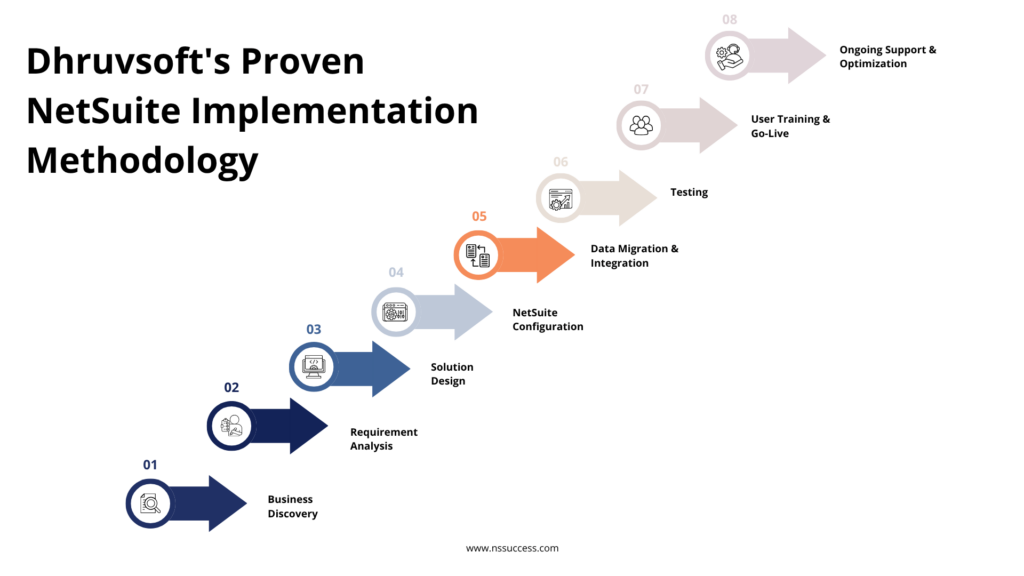
At Dhruvsoft, our NetSuite implementation approach focuses on aligning the ERP platform with your business requirements.
- Business Discovery: We begin by understanding your distribution business, organizational structure, current processes, operational challenges, and business objectives.
- Requirement Analysis: Our team identifies business requirements, process gaps, automation opportunities, reporting needs, integration requirements, and areas where NetSuite can improve operational efficiency.
- Solution Design: We develop a NetSuite solution aligned with your business processes, including the appropriate modules, workflows, roles, dashboards, customizations, integrations, and data structures.
- NetSuite Configuration: We configure NetSuite based on the approved solution design and business requirements, ensuring the system supports your key distribution processes.
- Data Migration & Integration: We prepare, cleanse, map, and migrate relevant business data into NetSuite, including customers, vendors, items, inventory, and financial information. We also integrate NetSuite with ecommerce platforms, CRM systems, payment gateways, logistics applications, marketplaces, and other third-party systems.
- Testing: We conduct functional and process testing to validate workflows, integrations, data, and system functionality and identify issues before go-live.
- User Training & Go-Live: We provide role-based training to help employees understand the NetSuite processes and functionality relevant to their responsibilities. We then support your team during the transition to the new NetSuite environment and help address initial issues.
- Ongoing Support & Optimization: Our relationship does not end at go-live. NSSuccess provides ongoing NetSuite support, optimization, enhancements, integration support, troubleshooting, and system improvements as your distribution business evolves.
Why Choose Dhruvsoft for NetSuite Wholesale Distribution ERP?
Choosing the right implementation partner is an important part of a successful ERP project. A distribution business needs a partner that understands both NetSuite and the operational complexity of wholesale distribution. Dhruvsoft combines NetSuite consulting experience with business process understanding to help companies implement and optimize their ERP environment.
Wholesale Distribution Understanding
We understand the importance of inventory, purchasing, order management, fulfillment, pricing, supplier management, customer management, and financial control in distribution businesses.
- End-to-End NetSuite Services: Our services can cover NetSuite consulting, implementation, customization, integration, data migration, optimization, and ongoing support.
- Business-Focused Approach: We focus on business processes rather than simply configuring software. Our goal is to align NetSuite with how your organization operates.
- Scalable Solutions: We design solutions that can support business growth, new locations, additional users, new channels, and changing operational requirements.
- Integration Expertise: We help connect NetSuite with the other applications your business relies on, creating a more connected technology ecosystem.
- Ongoing NetSuite Support: After implementation, our team can help with system improvements, troubleshooting, enhancements, integrations, and optimization.
- Industry-Oriented Solutions: Our NetSuite team works with businesses across different industries and can adapt NetSuite capabilities to specific distribution requirements.
Frequently Asked Questions
1. What is NetSuite Wholesale Distribution?
NetSuite Wholesale Distribution refers to using NetSuite ERP to manage the key operations of a wholesale distribution business, including inventory, purchasing, sales, order management, warehouse operations, financials, CRM, and reporting.
2. Is NetSuite suitable for wholesale distribution companies?
Yes. NetSuite provides ERP capabilities that can support many of the core processes used by wholesale distributors, including inventory management, purchasing, sales, fulfillment, warehouse operations, financial management, and reporting.
3. What wholesale distribution processes can NetSuite manage?
NetSuite can support processes such as procurement, inventory management, sales order management, warehouse operations, fulfillment, invoicing, accounts receivable, accounts payable, financial reporting, customer management, and business analytics.
4. Can NetSuite manage inventory across multiple warehouses?
Yes. NetSuite can provide centralized inventory visibility across multiple locations and support inventory management processes across warehouses and business locations.
5. Can NetSuite handle customer-specific pricing?
NetSuite can support different pricing structures and pricing rules, helping businesses manage customer-specific prices, quantity-based pricing, discounts, and other pricing requirements.
6. Can NetSuite integrate with ecommerce platforms?
Yes. NetSuite can be integrated with ecommerce platforms and other third-party applications. The exact integration approach depends on the platforms, business processes, and data that need to be exchanged.
7. Can NetSuite support multi-entity wholesale distribution businesses?
Yes. NetSuite provides capabilities for managing multiple entities and locations, including consolidated financial reporting and multi-currency operations where required.
8. How long does a NetSuite wholesale distribution implementation take?
Implementation timelines vary depending on factors such as business size, number of entities and locations, data volume, required customizations, integrations, modules, and process complexity. A detailed discovery and requirements assessment is generally required before establishing a project timeline.
9. Does Dhruvsoft provide NetSuite customization and integration?
Yes. Dhruvsoft provides NetSuite consulting, implementation, customization, integration, data migration, optimization, and ongoing support services for businesses with different operational requirements.
10. Can Dhruvsoft support us after NetSuite implementation?
Yes. Our NetSuite support services can help businesses with troubleshooting, enhancements, integrations, customizations, optimization, user support, and ongoing system improvements after implementation.
Start Your NetSuite Wholesale Distribution Journey with NSSuccess
Your ERP should do more than record transactions. It should help connect your people, processes, data, and business operations. With NetSuite for Wholesale Distribution, your organization can create a centralized platform for managing inventory, purchasing, sales, warehouse operations, customer relationships, and financial processes.
NSSuccess, powered by Dhruvsoft, can help you plan, implement, integrate, customize, and optimize NetSuite based on your distribution business requirements. Whether you are replacing legacy systems, consolidating multiple applications, expanding into new locations, improving inventory visibility, or looking to automate manual processes, our NetSuite experts can help you build a scalable ERP environment.
Ready to modernize your wholesale distribution operations? Talk to our NetSuite experts about your wholesale distribution requirements today.
 “NS Success” is the NetSuite Consulting Practice of Dhruvsoft Services Private Limited – a leading NetSuite Solution Provider Partner from India – providing services worldwide …