
Trading businesses run on thin margins and tight timing. A wholesale distributor might be managing thousands of SKUs across multiple warehouses, while a retailer is juggling in-store and online sales that need to reflect the same inventory count in real time. In both cases, the businesses that struggle are usually not the ones with bad products or weak sales teams. They are the ones running their operations on disconnected systems that cannot keep up with the pace and complexity of trading.
A separate accounting package, a separate inventory spreadsheet, a separate e-commerce platform, and a separate reporting tool might work when a trading company is small. But as order volume grows, as new sales channels are added, and as suppliers and customers expand across regions, that patchwork starts to break down in expensive and visible ways: stockouts on best-sellers, overstock on slow movers, pricing errors, and a finance team that never quite trusts the numbers in front of them.
This is exactly the problem Oracle NetSuite was built to solve for wholesale distributors and retailers. This guide covers what makes trading businesses operationally unique, the specific challenges NetSuite addresses, and what a well-executed NetSuite implementation actually looks like for a trading company.
Why Trading Companies Have Unique ERP Needs
Wholesale distribution and retail are not the same as manufacturing or professional services, and generic business software often falls short because of it. Trading companies live and die by a few specific operational realities: inventory that moves constantly across locations, pricing that varies by customer or channel, order volumes that can spike seasonally, and margins that are won or lost in the details of purchasing and fulfillment. An ERP built for trading needs to handle all of this natively, not as an afterthought bolted onto a generic accounting system.
Common Operational Challenges for Distributors and Retailers
Most trading companies that eventually look at NetSuite are already feeling a familiar set of pain points, even if they have not named them yet:
- Inventory counts that differ between the warehouse, the accounting system, and the online store
- Stockouts on fast-moving products alongside excess inventory sitting unsold in another location
- Manual, spreadsheet-based purchase order and reorder processes that cannot keep pace with demand
- Pricing inconsistencies across different customer tiers, channels, or regions
- Slow, error-prone order fulfillment that delays shipping and frustrates customers
- Disconnected point-of-sale, e-commerce, and back-office systems that all need manual reconciliation
- Limited visibility into which products, customers, or channels are actually profitable
- Difficulty scaling operations into new warehouses, regions, or sales channels without adding headcount at the same rate
Individually, each of these problems looks manageable. Together, they quietly erode margin every single month, often without showing up clearly on a profit and loss statement until the damage is already done.
How NetSuite Solves These Challenges
- Unified Inventory Management: NetSuite gives trading companies a single, real-time view of inventory across every warehouse, store, and sales channel. Instead of reconciling separate systems, stock levels update automatically as orders are placed, received, or fulfilled, which means the number showing in the system actually matches what is on the shelf.
- Multi-Location and Multi-Channel Support: For distributors operating multiple warehouses, or retailers selling through physical stores, e-commerce, and marketplaces simultaneously, NetSuite consolidates all of it into one platform. Orders can be fulfilled from the optimal location automatically, and inventory visibility extends across every channel rather than being siloed by location or platform.
- Demand Planning and Reorder Automation: NetSuite uses historical sales data and demand forecasting to help trading companies know what to reorder, when, and in what quantity, reducing both stockouts on popular items and excess capital tied up in slow-moving inventory.
- Flexible, Rules-Based Pricing: Trading businesses frequently need different pricing for different customer tiers, volume levels, contracts, or regions. NetSuite supports rules-based pricing that applies consistently and automatically, removing the manual pricing errors that come from spreadsheet-based price lists.
- Order Management and Fulfillment: From the moment an order is placed to the moment it ships, NetSuite manages the full order-to-cash process, connecting sales, inventory, and fulfillment so orders move faster and with fewer manual touchpoints.
- Integrated Point of Sale: For retailers, NetSuite’s point-of-sale capability connects in-store transactions directly to the same inventory and financial system used for e-commerce and wholesale operations, eliminating the end-of-day reconciliation that comes with a disconnected POS system.
- Financial Management and Reporting: Because inventory, sales, and purchasing all live in the same system as the general ledger, financial reporting reflects real operational activity in real time rather than requiring a separate reconciliation process at month-end.
Key NetSuite Features for Wholesale Distributors
- Advanced inventory management across multiple warehouses and locations
- Purchase order management with automated reorder points based on demand forecasting
- Landed cost tracking that accounts for freight, duties, and other costs affecting the true product margin
- Warehouse management, including barcode scanning and pick, pack, and ship workflows
- Vendor and supplier management, including performance tracking and lead time visibility
- Multi-currency and multi-subsidiary support for distributors working with international suppliers or customers
Key NetSuite Features for Retailers
- Unified commerce, connecting in-store, online, and marketplace sales into a single system
- Integrated point-of-sale that shares real-time inventory and customer data with the back office
- Customer relationship management that tracks purchase history across every channel
- Promotions and pricing management, including discounts, bundles, and loyalty programs
- Real-time sales and inventory dashboards for store-level and company-wide visibility
- Returns and exchange management that stays consistent across in-store and online channels
The Business Impact: What Changes After Implementation
The value of moving trading operations onto NetSuite tends to show up in a few consistent, measurable ways. Inventory accuracy improves significantly once every location and channel is drawing from the same real-time data. Order fulfillment speeds up because staff are no longer manually checking stock across multiple systems before confirming an order. Purchasing decisions improve because reorder recommendations are based on actual demand data rather than gut feel or outdated spreadsheets. And margin visibility improves because landed costs, pricing rules, and sales data all flow into the same reporting layer, making it possible to see which products and customers are actually profitable rather than just which ones generate the most revenue.
None of this happens automatically simply by purchasing the software. It happens when the system is configured around how a specific trading business actually operates, which is why implementation quality matters as much as the platform itself.
Industry-Specific Applications
- Consumer Goods Distribution: Distributors of consumer goods typically manage high SKU counts, seasonal demand swings, and relationships with both large retail buyers and smaller independent accounts. NetSuite’s demand planning and rules-based pricing help these businesses manage volume and pricing complexity without adding administrative overhead.
- Apparel and Fashion: Apparel distributors and retailers deal with size and color matrices, seasonal collections, and markdown management. NetSuite handles matrix items natively and gives merchandising teams the visibility they need to manage markdowns and seasonal transitions without excess inventory pile-up.
- Food and Beverage Distribution: Distributors in food and beverage need lot tracking, expiration date management, and traceability in case of a recall. NetSuite supports lot and serial tracking natively, giving these businesses the compliance and traceability capabilities that generic inventory tools typically lack.
- Electronics and Industrial Supply: Electronics and industrial distributors often manage complex vendor relationships, long lead times, and landed cost calculations that significantly affect true product margin. NetSuite’s purchasing and landed cost tools give these businesses accurate margin visibility on every order, even when freight, duties, and long lead times complicate the true cost of goods.
- Retail and Specialty Stores: Specialty retailers benefit from NetSuite’s unified commerce approach, allowing a single view of inventory and customer activity whether a sale happens in-store, online, or through a marketplace, which is increasingly what customers expect from any retail brand today.
Managing Growth Across Regions and Entities
Many trading companies eventually expand beyond a single warehouse or region, whether that means opening a second distribution center, entering a new country, or operating through a separate legal entity for tax or logistics reasons. This kind of growth is exactly where disconnected systems tend to break down fastest, since each new location often means another spreadsheet, another local software instance, or another manual process to keep things aligned with headquarters.
NetSuite handles this kind of expansion natively through built-in multi-subsidiary and multi-currency support. A distributor opening a new regional warehouse, or a retailer expanding into a new country, can add that entity within the same NetSuite instance rather than standing up a separate system and building a custom integration to keep it connected to the rest of the business. Financial consolidation across entities happens automatically, which means leadership can see a true, real-time picture of the whole business rather than waiting for someone to manually combine results at month-end.
Total Cost of Ownership and Return on Investment
Trading companies evaluating NetSuite often start by comparing its subscription cost against what they are already paying for their current accounting, inventory, and e-commerce tools. That comparison is useful, but it only tells part of the story. The bigger cost most businesses are not tracking closely is the cost of inefficiency: the hours staff spend reconciling inventory between systems, the lost sales from stockouts that better demand planning would have prevented, the margin quietly lost to pricing errors, and the working capital tied up in excess inventory sitting in the wrong location.
When trading companies calculate return on investment for a NetSuite implementation, the strongest results typically come from a combination of factors: fewer hours spent on manual reconciliation, faster order fulfillment that improves customer retention, better demand planning that reduces both stockouts and excess inventory, and more accurate margin visibility that allows pricing and purchasing decisions to actually reflect profitability rather than guesswork. For most growing distributors and retailers, these operational gains outweigh the platform’s cost well within the first year or two of going live.
What a NetSuite Implementation Looks Like for a Trading Company
Step 1: Assess Current Operations
The implementation process starts with a clear-eyed look at how inventory, purchasing, sales, and fulfillment actually work today, including where manual workarounds and disconnected systems are creating the most friction.
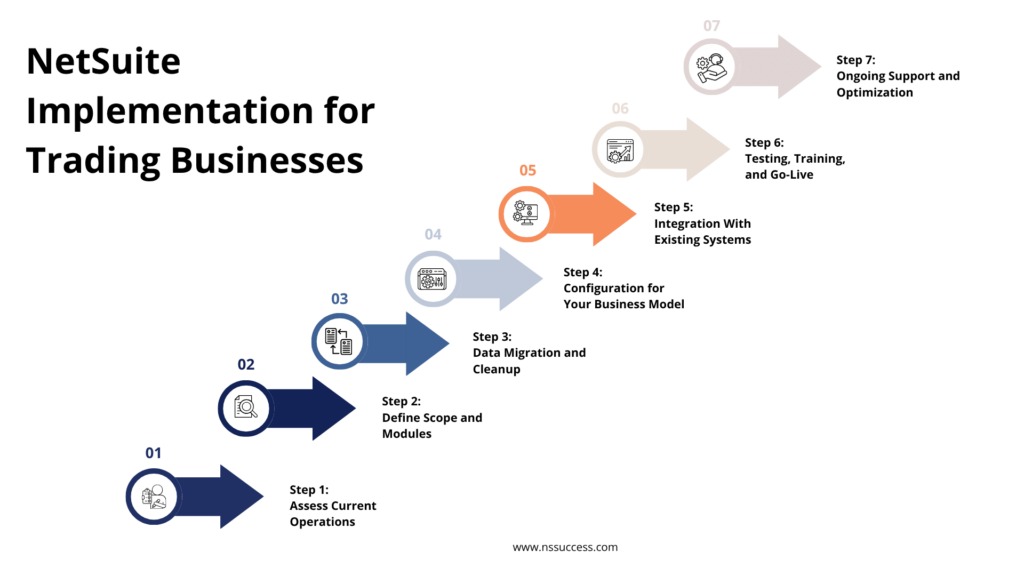
Step 2: Define Scope and Modules
Based on that assessment, the right combination of modules is identified, which might include inventory management, order management, point of sale, warehouse management, or demand planning, depending on whether the business is primarily wholesale, retail, or a hybrid of both.
Step 3: Data Migration and Cleanup
Product catalogs, customer and vendor records, historical sales data, and current inventory counts are cleaned and migrated into NetSuite. For trading companies, this step is particularly important since inaccurate starting inventory data undermines trust in the system from day one.
Step 4: Configuration for Your Business Model
Pricing rules, warehouse workflows, reorder points, and reporting are configured to match the specific way the business operates, rather than forcing operations to adapt to a generic template.
Step 5: Integration With Existing Systems
For businesses keeping an existing e-commerce platform, POS system, or shipping carrier integration, these connections are built and tested as part of the implementation, so the full technology stack works together rather than in isolation.
Step 6: Testing, Training, and Go-Live
Before go-live, the system is tested against real order and inventory scenarios, and warehouse, sales, and finance teams are trained so operations can continue smoothly from the very first day on the new platform.
Step 7: Ongoing Support and Optimization
After go-live, continued support helps refine workflows, add new sales channels or locations, and make sure the system keeps evolving alongside the business rather than becoming outdated a few years down the line.
Signs Your Trading Business Is Ready for NetSuite
- Inventory data regularly does not match across systems or locations
- Your team spends significant time manually reconciling orders, inventory, and financial data
- You are adding new sales channels or warehouses faster than your current systems can support
- Pricing errors or inconsistencies are creating customer service issues or margin leakage
- Leadership cannot get a real-time view of profitability by product, customer, or channel
- Your current accounting software was not designed to handle inventory or order complexity at your current scale
Why the Right NetSuite Implementation Partner Matters
For trading companies, the difference between a NetSuite implementation that delivers real operational improvement and one that simply digitizes existing inefficiencies almost always comes down to the implementation partner. The right partner understands the specific rhythms of wholesale distribution and retail, from seasonal demand planning to multi-channel fulfillment, and configures the platform around those realities rather than applying a generic template.
How NsSuccess (the NetSuite practice of Dhruvsoft) Helps
- NetSuite implementation designed specifically for wholesale distribution and retail operations
- Inventory, warehouse, and order management configuration tailored to your business model
- Point-of-sale and e-commerce integration for unified, multi-channel operations
- Data migration and cleanup to protect inventory and financial accuracy from day one
- Ongoing support and optimization as your product lines, channels, and locations grow
Conclusion: Building an Operation That Can Actually Scale
Wholesale distributors and retailers do not need more software. They need one connected system that gives them accurate inventory, reliable fulfillment, and real financial visibility across every location and channel they operate in. Piecing that together from separate accounting, inventory, and e-commerce tools might work at a small scale, but it becomes a genuine liability as order volume, product complexity, and channel count grow.
Oracle NetSuite was built to solve exactly this problem, giving trading companies a single platform that connects purchasing, inventory, sales, fulfillment, and financial reporting, so growth does not have to mean adding more manual work and more disconnected systems along the way.
Frequently Asked Questions
Is NetSuite suitable for small and mid-sized wholesale distributors, or only large enterprises?
NetSuite is used by trading companies of many sizes, from growing wholesale distributors to large, multi-national retail organizations. Its modular structure allows a business to start with the core functionality it needs and add more capability as it grows, rather than requiring enterprise-scale complexity from day one.
Can NetSuite handle both wholesale and retail operations in one system?
Yes. NetSuite is well suited to hybrid businesses that sell both wholesale and direct to consumer, since it can manage different pricing structures, order types, and fulfillment workflows for each channel within a single connected platform.
Does NetSuite integrate with existing e-commerce platforms?
NetSuite offers both native commerce capabilities and integration options with popular third-party e-commerce platforms, allowing businesses to choose the approach that best fits their existing technology investment and future plans.
How long does a NetSuite implementation typically take for a trading company?
Timelines vary based on the number of locations, sales channels, and the complexity of existing data, but most trading company implementations involve several months of assessment, configuration, data migration, and testing before go-live.
Will NetSuite reduce the number of separate systems my business currently uses?
In most cases, yes. Because NetSuite unifies inventory, order management, purchasing, point of sale, and financials in a single platform, it typically allows trading companies to retire several disconnected tools that were previously required to cover the same functionality.
Ready to Bring Your Trading Business Onto One Connected Platform?
NsSuccess helps wholesale distributors and retailers implement NetSuite in a way that reflects how their business actually operates, from inventory and warehouse management to point of sale and multi-channel fulfillment. If disconnected systems are slowing down your operations or hiding your real margins, our NetSuite experts can help you build a platform that scales with your business. Contact NsSuccess today to start the conversation.

 “NS Success” is the NetSuite Consulting Practice of Dhruvsoft Services Private Limited – a leading NetSuite Solution Provider Partner from India – providing services worldwide …