
As businesses expand internationally, tax compliance stops being a back-office finance task. Entering a new country can bring new VAT registrations, sales tax obligations, withholding requirements, reporting rules, and electronic invoicing mandates. Regulations also keep changing, which makes manual processes harder to sustain.
For CFOs and finance leaders, the challenge is not calculating the right tax on a single transaction. It is building a connected tax process that works consistently across countries, subsidiaries, customers, vendors, currencies, and transaction types.
Oracle NetSuite can play an important role here. It provides a centralized financial platform that connects transaction processing, tax determination, invoicing, accounting, and reporting. Depending on the countries involved and the complexity of the requirements, businesses combine NetSuite’s native capabilities with SuiteTax, country localization, third-party tax engines, and e-invoicing solutions.
This guide explains how to use NetSuite to manage VAT, sales tax, withholding tax, and e-invoicing while building a tax architecture that scales with international growth.
Why Global Tax Compliance Gets Harder as Companies Grow
A company operating in one country usually has a manageable tax process. Expansion changes that quickly, especially with multiple legal entities or cross-border sales. Common challenges include:
- Different tax rules and rates across jurisdictions
- Multiple VAT or sales tax registrations
- Changing legislation and compliance deadlines
- Incorrect tax classifications for customers and vendors
- Manual calculations and spreadsheet-based processes
- Country-specific invoice, reporting, and documentation rules
- Cross-border withholding tax obligations
- Expanding e-invoicing and real-time reporting mandates
- Difficulty reconciling tax liabilities across subsidiaries
- Limited group-level visibility into tax exposure
The question for a growing organization becomes: Can our financial system consistently determine, calculate, record, report, and document tax obligations in every jurisdiction where we operate? A well-designed NetSuite tax architecture helps answer it.
The Four Building Blocks of Global Tax Compliance
Most tax frameworks rest on four activities:
- Tax determination: deciding whether tax applies and which type and rate, based on the parties, location, and product or service.
- Tax calculation: applying the right rate, including tax-inclusive and tax-exclusive pricing, exemptions, and reverse charge.
- Tax reporting: capturing transaction data in a form that supports statutory returns, management reporting, and reconciliation.
- Compliance and documentation: keeping invoices, audit trails, certificates, and electronic submissions in line with each jurisdiction’s rules.
A NetSuite tax implementation should connect all four inside one system, rather than spreading them across disconnected tools.
Managing VAT Across Regions
VAT is the standard consumption tax across Europe, the Middle East, Africa, and much of the Asia-Pacific. Rates, exemptions, registration thresholds, and reporting formats still differ meaningfully by country, so a single global VAT configuration is risky. Depending on country configuration and licensed capabilities, NetSuite can manage:
- Tax codes and rates by jurisdiction
- Tax-inclusive and tax-exclusive transactions
- Input tax on purchases and output tax on sales
- VAT reporting for statutory filings
- Customer and vendor tax registration data
- VAT treatment across multiple subsidiaries
On the sales side, the system determines whether VAT applies, which rate is relevant, where the supply is taxable, and how VAT appears on the invoice. On the purchasing side, finance gets visibility into recoverable and non-recoverable input VAT and each vendor’s tax status. Keeping this inside NetSuite, not in a side spreadsheet, cuts the manual reconciliation that typically causes errors.
Sales Tax for US and Multi-State Operations
US sales tax works very differently from VAT. Liability can depend on the customer’s location, the seller’s nexus, the product or service type, and jurisdictions down to city or county level.
NetSuite acts as the financial system of record, while tax determination is often handled by native capabilities combined with a specialized third-party tax engine, depending on complexity. An ERP does not make a business compliant in every state simply because tax functionality exists in the platform. The architecture has to be designed around the company’s actual nexus footprint, product taxability rules, and filing obligations.
Withholding Tax Management
Many countries require tax to be deducted at the point of payment. Businesses commonly withhold on payments to vendors and suppliers, independent contractors, professional service providers, and non-resident entities.
When withholding is handled manually, businesses run into incorrect rates, outdated vendor records, delayed certificates, and difficult reconciliations. These problems usually surface during a filing deadline or an audit.
NetSuite centralizes vendor records, transactions, and accounting entries. Country-specific withholding rules typically require localization or supporting tools. Before implementation, finance teams should define the withholding categories, rates, thresholds, vendor classifications, and certificate requirements for each country.
E-Invoicing Is Now a Core Compliance Requirement
Governments are moving from after-the-fact invoice reporting to real-time or near-real-time systems. In these systems, invoice data must be submitted to or validated by a tax authority or authorized platform at or near the time of issue. Mandates are active or expanding in India, Saudi Arabia, Italy, Mexico, Brazil, and a growing number of European and Middle Eastern jurisdictions.
Rules, formats, and timelines differ by country and continue to evolve, so e-invoicing is not a one-time setup. Businesses that treat it as a formatting exercise often underestimate the integration work and discover compliance gaps later.
How NetSuite Fits Into a Global E-Invoicing and Tax Workflow
NetSuite is typically where the underlying transaction data originates. A connected eInvoicing and tax workflow looks like this:
- Customer or vendor setup: capture legal name, tax registration number, address, country, and tax classification at onboarding.
- Transaction creation: orders and purchases are entered through normal order-to-cash and procure-to-pay activity.
- Tax determination and calculation: configured rules, and where applicable, an integrated tax engine, determine and calculate tax.
- Invoice generation: the invoice carries all required tax information in the format the jurisdiction expects.
- E-invoice submission: where mandated, the invoice is validated, transformed into the required format, and submitted. The authority’s response, such as clearance or acknowledgment, is captured.
- Accounting: tax amounts post to the correct general ledger accounts.
- Reporting and reconciliation: finance uses the same data for returns, reconciliation, audits, and analysis.
Depending on the jurisdiction, this relies on a combination of NetSuite country localization, SuiteTax, Oracle-supported functionality, certified third-party e-invoicing providers, middleware, and country-specific tax applications. The right mix depends on the country, tax regime, transaction volume, and number of entities. Avoid forcing one generic e-invoicing workflow onto every country. That approach breaks down as soon as a new requirement appears.
A Note for Businesses Operating in India
In India, GST e-invoicing requires eligible businesses to report B2B invoices to the Invoice Registration Portal (IRP) and receive an Invoice Reference Number (IRN) and signed QR code before the invoice is valid. Withholding takes the form of TDS, with its own sections, rates, and certificate requirements. Both should be scoped from the start of a NetSuite implementation for any Indian entity, typically through India localization and a GST Suvidha Provider (GSP) or e-invoicing connector.
SuiteTax and Multi-Subsidiary Tax Management
For complex, multi-country requirements, SuiteTax offers more flexible configuration and determination logic than NetSuite’s legacy tax framework. Its benefits include:
- Centralized tax management across subsidiaries
- Rules-based tax configuration
- Support for multi-jurisdiction scenarios
- Integration with external tax engines
- Clearer visibility into tax transactions and reporting
Most global businesses operate several legal entities with different currencies and tax registrations. NetSuite OneWorld lets organizations centralize financial management while respecting the tax boundaries between subsidiaries. A good global framework standardizes several things: tax codes, registration data, customer and vendor tax information, chart of accounts alignment, approvals for tax-sensitive transactions, and compliance calendars. Country-specific needs, such as local invoice layouts or unique withholding rules, are then handled through targeted localization rather than custom builds for every entity. SuiteTax still needs careful tax and process design up front. Configuration should follow the organization’s tax requirements, not the other way round.
What This Means for CFOs
Tax affects cash flow, profitability, planning, and risk, so CFOs increasingly want direct sight of tax data. With tax centralized in NetSuite, finance leaders get a more current, consolidated view of:
- Total tax liabilities across entities
- Tax collected versus tax due
- Payments made and outstanding obligations
- Transaction volumes by jurisdiction
- Compliance status ahead of filing deadlines
Tax also runs through accounts receivable and accounts payable. It affects invoices, credit memos, and collections on one side, and vendor bills, withholding, and recoverable input tax on the other. Building tax logic into these processes gives finance control across the full transaction lifecycle instead of reconciling tax after the fact.
Audit Readiness
During a tax audit, finance teams need fast answers to a few questions. Where did the transaction originate? Which tax treatment and rate were applied, and why? Which customer or vendor was involved? Was the invoice correctly issued and reported, and submitted electronically where required? What accounting entry resulted?
A connected ERP makes these relationships much easier to trace than a patchwork of spreadsheets, provided the organization maintains consistent configurations, approval controls, retention policies, and regular reconciliations.
Common Mistakes in NetSuite Tax Implementations
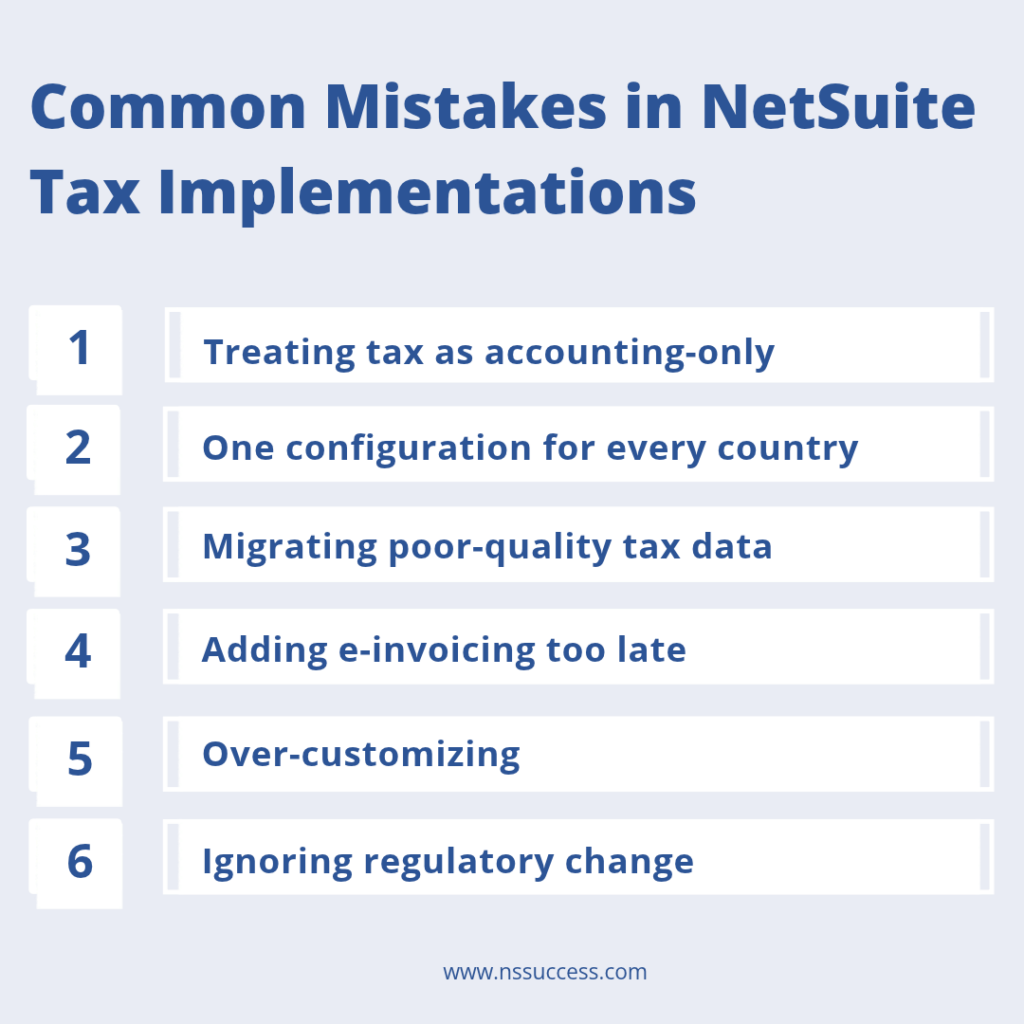
- Treating tax as accounting-only: Tax touches sales, procurement, billing, inventory, and reporting.
- One configuration for every country: Standardize the framework, but address local requirements.
- Migrating poor-quality tax data: Wrong registrations, classifications, or exemption data cause problems after go-live.
- Adding e-invoicing too late: Design for it from the start, not as a final integration task.
- Over-customizing: Prefer standard functionality and supported localization wherever they meet the requirement.
- Ignoring regulatory change: Rates, formats, and mandates keep evolving after go-live.
A CFO’s Checklist for NetSuite Tax Architecture
Before approving the design, finance leaders should be able to answer:
- Does the ERP support every country where we operate today?
- Which requirements need localization, configuration, or a third-party tax engine?
- Which countries require e-invoicing now, and which will soon?
- How will withholding tax be calculated, tracked, and reported?
- How will registrations be maintained and new countries onboarded, as we grow?
- What is the process for implementing tax rule changes, and who owns tax configuration long term?
- Can we reconcile tax liabilities easily at period close, and are our reports auditable end to end?
Why the Right Implementation Partner Matters
Global tax implementation sits where ERP, finance, tax, and compliance meet. It takes a partner who understands how tax obligations flow through a business, not just how NetSuite is configured. An experienced partner helps you:
- Assess current tax processes
- Document country-specific tax and e-invoicing requirements
- Design the target architecture and configure SuiteTax
- Plan tax engine and e-invoicing integrations
- Migrate and validate tax master data
- Test compliance scenarios, train finance teams, and support the system as regulations change
At NSSuccess, we design NetSuite around a client’s actual business processes rather than a generic configuration. Our approach follows a clear path: Assess, Design, Configure, Integrate, Test, Train, Go Live, and Optimize.
Conclusion
Tax compliance is becoming more digital. Expect more e-invoicing mandates, more real-time reporting, and more automated determination and digital audits. NetSuite provides the centralized foundation, and localization, SuiteTax, tax engines, and e-invoicing solutions are layered on according to each jurisdiction’s requirements.
The real value comes from connecting transactions, tax determination, invoicing, accounting, and reporting into one process. For finance leaders, that means better visibility, stronger controls, less manual effort, and a foundation that adapts to new rules without rebuilding the ERP each time.
Frequently Asked Questions
Can NetSuite handle tax compliance for businesses operating in more than ten countries?
Yes. NetSuite OneWorld is designed for multi-entity, multi-country operations, and SuiteTax supports subsidiary-level tax configuration. Each entity can follow local rules while rolling up into consolidated reporting. The real constraints are configuration depth and the quality of localization and third-party integrations, not the number of jurisdictions.
Does NetSuite calculate VAT and sales tax automatically?
Once tax rules, nexus, and rates are configured for each subsidiary and jurisdiction, NetSuite applies tax on transactions without manual code entry. For US sales tax, many implementations add a dedicated tax engine to keep state and local rates current.
Is NetSuite e-invoicing compliant with mandates in Europe, the Middle East, India, and Latin America?
NetSuite supports e-invoicing in many mandated markets through localization features and certified connectors, depending on each country’s model. Because mandates change frequently, coverage should be validated country by country during implementation. NSSuccess helps clients confirm the right approach for their footprint.
How does NetSuite handle withholding tax on cross-border vendor payments?
NetSuite holds the vendor records, transactions, and accounting entries. Withholding rules, such as rates by vendor classification, payment type, or treaty status, are typically configured through country localization or supporting tools. Once set up, withholding is applied during payment processing, and the data feeds filings and vendor certificates.
How long does a tax-ready NetSuite implementation take for a multi-country business?
It depends on the number of subsidiaries, jurisdictions, and integrations. Tax is usually planned as a core work-stream within the overall implementation, not a separate project. A business in one or two countries moves faster than one with several e-invoicing mandates or many US nexus states.
Can NetSuite reduce the risk of tax audits and penalties?
A properly configured setup reduces risk by generating calculations, exemption handling, and filing data consistently from one system of record. It does not replace tax expertise, but it removes many of the manual errors that typically lead to penalties and audit findings.
Ready to Simplify Global Tax Compliance With NetSuite?
NSSuccess helps growing and global organizations design, implement, integrate, and optimize Oracle NetSuite for complex financial and operational requirements. Whether you’re managing VAT, sales tax, withholding tax, e-invoicing, multi-entity accounting, or international expansion, our NetSuite specialists can help you build a scalable, compliance-ready ERP environment.
Talk to NSSuccess about your NetSuite tax and financial transformation requirements.

 “NS Success” is the NetSuite Consulting Practice of Dhruvsoft Services Private Limited – a leading NetSuite Solution Provider Partner from India – providing services worldwide …