
Non-profit organizations operate with a unique financial responsibility. Unlike commercial businesses that primarily focus on revenue and profitability, non-profits must demonstrate how donations, grants, and other funding sources support their mission. They must manage restricted funds, monitor program expenses, comply with grant conditions, and provide transparent reports to donors, boards, auditors, and funding agencies.
As nonprofit operations expand, managing these responsibilities through spreadsheets, standalone accounting systems, and disconnected donor databases becomes increasingly difficult. Finance teams may spend hours reconciling transactions, tracking grant expenditures, preparing financial statements, and collecting information from different departments.
These challenges can affect financial visibility, reporting accuracy, and the organization’s ability to make timely decisions. NetSuite for nonprofit organizations is a cloud-based ERP platform that connects fund accounting, grant tracking, donation and pledge accounting, program expenses, purchasing, and financial reporting. Oracle delivers these capabilities through its Social Impact editions and nonprofit SuiteApps, so what an organization gets depends on the edition it licenses and how the system is configured.
In this article, we explore how NetSuite can help non-profits improve fund accounting, grant management, donor reporting, and financial accountability, which editions and SuiteApps provide each capability, along with the implementation considerations that IT and finance leaders should evaluate.
What Is NetSuite for Non-profit Organizations?
NetSuite is a cloud-based ERP platform that helps organizations manage financial and operational processes within a connected system. For nonprofit organizations, NetSuite can be configured to support donation accounting, grant tracking, budgeting, program expenditure monitoring, financial consolidation, procurement, and management reporting.
Rather than maintaining separate spreadsheets for every grant or program, finance teams can use a structured financial system with consistent transaction records and reporting dimensions. Key capabilities include:
- Fund and revenue restriction tracking.
- Grant income and expenditure management.
- Budgeting and financial forecasting.
- Donation and pledge accounting.
- Program and project expense reporting.
- Accounts payable and receivable.
- Financial statements and management dashboards.
- Multi-entity and multi-currency financial management, where required.
- Integration with donor management, fundraising, payroll, and other business applications.
NetSuite Non-profit Editions and SuiteApps
NetSuite’s nonprofit functionality is delivered through SuiteApps installed on the core ERP. Knowing which component provides which capability helps avoid surprises during scoping.
| Component | What it provides |
|---|---|
| NFP Financials | The core nonprofit SuiteApp behind all Social Impact editions. Adds data structures for fund accounting, restrictions, programs, grants, and pledges and donations, plus nonprofit financial reports. |
| Social Impact Donation Edition | NFP Financials and nonprofit financial metrics, with a CFO role and dashboard. Designed for small non-profits. |
| Social Impact Starter Edition | Adds custom nonprofit roles, dashboards, KPIs, and scorecards. Designed for mid-size non-profits. |
| Social Impact Standard Edition | Adds NFP Constituent Management and SuiteApprovals for approval workflows. Designed for enterprise non-profits. |
| Grant Management SuiteApp | Standalone grant records, transaction tagging, dashboards, and reports for organizations not on a Social Impact edition. It cannot be installed alongside NFP Financials. |
The NetSuite Social Impact Program
Through its Social Impact program, Oracle NetSuite offers qualifying non-profits donated or discounted software, pro-bono services, and capacity-building support. Eligibility and terms vary, so confirm them with Oracle before budgeting for licenses.
Why Nonprofits Need Integrated Financial Management
Nonprofits frequently receive funding from several sources, each with its own conditions, reporting requirements, and timelines. A charitable foundation may provide funding for a specific community program. A corporate donor may sponsor an educational initiative. Individual supporters may contribute unrestricted donations that can be used for general operations.
When this information is maintained in separate systems, finance teams may struggle to determine how much funding remains available, which expenses qualify for reimbursement, and whether a particular program is operating within budget. Common challenges include:
- Limited visibility into restricted funds: Restricted donations and grants must be used according to the conditions established by the donor or grant agreement. Without reliable tracking, organizations may find it difficult to distinguish available funding from amounts committed to specific activities.
- Manual grant expenditure tracking: Grant managers often collect expenditure information from finance teams, program managers, procurement, and field offices. Manual consolidation increases administrative work and makes it harder to identify budget variances.
- Time-consuming donor reporting: Donors and funding agencies may request different combinations of financial statements, expenditure summaries, milestones, and supporting documentation. Preparing each report manually can delay responses and increase the risk of inconsistencies.
- Disconnected financial and operational data: When finance, fundraising, inventory, and program teams use different systems, decision-makers may lack a complete view of the resources required to deliver a program.
- Difficult financial forecasting: Nonprofits need to understand both current cash availability and expected future funding. Delayed information about grant receipts, pledges, commitments, and expenditure can make cash-flow planning more difficult.
An integrated ERP approach helps address these challenges by connecting financial transactions with the funds, grants, programs, and organizational units they support.
How NetSuite Supports Fund Accounting for Nonprofits
Fund accounting is a central requirement for many nonprofit organizations. It helps them organize financial activity according to funding sources, restrictions, programs, and accountability requirements.
Unlike a simple income-and-expense summary, nonprofit fund accounting must distinguish how resources can be used and whether the organization has met the conditions attached to those resources.NetSuite can support this approach through its general ledger, chart of accounts, accounting segments, and the NFP Financials SuiteApp, which adds nonprofit segments such as Program and Restriction.
1. Tracking restricted and unrestricted funds
Nonprofits may receive unrestricted contributions for general operations and restricted contributions for particular programs or purposes. NetSuite can be configured to identify transactions by fund, program, grant, department, location, or other relevant dimensions. For example, an organization might receive funding for three initiatives:
- Education program: Funding restricted to learning materials, teacher training, and student support.
- Healthcare program: Funding designated for medical supplies and community health services.
- General operations: Unrestricted funding for approved administrative and operational expenses.
Finance teams can use appropriate accounting classifications and reporting structures to understand how funds are allocated and spent. The organization should define its accounting treatment and restriction-release process with its finance team and auditors before implementation.
2. Monitoring program expenses
Every nonprofit program has its own financial requirements. Some programs involve travel, equipment, supplies, personnel, and vendor payments, while others primarily involve service delivery. NetSuite can associate eligible transactions with the relevant programs or grants, allowing managers to compare actual expenditure against approved budgets.
For example, a program manager can review spending on supplies, personnel, and travel to identify whether expenditures are exceeding expectations. This visibility supports earlier intervention and helps organizations make informed decisions about resource allocation.
3. Improving budget control
Budget management is essential when organizations operate with fixed grants, annual donations, or funding commitments tied to specific deliverables.
NetSuite budgets let non-profits compare planned and actual spending by fund, program, or department. Grant-specific budget controls and approval rules usually need additional configuration, covered under grant management below.
4. Strengthening financial reporting
Accurate financial reporting helps nonprofit leaders demonstrate responsible stewardship of resources. NFP Financials includes nonprofit reports such as the Statement of Financial Position, Statement of Cash Flow, an NFP income statement, Expenses by Program, Expense by Grant, Revenue by Restriction, and Expenses by Functional Expense.
Organizations operating under US nonprofit accounting requirements may need reports such as statements of financial position, statements of activities, and statements of functional expenses. Reports should be reviewed against the organization’s applicable accounting standards.
NetSuite Grant Management: From Funding Award to Final Reporting
Grant management involves more than recording money received from a funding agency. Organizations must manage the complete grant lifecycle, including applications, awards, budgets, spending conditions, milestones, reporting deadlines, and financial reconciliation. NetSuite’s grant management capabilities can help organizations centralize grant-related financial information and monitor the use of awarded funds.
1. Centralized grant information
A nonprofit may manage multiple grants simultaneously, each with different funding amounts, project periods, eligible expenses, and reporting requirements. A structured grant record should capture relevant information, including:
- Grantor or funding organization.
- Approved award amount.
- Grant start and end dates.
- Funding restrictions and eligible expenditure categories.
- Associated programs and departments.
- Reporting deadlines and milestones.
- Budget allocations and financial transactions.
The level of detail and automation depends on whether the organization uses a Social Impact edition or the standalone Grant Management SuiteApp, and on any separate application used for grant applications and relationships.
2. Grant budget versus actual expenditure
One of the most important grant management requirements is ensuring that expenditure remains within approved limits and meets the funding agreement’s conditions. Consider a nonprofit that receives a grant of $250,000 for a workforce development program. The approved budget includes:
| Expense category | Approved budget |
|---|---|
| Training and workshops | $100,000 |
| Learning materials | $45,000 |
| Program personnel | $75,000 |
| Travel and field activities | $20,000 |
| Monitoring and evaluation | $10,000 |
| Total | $250,000 |
With an appropriately configured NetSuite solution, the finance team can associate eligible transactions with the grant and review actual expenditure against these budget categories. If training costs increase beyond the planned amount, the organization can investigate the variance and determine whether a budget revision, internal approval, or discussion with the grantor is necessary. This process improves financial visibility and helps teams identify potential issues before grant reporting deadlines.
3. Managing grant restrictions and releases
Some grants or donations have conditions that affect when revenue can be recognized or when restrictions may be released. NetSuite’s nonprofit financial management functionality includes revenue restriction management capabilities. Restricted revenue is released once the relevant conditions are met, and recent NFP Financials versions can release eligible use-restricted revenue automatically.
This requires a clear understanding of the grant agreement, the organization’s accounting policies, and applicable accounting standards. Automating parts of the process can improve consistency, but the organization must establish appropriate validation, approval, and reconciliation procedures.
4. Monitoring deadlines and reporting obligations
Grant agreements frequently specify reporting dates, milestone requirements, and supporting documentation. Missing a deadline may delay reimbursement, create additional administrative work, or affect future funding opportunities.
A nonprofit’s grant management process should include a clear view of upcoming reporting obligations, responsible team members, required financial information, and approval status. NetSuite workflows, saved searches, dashboards, or connected project management applications can help support this process.
5. Supporting audit preparation
Grant audits and funding reviews may require transaction details, supporting documents, approval histories, and reconciliations. Maintaining consistent transaction classifications and documentation can make it easier to trace grant expenditures from a summary report back to the underlying financial records. The goal is to establish a reliable audit trail rather than relying on manual searches across email, spreadsheets, and separate accounting applications.
Donor Reporting and Contribution Management
Donor trust depends on transparent communication and responsible use of contributions. Organizations must maintain accurate donation records, provide appropriate acknowledgments, and explain how funding supports their mission.
NetSuite can support the financial side of donor management by connecting donations, pledges, receipts, and related transactions with accounting and reporting processes.
For broader fundraising and relationship management, organizations may use NetSuite’s constituent management functionality (included in the Social Impact Standard Edition) or integrate a dedicated donor CRM, depending on their needs.
1. Maintaining reliable donation records
A nonprofit may receive one-time gifts, recurring donations, corporate contributions, foundation grants, and in-kind donations. Its financial system should record the relevant transaction details, including the amount, receipt date, payment method, accounting classification, and applicable restriction.
For in-kind contributions, the organization should establish appropriate valuation and accounting procedures based on its policies and applicable standards.
2. Improving donor financial transparency
Donors and grantors may want to understand how contributions are allocated and what expenditures have occurred. NetSuite reporting can help finance teams produce financial summaries that connect funding with relevant programs and expenditure categories.
For example, a donor-funded literacy initiative may require a report showing contributions received, training costs, educational materials purchased, and remaining available funds. The report should be generated from validated financial information and reviewed before it is shared externally.
3. Supporting pledge management
Some donors commit to contributions that will be paid over time rather than immediately. NFP Financials includes pledge and donation management, so NetSuite can help track pledge-related receivables, expected receipts, payment schedules, and outstanding balances.
This information can contribute to cash-flow forecasting and help finance teams follow up on outstanding commitments. Recognition of pledge revenue and receivables must follow the organization’s accounting policies and applicable requirements.
4. Connecting donor engagement with financial records
Financial reporting alone does not provide a complete picture of donor relationships. Fundraising teams may also need contact histories, campaign participation, communication preferences, giving patterns, and engagement records.
Organizations should determine whether their NetSuite nonprofit configuration meets these needs or whether a dedicated CRM or fundraising platform should be integrated with the ERP.A well-designed integration can help reduce duplicate data entry and improve coordination between fundraising and finance teams while maintaining appropriate access controls.
Financial Reporting and Dashboards for Nonprofit Leaders
Nonprofit executives need timely financial information to evaluate program performance, monitor funding availability, and make operational decisions. NetSuite reporting and dashboard capabilities can provide visibility into financial activity when transactions are consistently classified and the relevant reporting structures are configured correctly.
Key reports nonprofits should consider
| Report | Business purpose |
|---|---|
| Statement of financial position | Understand assets, liabilities, and net assets. |
| Statement of activities | Review revenue, expenses, and changes in net assets. |
| Cash-flow report | Monitor liquidity and expected cash requirements. |
| Grant budget versus actuals | Identify spending variances against approved funding. |
| Program expense report | Understand the financial resources used by each program. |
| Restricted fund report | Review balances and transactions associated with funding restrictions. |
| Donation and pledge report | Monitor contributions received and outstanding commitments. |
| Accounts payable aging | Identify outstanding supplier obligations. |
| Budget variance report | Compare planned expenditure with actual results. |
Building role-based dashboards
Different nonprofit stakeholders require different levels of detail. Social Impact editions include predefined nonprofit roles and dashboards, such as CFO, grant administrator, and program manager, which can be tailored further.
- CFO and finance director: Cash position, financial performance, budget variances, and outstanding liabilities.
- Grant manager: Grant balances, expenditure against budgets, and upcoming reporting obligations.
- Program manager: Program costs, committed expenditures, and available resources.
- Executive director: Overall financial sustainability, funding trends, and program-level performance.
- Board members: Financial statements, budget performance, and high-level organizational indicators.
Role-based dashboards help users access relevant information without requiring every stakeholder to work directly with detailed accounting reports.
NetSuite for Nonprofits: Key Benefits
Implementing NetSuite with an appropriate nonprofit configuration can improve financial and operational management in several ways.
- Greater financial visibility: Connected financial records help organizations review funding, expenditure, and budget performance using consistent information.
- Improved grant accountability: Grant-related transactions can be classified and reported against the appropriate funding source and program, making financial reviews more structured.
- Reduced manual reporting effort: Automated reporting and standardized financial processes can reduce repetitive spreadsheet work and improve consistency.
- Better resource allocation: Finance and program managers can use budget and expenditure information to identify variances and prioritize available resources.
- More consistent financial controls: Configured approvals, transaction validation, access restrictions, and audit trails can help organizations strengthen their financial control environment.
- Support for organizational growth: A scalable ERP foundation can help nonprofits manage additional programs, locations, entities, funding sources, and reporting requirements as their operations evolve.
These benefits depend on data quality, process design, implementation quality, user adoption, and ongoing system governance. Technology alone cannot replace sound financial policies or effective internal controls.
How to Implement NetSuite for a Nonprofit Organization
A successful implementation begins with the organization’s financial and operational requirements rather than with software configuration alone.
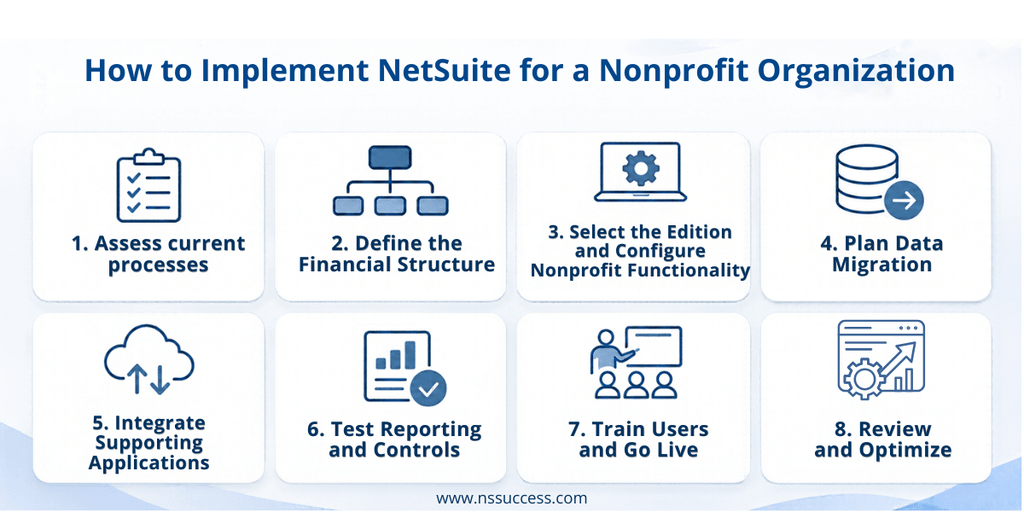
- Step 1: Assess current processes: Document existing fund accounting, donation processing, grant management, budgeting, reporting, procurement, and program management workflows. Identify manual activities, duplicate records, reporting delays, and control weaknesses.
- Step 2: Define the financial structure: Design the chart of accounts, accounting segments, fund classifications, program dimensions, grant structures, and reporting requirements. Involve finance leaders and auditors early to confirm that the proposed structure supports the organization’s accounting policies.
- Step 3: Select the edition and configure nonprofit functionality: Choose between the Social Impact Donation, Starter, and Standard editions or the standalone Grant Management SuiteApp, and check eligibility for the Social Impact program. Then configure fund tracking, grant management, donation accounting, budgeting, and reporting.
- Step 4: Plan data migration: Prepare financial balances, historical transactions, donor and grant records, open commitments, and supporting information for migration where appropriate. Clean and validate the source data before transferring it into the new system.
- Step 5: Integrate supporting applications: Determine whether the organization needs connections with donor CRM systems, fundraising applications, payment gateways, payroll platforms, banking services, or project management tools. Define how data will move between applications, which system owns each record, and how errors will be handled.
- Step 6: Test reporting and controls: Validate grant budgets, restricted fund tracking, financial statements, approval workflows, integration behavior, and role-based access. Test representative transactions from initial receipt through accounting, reporting, and reconciliation.
- Step 7: Train users and go live: Provide role-specific training for finance staff, grant managers, program managers, and other users. Complete final reconciliations, confirm operational readiness, and establish a support process for resolving issues after launch.
- Step 8: Review and optimize: After go-live, monitor reporting accuracy, process efficiency, user adoption, and system performance. Refine workflows and dashboards as the organization’s reporting needs and funding arrangements evolve.
Common Mistakes to Avoid During NetSuite Nonprofit Implementation
Nonprofit ERP projects can become unnecessarily complex when organizations overlook important accounting and operational requirements.
- Choosing an edition before mapping requirements: Confirm whether you need constituent management, approval workflows, or financials only before choosing an edition. The Grant Management SuiteApp cannot be combined with NFP Financials.
- Treating every fund as a separate accounting system: Design a consistent financial structure that supports consolidated reporting while preserving the required fund and grant detail.
- Ignoring grant-specific conditions: Document restrictions, eligible expenses, milestones, and reporting obligations before configuring grant workflows.
- Assuming donor CRM requirements are fully covered: Evaluate fundraising, constituent relationship management, and donor communications separately from financial accounting.
- Migrating unverified data: Reconcile opening balances, outstanding pledges, grant balances, and historical records before go-live.
- Customizing too early: Use standard NetSuite capabilities where suitable and introduce customization only when there is a clear business requirement.
- Overlooking user training: Ensure that users understand transaction classifications, approvals, grant coding, and reporting procedures.
- Failing to assign system ownership: Establish clear responsibilities for financial configuration, integration monitoring, security, reporting, and ongoing support.
Avoiding these mistakes can improve project predictability and help the organization establish a sustainable financial management environment.
Why Choose NSSuccess for NetSuite Nonprofit Implementation?
Choosing the right implementation partner is important when financial accountability, grant compliance, and operational transparency are central to an organization’s mission.
NSSuccess, the NetSuite-focused practice of Dhruvsoft, is a certified Oracle NetSuite Solution Provider that helps organizations evaluate, implement, integrate, and support Oracle NetSuite solutions. Our practice is ISO 9001 and ISO 27001 certified, which matters when donor and grant data are involved.
For nonprofits, we cover the full lifecycle described above: process assessment, edition selection, solution design, data migration, integration with donor CRM, payment, and payroll systems, user training, and ongoing support. The recommended approach depends on the nonprofit’s size, current systems, accounting policies, grant complexity, and reporting obligations. Talk to our NetSuite nonprofit team to learn more about the solution and implementation approach.
Conclusion
Nonprofit organizations need reliable financial systems to manage restricted funding, monitor grant expenditure, maintain donor accountability, and demonstrate the value of their programs.
With the right edition and a well-planned configuration, NetSuite provides a connected foundation for these needs. However, successful adoption requires more than software installation. Nonprofits must define appropriate accounting structures, establish grant controls, validate their data, configure reporting, and train users to follow consistent processes.
With a carefully planned implementation, NetSuite can help nonprofit leaders strengthen financial oversight and devote more attention to the programs and communities they serve.
Frequently Asked Questions
Can NetSuite support fund accounting for nonprofits?
Yes. NetSuite can support nonprofit fund accounting through its general ledger, accounting segments, and the NFP Financials SuiteApp. The system should be configured to reflect the organization’s fund structure, restrictions, and reporting requirements.
How does NetSuite help with grant management?
Through the Social Impact editions or the standalone Grant Management SuiteApp, NetSuite supports grant records, transaction tagging by grant, budget-versus-actual tracking, restriction management, and grant reports and dashboards.
Can NetSuite generate nonprofit financial reports?
Yes. NFP Financials includes nonprofit statements and reports such as the Statement of Financial Position, Statement of Cash Flow, Expenses by Program, Expense by Grant, and Expenses by Functional Expense. Organizations should validate that their required reports meet applicable accounting standards.
Is NetSuite a complete donor management system?
Constituent management is included in the Social Impact Standard Edition. Nonprofits with complex fundraising, campaign, or relationship management needs often integrate a dedicated donor CRM instead.
Can NetSuite track restricted and unrestricted donations?
NetSuite can be configured to track funding classifications and restrictions, subject to the selected nonprofit functionality and accounting design. Organizations should establish clear procedures for recognizing revenue and releasing restrictions.
Can NetSuite integrate with fundraising and payment platforms?
Yes. NetSuite can integrate with suitable external applications using supported APIs, middleware, connectors, or other integration methods. Integration design should address data ownership, reconciliation, security, and error handling.
How long does NetSuite implementation take for a nonprofit?
The timeline depends on the organization’s size, financial complexity, number of entities, data migration requirements, integrations, and customization needs. A single-entity implementation using a standard Social Impact edition typically takes three to six months; multi-entity or heavily integrated projects take longer. A scoped assessment is the best way to estimate the implementation schedule.
How can a NetSuite implementation partner help nonprofits?
A qualified implementation partner can help define financial requirements, select the right edition, configure nonprofit capabilities, design integrations, migrate data, validate reports, train users, and provide ongoing support.
Ready to improve your nonprofit’s fund accounting, grant management, and financial reporting? Contact NSSuccess to discuss your NetSuite requirements and explore an implementation approach aligned with your organization’s mission.

 “NS Success” is the NetSuite Consulting Practice of Dhruvsoft Services Private Limited – a leading NetSuite Solution Provider Partner from India – providing services worldwide …